SacredForm · Figures
The Platonic solids
The five regular solids, to turn in your hands
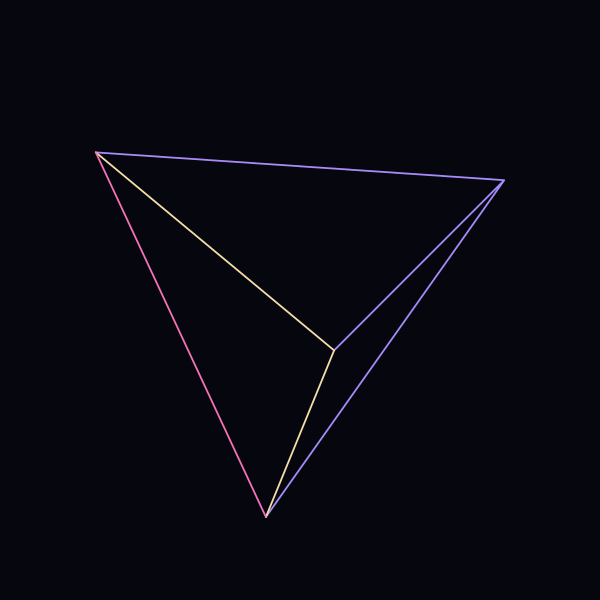
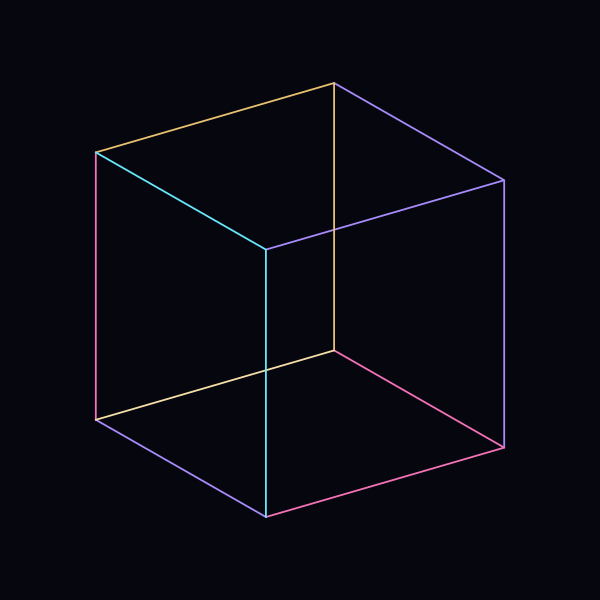
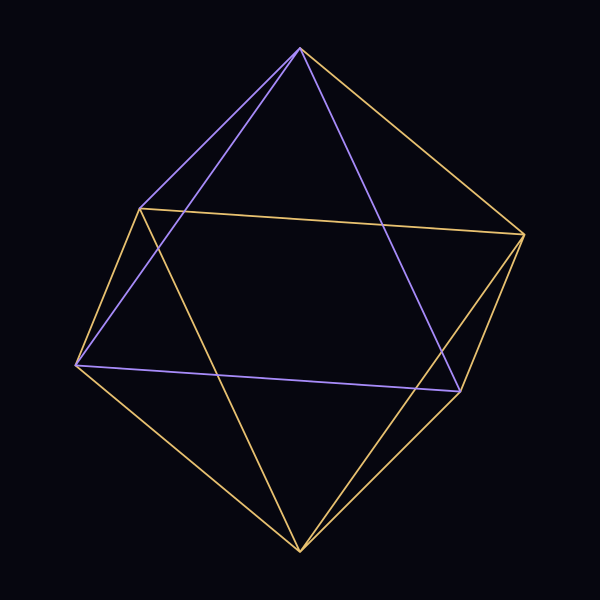
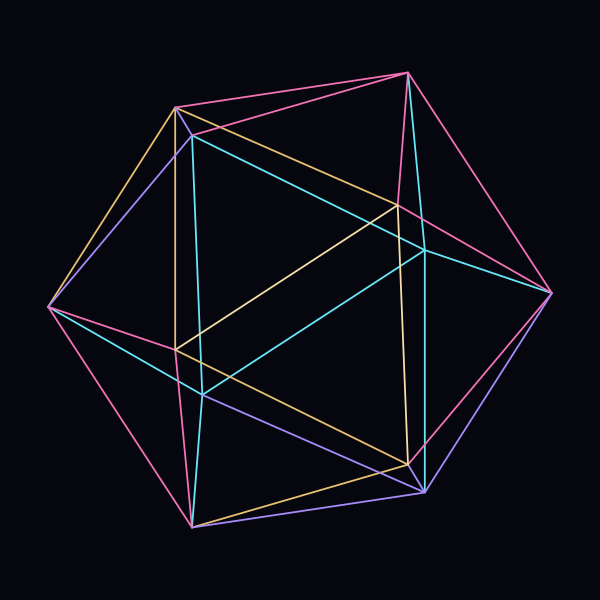
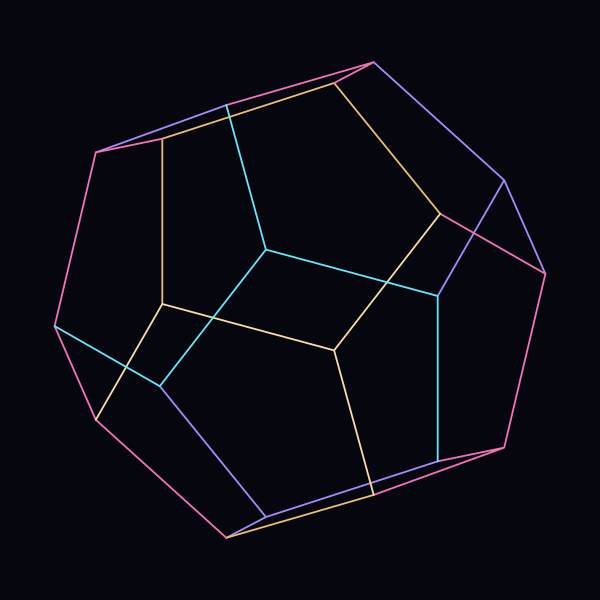
A Platonic solid is a convex solid whose faces are all the same regular polygon, with the same number of them meeting at every corner. There are exactly five: the tetrahedron, the cube, the octahedron, the icosahedron and the dodecahedron. Each opens in SacredForm, where you can turn it, hear the chord of its edges, slice it with a plane, and lift it into its four-dimensional cousin.
The five at a glance
| Solid | Symbol | Faces | At a corner | Edges | Vertices | Dual | Dihedral angle | Volume | Element |
|---|---|---|---|---|---|---|---|---|---|
| Tetrahedron | {3,3} | 4 triangles | 3 | 6 | 4 | itself | 70.53° | 0.1179 | fire |
| Cube | {4,3} | 6 squares | 3 | 12 | 8 | octahedron | 90° | 1.0000 | earth |
| Octahedron | {3,4} | 8 triangles | 4 | 12 | 6 | cube | 109.47° | 0.4714 | air |
| Icosahedron | {3,5} | 20 triangles | 5 | 30 | 12 | dodecahedron | 138.19° | 2.1817 | water |
| Dodecahedron | {5,3} | 12 pentagons | 3 | 30 | 20 | icosahedron | 116.57° | 7.6631 | the heavens |
Every one obeys Euler’s formula: vertices − edges + faces = 2. The cube has 8 − 12 + 6, the icosahedron 12 − 30 + 20.
Why there are only five
At least three faces must meet at each corner, and their angles there must add up to less than 360°, or the corner would lie flat. A regular hexagon’s angle is already 120°, so three of them make 360° and lie flat: the faces must be triangles, squares or pentagons. Triangles, at 60°, can meet three, four or five at a corner, giving the tetrahedron, the octahedron and the icosahedron; six would make 360°. Squares, at 90°, and pentagons, at 108°, can only meet three at a time, giving the cube and the dodecahedron. That leaves five, and no more.
Duals
Put a point at the center of every face and join the points of neighboring faces, and you get the solid’s dual: faces and corners trade places. The cube and the octahedron are duals, 6 faces and 8 corners against 8 faces and 6 corners, and so are the dodecahedron and the icosahedron. The tetrahedron is its own dual, and two of them interlocked make the star tetrahedron.
History
The solids are named for Plato, who in the Timaeus, about 360 BCE, made them the shapes of the elements: fire the tetrahedron, air the octahedron, water the icosahedron and earth the cube. Of the dodecahedron he said only that the god used it for arranging the constellations on the whole heaven. Aristotle later added aether as a fifth element of the heavens, though he never matched it to the dodecahedron. The octahedron and icosahedron are credited to Theaetetus, Plato’s contemporary, who may also have first proved that there are no others.
Euclid builds all five in the last book of the Elements, Book XIII, and shows that no sixth exists. In 1596 Johannes Kepler nested them between the spheres of the six known planets in his Mysterium Cosmographicum, octahedron innermost, then icosahedron, dodecahedron, tetrahedron and cube. He never gave the model up, but it was wrong; fitting it to Tycho Brahe’s observations led him instead to his laws of planetary motion. See Kepler’s model.
Beyond the five
Let the faces be regular polygons of more than one kind and you get the thirteen Archimedean solids, such as the cuboctahedron and the snub cube. Go up a dimension and there are six regular shapes, not five: the shapes of four dimensions, the tesseract among them.