SacredForm · Cymatics
Cymatics simulator
Sound made visible on a plate, in water, in a room and in open air
Cymatics is the study of the patterns vibration draws: sand gathering on a ringing plate, ripples standing in a dish of water. SacredForm’s Cymatics mode simulates four of them, with their sound, in the browser on a computer or a phone.
The plate, the water, the room and the air are driven by one sound: a pure tone you glide by dragging across the plate or the water, your own voice through the microphone, or a chord. Every figure in Explore has one, the frequencies at which its network of edges would resonate, and Harmony’s planets, rhythm rings and Lambdoma send theirs too. Everything plays in the tuning you choose, A = 440 or 432, scientific C = 256 or baroque A = 415, and can be recorded as a video with its sound.
Free, with no account. After the first visit it works offline, and it can be installed as an app.
1 of 4
The Chladni plate
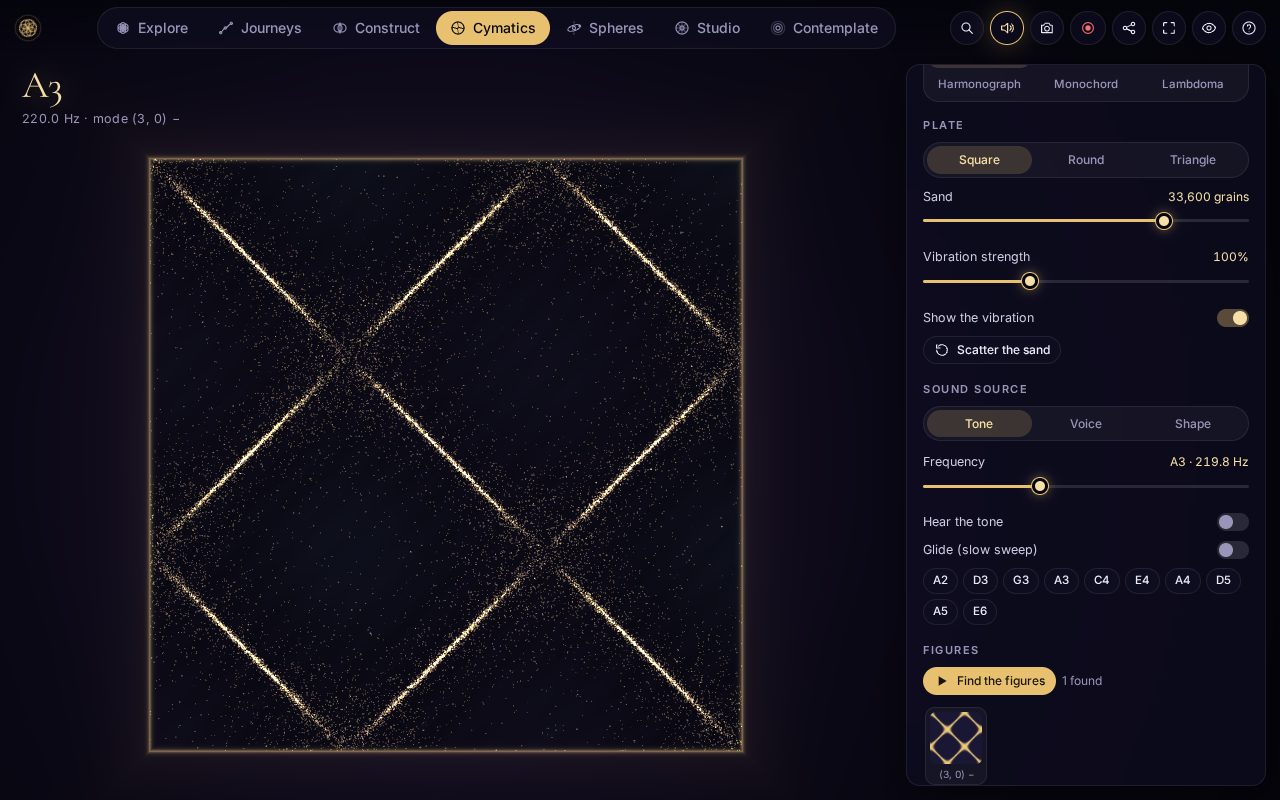
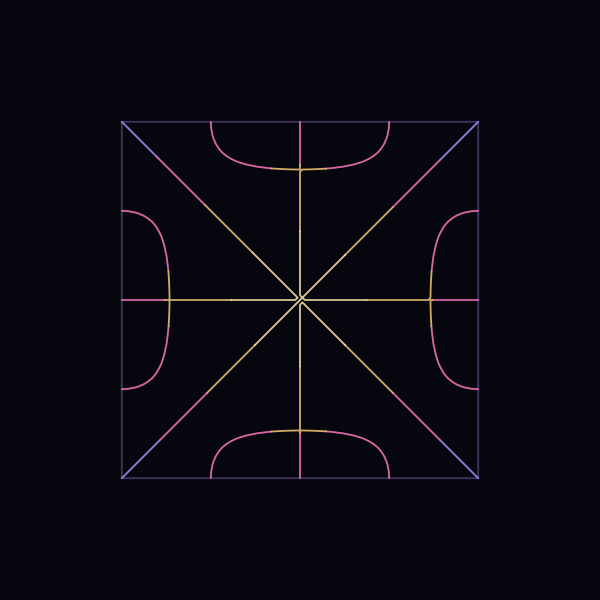
Tens of thousands of grains of sand on a square, round or triangular plate. When the tone meets one of the plate’s resonances, the plate divides into cells that swing opposite to their neighbors, and the sand is thrown off them onto the still lines between, the nodal lines. Between resonances the plate barely moves and the sand rests. Shaken at its center, as on a speaker, or bowed at its edge, as Chladni did, it rings different sets of figures.
Find the figures climbs through the plate’s resonances and rests on one after another until the sand settles, naming the mode. Every figure you reach, this way or by hand, is kept to return to. Sing a steady note and the plate follows your pitch.
See the first figures of every plate, drawn from the same modes, and why they look as they do.
2 of 4
Water
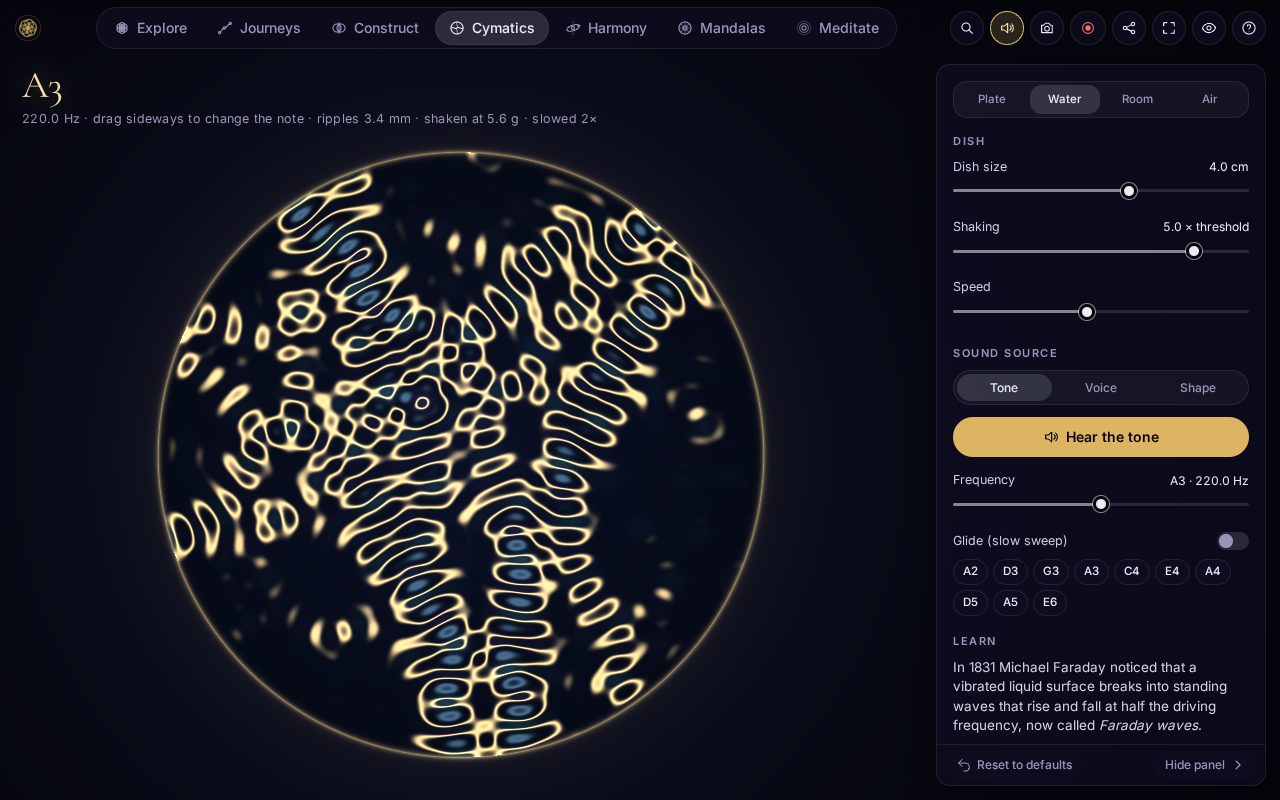
In 1831 Michael Faraday noticed that a vibrated liquid surface breaks into standing waves that rise and fall at half the driving frequency, now called Faraday waves. Below a threshold of shaking the water’s viscosity damps them away; above it, ripples grow out of the slightest tremor. Lit by a ring of lamps, the surface shines only where it tilts at one particular angle, tracing a thin lace.
The dish is solved as physics on the GPU: the flow under the surface, gravity, surface tension and viscosity, for clean water at 20 °C, in the dish’s own modes. It reads out the ripples’ length and the acceleration in g. Nothing sets the pattern: shaken gently, the dish’s own modes win, in rings and spokes, and shaken hard, many compete in a shifting lace of cells. Small ripples are held by surface tension, and their wavelength shrinks as the frequency to the power of −2/3, so higher notes draw finer lace, in a smaller dish. With a chord as the sound, each of its tones shakes the dish. What it leaves out: the meniscus at the wall and films on the water, which raise a real dish’s threshold, and breaking, which it stands in for where the water grows too steep.
3 of 4
Standing waves in a room
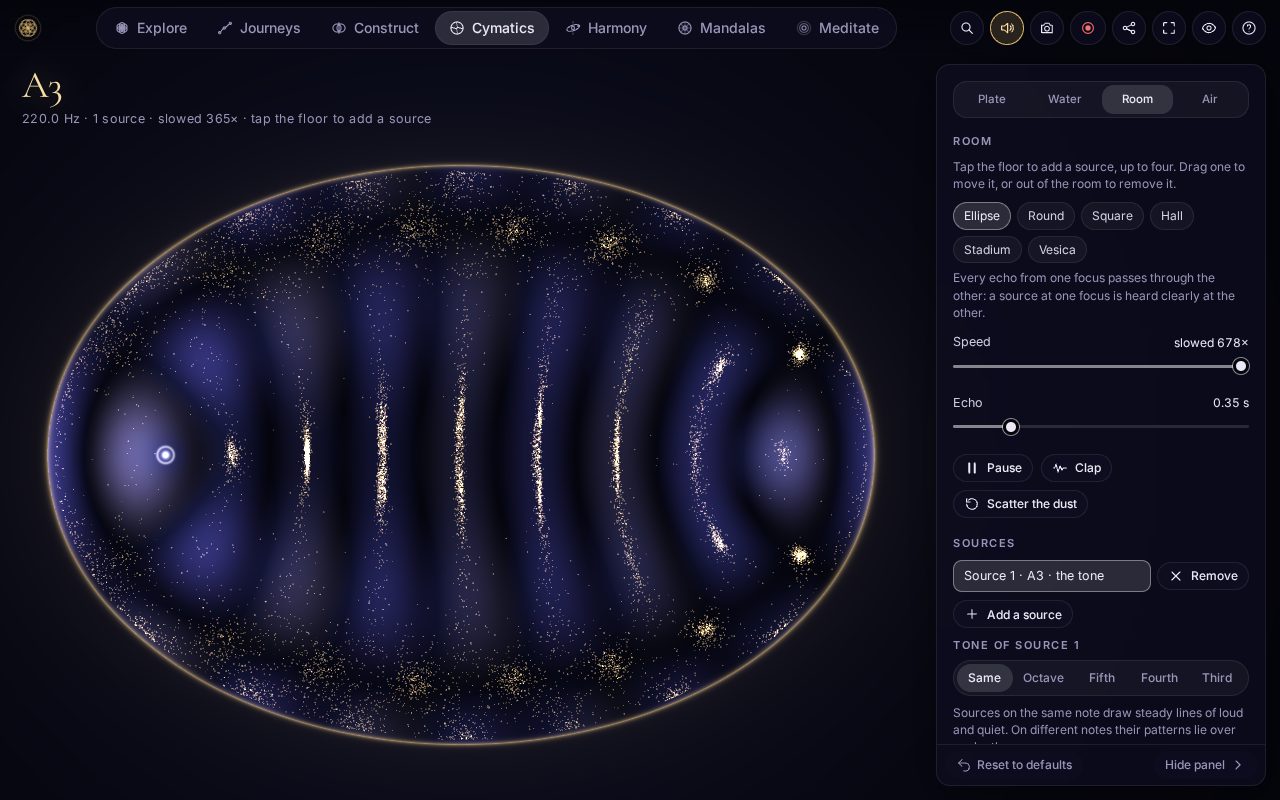
Sound filling the floor plan of a room. Place up to four sources, each on the tone or an interval above it, and watch the sound spread at about 343 meters a second, slowed to be seen, reflect from the walls and meet itself. At certain pitches the echoes line up into standing waves, which acousticians call room modes: those notes ring louder and longer. Lord Rayleigh worked out their pitches for a rectangular room in The Theory of Sound, in the 1870s.
Gold dust does what August Kundt’s did in a sounding tube in 1866: shaken off where the air swings to and fro, it piles up where the air stays still, which is where the pressure swings most. Six floor plans show what a room’s shape does. An ellipse sends every echo from one focus through the other; in a round room sound creeps along the wall, as Rayleigh explained for the whispering gallery of St Paul’s Cathedral; and in a stadium, a classic shape of chaos, the echoes never settle into a regular path. Clap to watch one sharp sound spread, reflect and gather.
The sound is worked out on the graphics card from the wave equation, at the tones’ true pitches. It is a floor plan only, like a slice of a very tall room: real rooms add a ceiling, furniture and soft surfaces, and their sound is far too gentle to move dust.
4 of 4
Interference in 3D
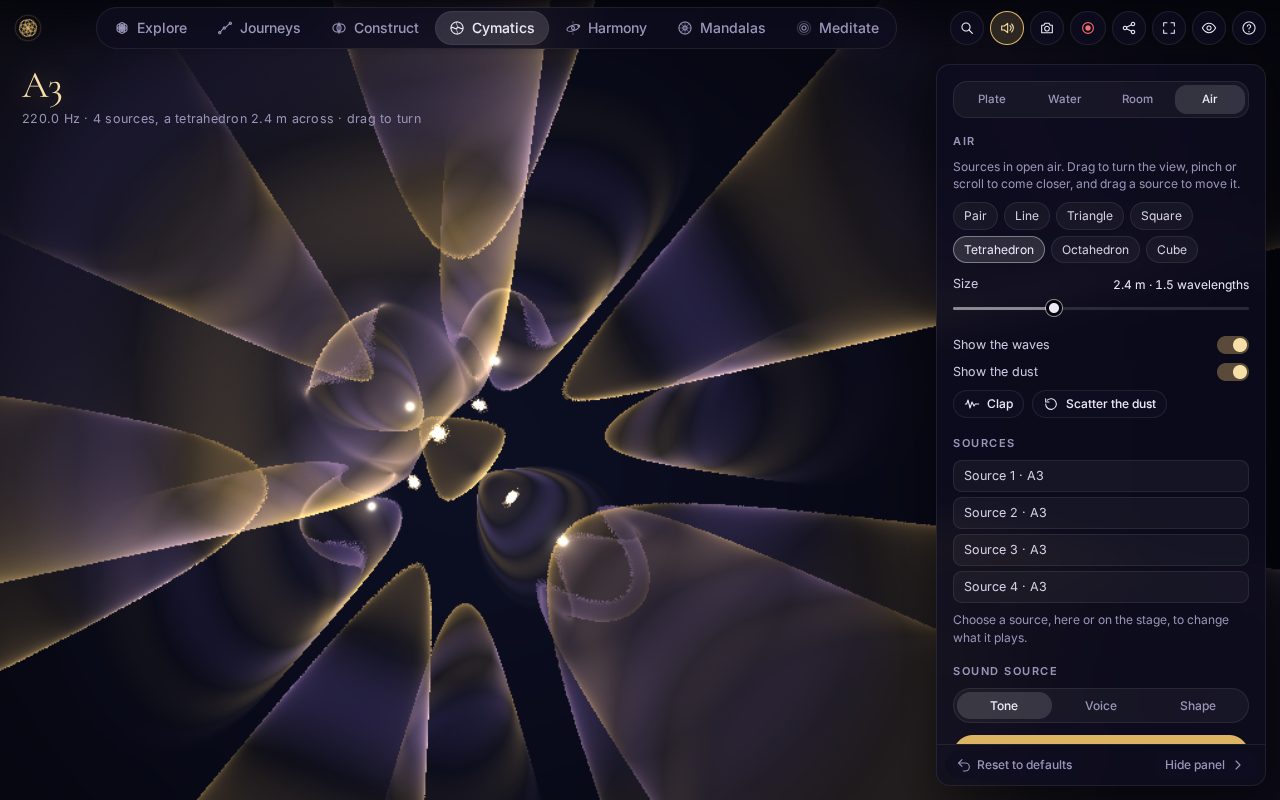
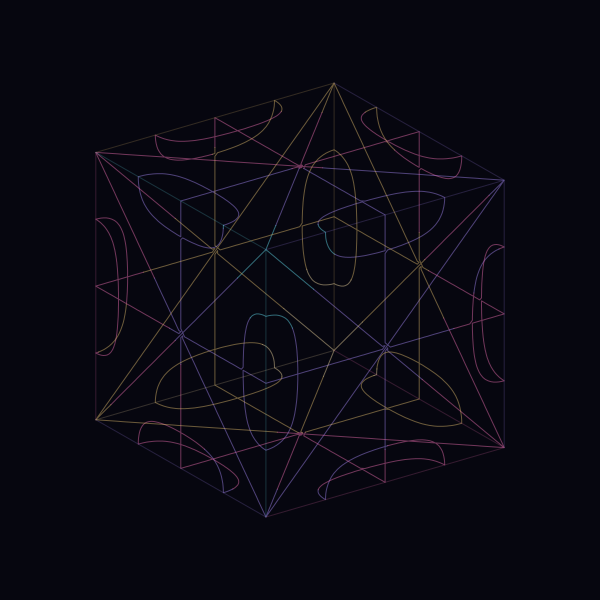
Sound from up to eight sources in open air, in three dimensions: a pair, a line, a triangle, a square, or the corners of a tetrahedron, an octahedron or a cube. Each sends out a spherical wave. Where the waves arrive in step they add up, where they arrive half a cycle apart they cancel, and the places where they add up are drawn as glass shells you can turn and come close to. Two sources on one note draw them on hyperboloids, every point whose distances to the two differ by a whole number of wavelengths; the Platonic solids’ corners draw symmetric petals and pockets.
Drag a source to move it, or put it half a cycle behind the others and watch loud places turn quiet: in a pair, the plane midway between the two falls silent. Each source can play the tone or an interval above it, but sources on different notes hold no still pattern: their waves pass through each other. Gold dust gathers where the sound’s radiation pressure would hold a grain, as an acoustic levitator holds beads in ultrasound, if the sound were loud enough. Clap, and a front grows from every source as a sphere at the speed of sound, slowed to be seen.
With no walls nothing needs simulating: the sound anywhere is the sum of the sources’ waves, worked out exactly at the tone’s true pitch, and a ray is traced through it for every pixel. The shells show how the waves combine, measured against how loud the sources would be apart, so the pattern shows as clearly far away as beside a source.
Where the word comes from
Robert Hooke saw lines form in flour on a bowed glass plate in 1680, and Ernst Chladni published the sand figures of bowed plates in 1787. In the 1960s the Swiss physician Hans Jenny revived these experiments with liquids, pastes and powders, filmed them, and named the study cymatics, from the Greek kyma, “wave” (Kymatik, 1967).
The ratios of harmony
The monochord, the Lambdoma and the harmonograph play and draw the whole-number ratios of harmony rather than the patterns vibration leaves in matter, so they are in SacredForm’s Harmony mode, beside the planets, and on the music of the spheres page. The harmonograph also has a page of its own.
Related figures
Learn it step by step
- Journey Sound Made VisibleCymatics and the music of shapes