SacredForm · Harmony · Dance
Planetary dances
Roses drawn by pairs of planets on their real orbits
Take two planets and draw a line between them every few days as they circle the Sun. Over the years the lines build a rose, and the ratio of the two planets’ years decides its shape: Earth and Venus, at 13 to 8, draw the pentagram of Venus.
These are the dances in SacredForm’s Harmony mode, drawn here from the same orbits by the same rules. Each planet moves on a fixed ellipse by Kepler’s laws, set by its mean orbital elements for the start of 2000: its period, its average distance, how stretched its ellipse is, which way its nearest point to the Sun lies, and where it was on the day. The orbits are all drawn flat, in one plane: their tilts, and the pull of the planets on one another, are left out.
The two faint rings are the orbits, with the Sun at the center. A meeting is when the two planets line up on the same side of the Sun: each is marked in gold on the outer ring and joined to the next, so the meetings draw a star of their own. Two dances are seen from a planet instead, and trace the other’s path around it, with the Sun’s circle faint. Each drawing here starts at a meeting, or halfway between two when seen from a planet, as in the app, where a dance starts from the last meeting before today.
In the app the lines draw themselves as the planets move, a chime sounds at each meeting, and you can choose any two planets, set how often a line is drawn and for how long, and save the drawing as SVG for a pen plotter.
-
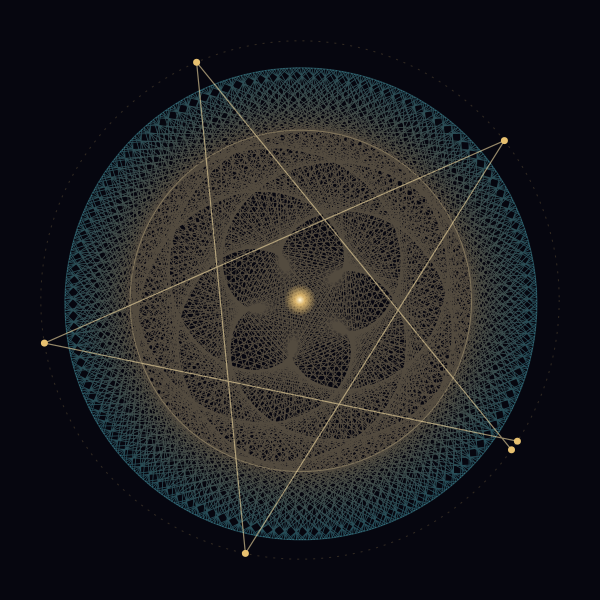
Earth and Venus · a line every 3 days for 8 years
The pentagram of Venus
Every 584 days Venus passes between the Earth and the Sun. Five of these meetings take 8 years, and they fall on the points of a pentagram. In those 8 years Venus circles the Sun 13 times, lapping Earth 13 − 8 = 5 times. 13 and 8 are neighboring Fibonacci numbers, so their ratio is near the golden ratio: a coincidence, but a lovely one.
- Meet every
- 584 days
- Ratio of their years
- 1.626 ≈ 13 : 8
- Meetings in 8 years
- 5
-
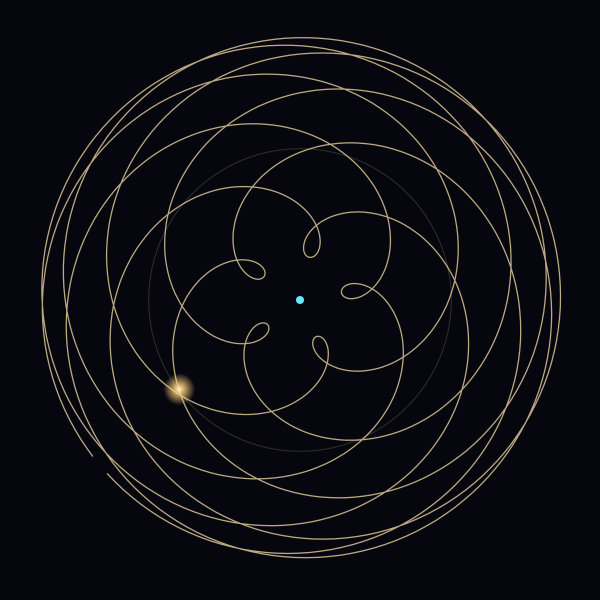
Earth and Venus · seen from Earth over 8 years
Venus seen from Earth
The same dance seen from Earth. Venus loops backwards each time it overtakes us, and after 8 years its path closes into a five-petalled rose around the Earth. This is the curve early astronomers had to explain with epicycles.
- Meet every
- 584 days
- Ratio of their years
- 1.626 ≈ 13 : 8
- Meetings in 8 years
- 5
-
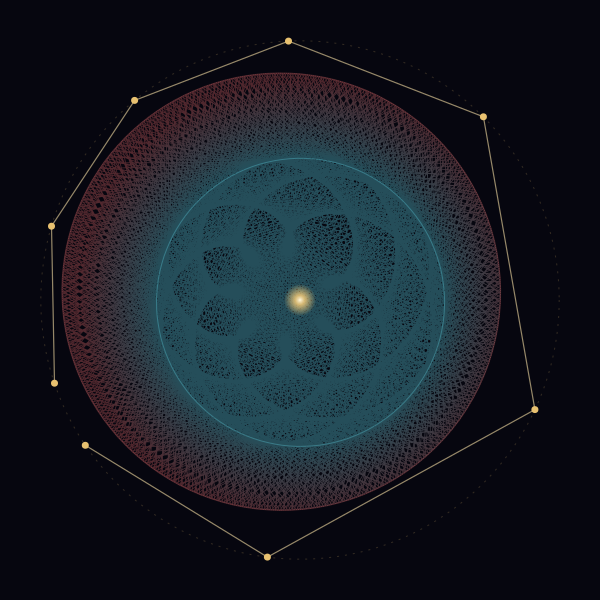
Earth and Mars · a line every 4 days for 15 years
Earth and Mars
Mars and Earth meet every 780 days. Seven meetings take almost exactly 15 years (15 : 8), so the lines weave a seven-fold flower with a slow twist. It is why Mars’s closest approaches come every 15 or 17 years.
- Meet every
- 2.1 years
- Ratio of their years
- 1.881 ≈ 15 : 8
- Meetings in 15 years
- 7
-
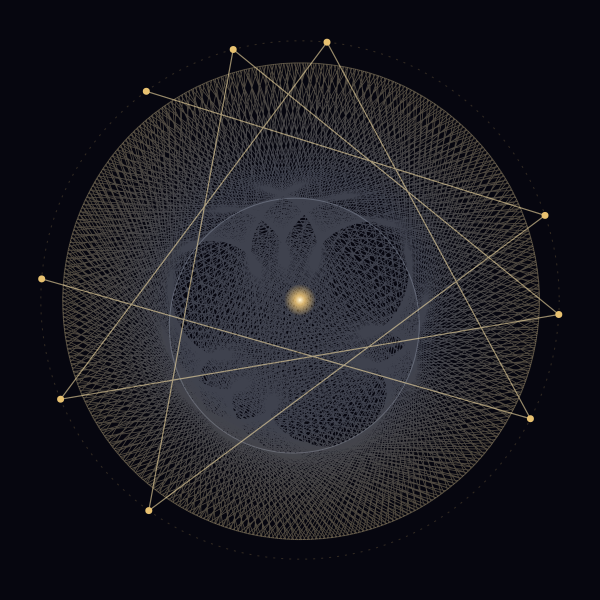
Mercury and Venus · a line every 1.2 days for 3.2 years
Mercury and Venus
The two inner planets meet every 145 days. Their ratio is close to 23 : 9, and the lines braid a fine, many-petalled mandala in just a few years.
- Meet every
- 145 days
- Ratio of their years
- 2.554 ≈ 23 : 9
- Meetings in 3.2 years
- 8
-
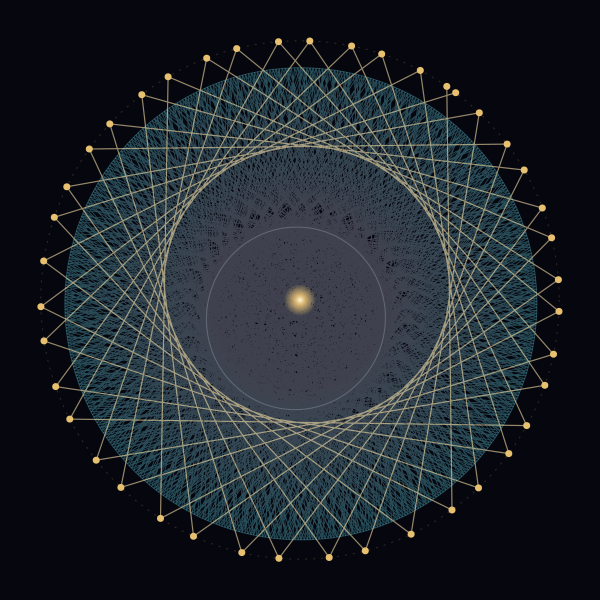
Earth and Mercury · a line every 3 days for 13 years
Earth and Mercury
Mercury laps the Earth every 116 days. Fifty-four of its years take almost exactly thirteen of ours, so after 41 meetings the pattern comes around again. This is why transits of Mercury across the face of the Sun often come 13 years apart, as in 2006 and 2019.
- Meet every
- 116 days
- Ratio of their years
- 4.152 ≈ 54 : 13
- Meetings in 13 years
- 41
-
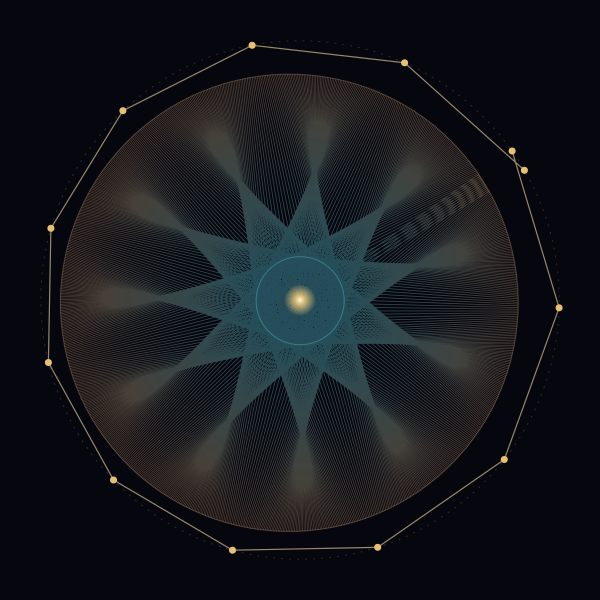
Earth and Jupiter · a line every 5 days for 12 years
Earth and Jupiter
Jupiter takes almost 12 years to circle the Sun. In 12 years Earth circles 12 times and Jupiter about once, so Earth laps it 11 times: an eleven-fold rose.
- Meet every
- 399 days
- Ratio of their years
- 11.862 ≈ 12 : 1
- Meetings in 12 years
- 11
-
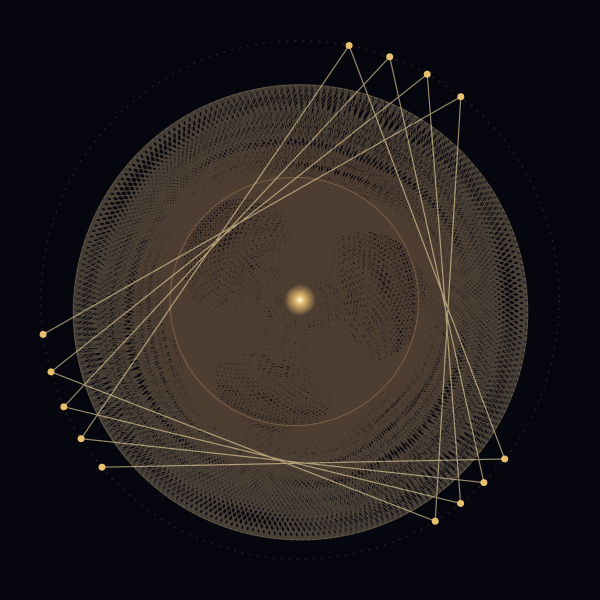
Jupiter and Saturn · a line every 45 days for 240 years
The Great Conjunctions
Jupiter and Saturn meet every 19.86 years. Their years are close to 5 : 2, and 5 − 2 = 3: three meetings make a near-perfect triangle that slowly turns through the zodiac. Drawing these triangles in 1595 gave Kepler his first great idea, shapes nested between the planets’ spheres.
- Meet every
- 19.9 years
- Ratio of their years
- 2.483 ≈ 5 : 2
- Meetings in 240 years
- 12
-
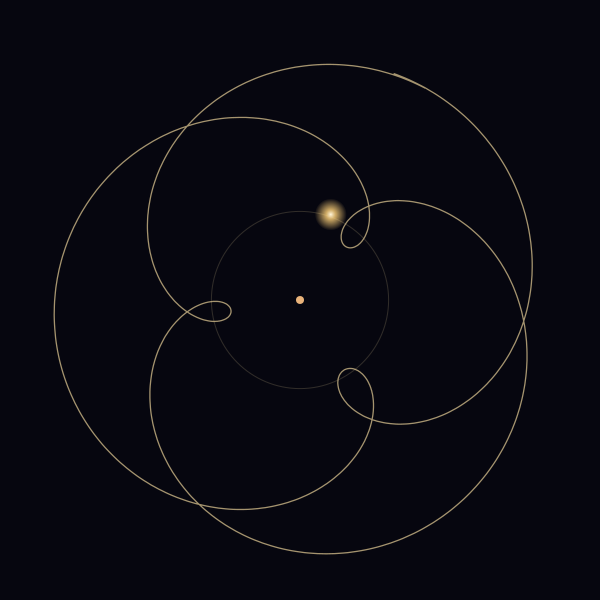
Jupiter and Saturn · seen from Jupiter over 59.6 years
Jupiter and Saturn, 5 : 2
Seen from Jupiter, Saturn loops back three times as Jupiter overtakes it. Five Jupiter years (59.3) almost equal two of Saturn’s (58.9). This near 5 : 2 resonance, the “great inequality”, pulls both planets a little ahead and behind over some 900 years; Laplace explained it in 1785.
- Meet every
- 19.9 years
- Ratio of their years
- 2.483 ≈ 5 : 2
- Meetings in 59.6 years
- 3
-
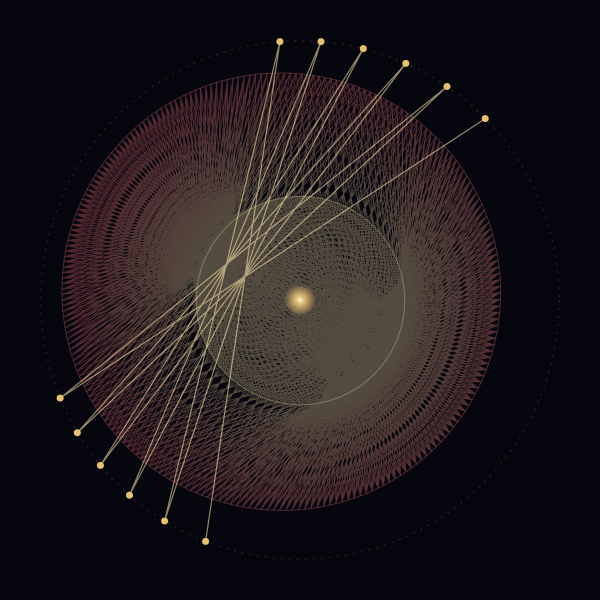
Venus and Mars · a line every 3 days for 10 years
Venus and Mars
Mars takes a little more than three Venus years to go round once (about 3 : 1). They meet twice for each turn of Mars, on nearly opposite sides of the Sun, so the lines form a slowly turning figure of two lobes.
- Meet every
- 334 days
- Ratio of their years
- 3.057 ≈ 3 : 1
- Meetings in 10 years
- 11
-
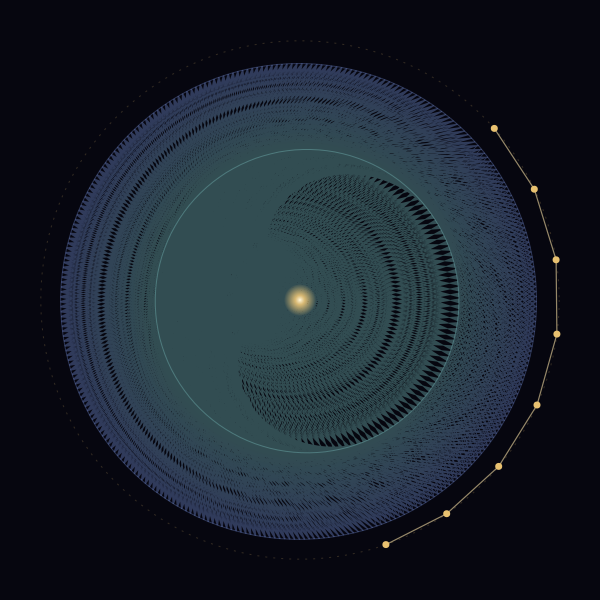
Uranus and Neptune · a line every 200 days for 1,200 years
Uranus and Neptune
The ice giants are close to a 2 : 1 resonance. They meet only every 171 years (last in 1993), and the rose takes more than a thousand years to close.
- Meet every
- 171 years
- Ratio of their years
- 1.961 ≈ 2 : 1
- Meetings in 1,200 years
- 7
Why roses?
Two planets circling the Sun are like two gears. When their periods form a simple ratio, their meetings repeat at the same places, and the lines between them close into a symmetric figure. The number of petals is the difference of the ratio’s two numbers: 13 − 8 = 5 for Venus.
The rest of Harmony
Harmony has five more parts. Kepler gives each planet a voice from its true speed across the sky as seen from the Sun, raised by whole octaves so it can be heard, as Kepler did: the ratio of each planet’s slowest and fastest speeds was a musical interval, a major third for Saturn and a minor third for Jupiter. It also checks his third law, T² ∝ a³, which he found in 1618 while searching for the music. Rhythm turns polygons, star polygons and Euclidean rhythms into rings of polyrhythm, where the angle between two corners is the time between two notes. The Monochord divides a string as legend says Pythagoras did, the Lambdoma sets out the table of ratios, and the Harmonograph lets pendulums draw the intervals.
Related figures
Kepler first tried to explain the planets with the five Platonic solids nested between their spheres. The meetings of Earth and Venus draw a pentagram, the star whose lines cut one another in the golden ratio.