SacredForm · Mandalas
Mandala maker
Draw mandalas online with symmetry, hear them, and lift them into space
Draw one stroke and it is repeated all the way round, mirrored if you like, up to thirty-two times. SacredForm’s Mandalas mode is a free mandala maker in the browser, on a computer or a phone: it also tiles the plane by any of the seventeen wallpaper groups, sings every stroke, and lifts a finished mandala into 3D.
Free, with no account: drawings are kept on your device. Draw with a mouse, a finger or a pen; with a pen, the line can follow your pressure.
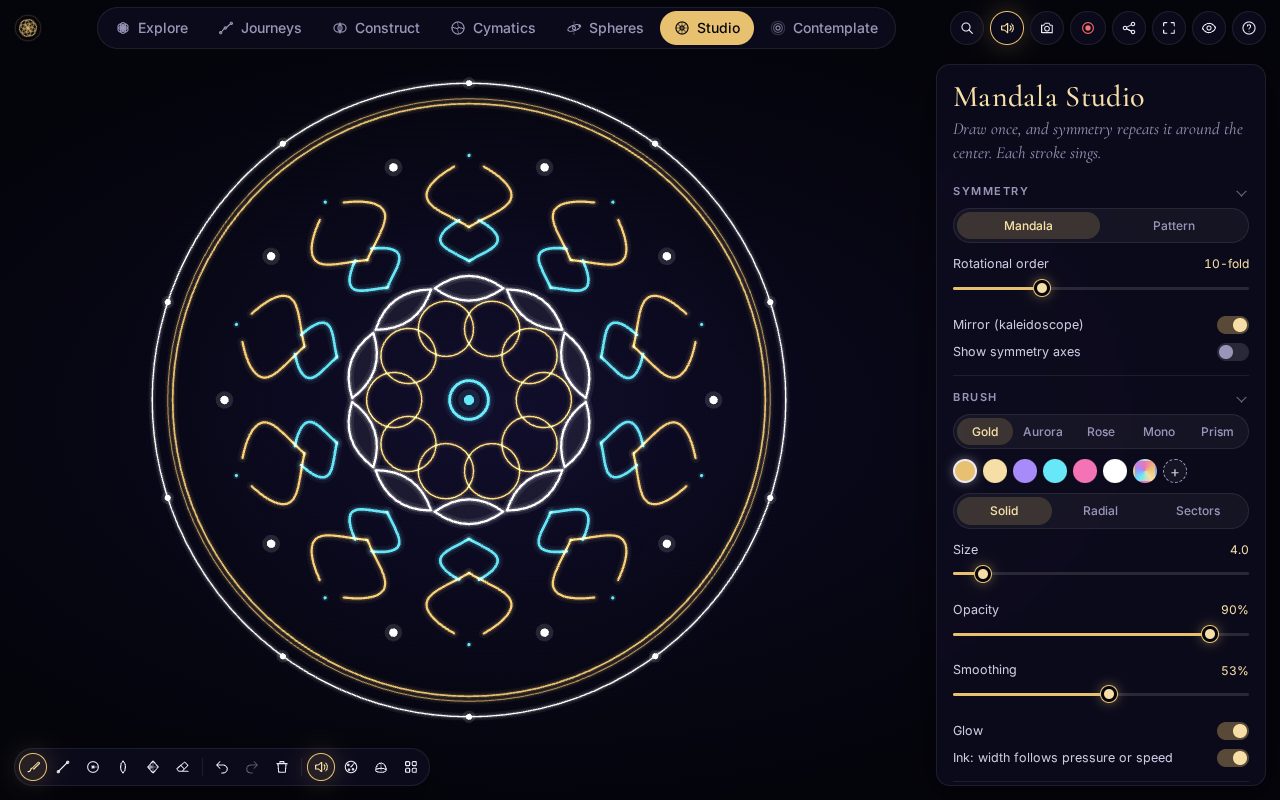
Mandala
Draw once, and it goes all the way round
Choose a rotational order from 1 to 32 and draw: every stroke is copied that many times around the center, and with Mirror on, reflected too, as in a kaleidoscope. The tools are a brush, a line, a circle and a petal, and fill, which colors the closed shape under your tap like a pane of stained glass and repeats it like any stroke. An eraser takes strokes away, and everything can be undone.
Colors come from five palettes or your own. A stroke can be solid, run as a gradient from the center to the rim, or give each symmetry copy the next color in turn. The ground can be night, lapis, black or parchment: on dark grounds glowing lines add up like light, and on parchment they darken like ink. Faint guides lie underneath if you want them, polar lines, the Seed of Life, the Flower of Life or Metatron’s Cube, and circles and petals can snap to their points. Surprise me makes a mandala of its own, which you can go on editing.
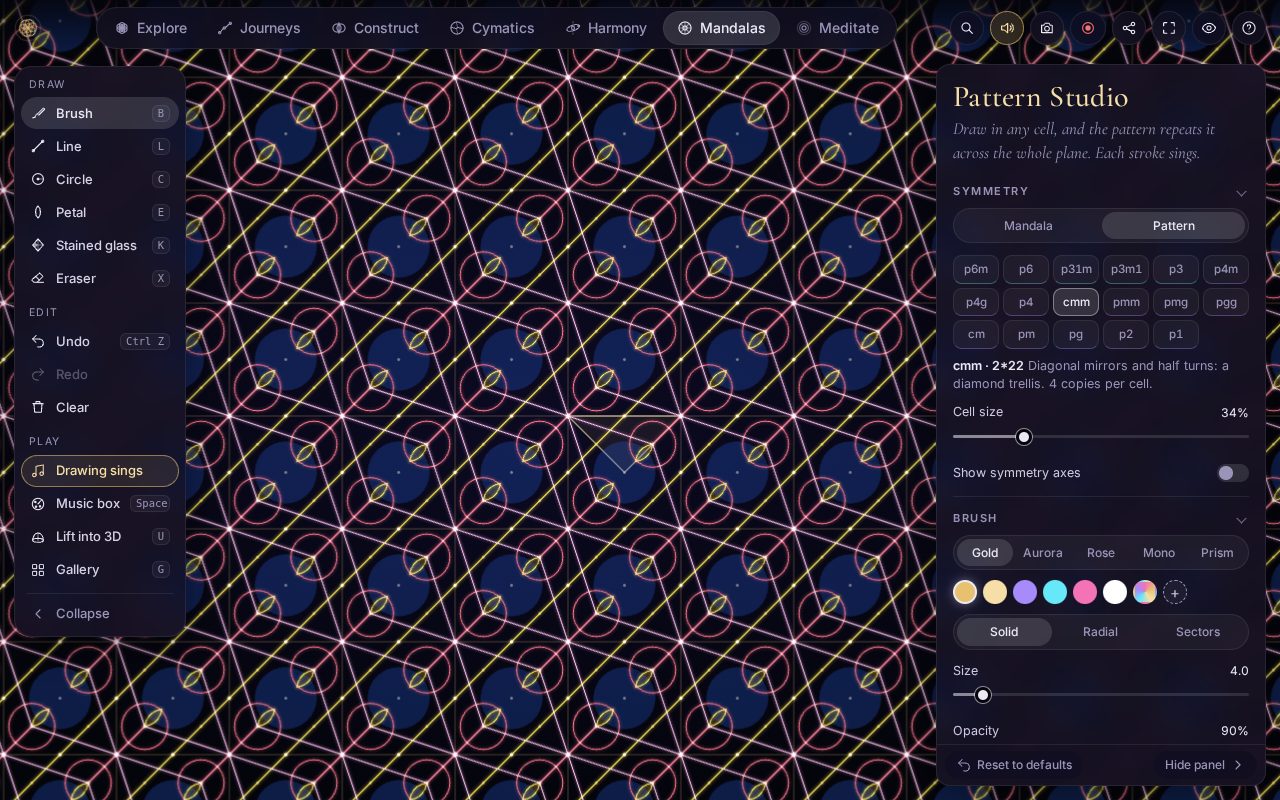
Pattern
Repeat it across the whole plane
In Pattern mode a stroke is repeated across the whole plane instead of around one center, by any of the seventeen wallpaper groups, from p1, plain translation, to p6m, the full symmetry of the hexagon. Draw in any cell and every other cell follows. The guide is the group’s lattice, with its mirrors, glide lines and centers of rotation marked as crystallographers mark them, and one fundamental domain lit: the smallest piece from which the group builds everything.
Seamless tile saves one period of the pattern as a PNG that repeats without a seam, ready for a background, fabric or paper. See all seventeen wallpaper groups and how to tell them apart.
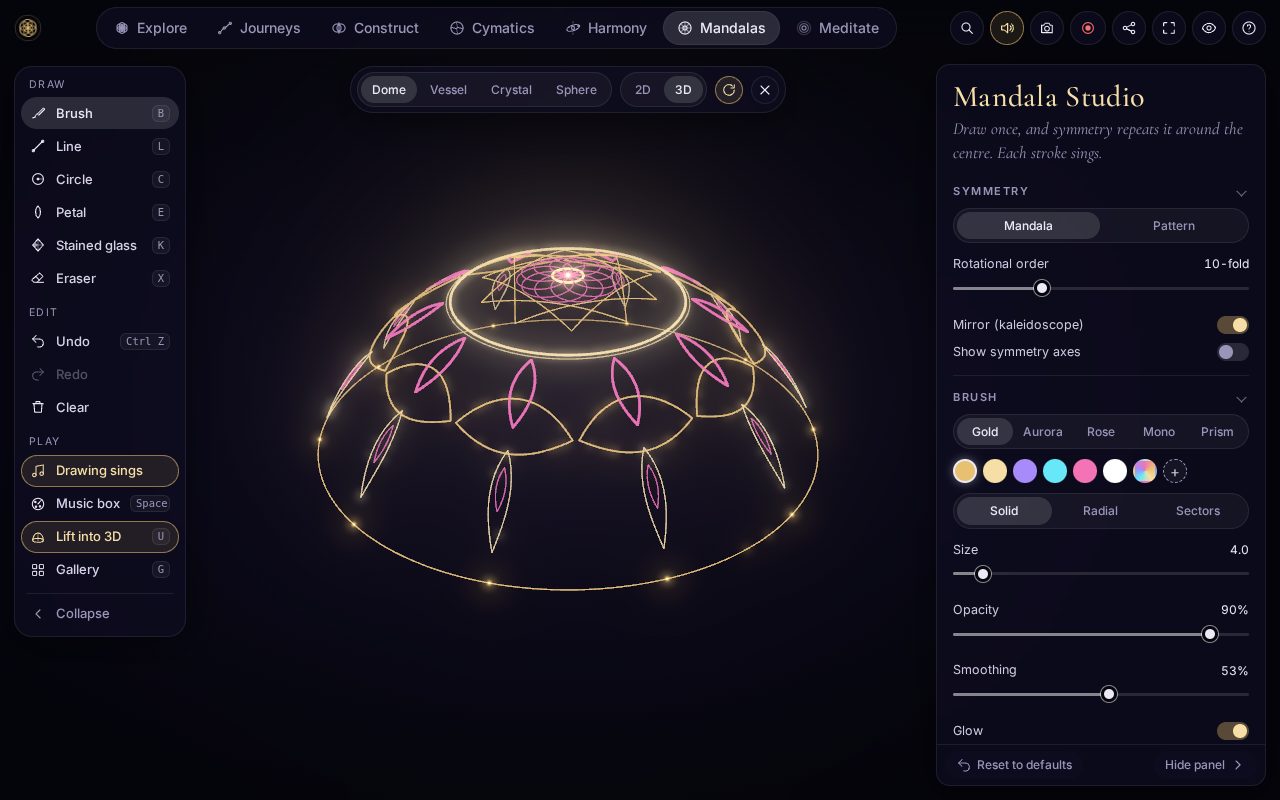
Space
Lift it into 3D
Lift into 3D raises the finished mandala off the page. As a dome it becomes a hemisphere whose shadow is exactly the drawing; as a vessel its rings become the bands of a turned vase; as a crystal it rises in stepped tiers, highest at the center; as a sphere it wraps round a globe, the center at its pole and each ring a circle of latitude. A dial turns the view from straight down, where the form matches the drawing line for line, to the form in space. A pattern lifts as the disk of it a mandala would fill, laid over the dome like the tiled cupola of a mosque.
Every stroke sings
As you draw, the pen sounds: its pitch rises toward the center and falls toward the rim, it pans with the angle, and the symmetry comes back as a soft round: the note echoes quickly for each copy, up to six times, climbing in fifths and octaves. The music box plays a finished mandala. An arm sweeps round like a radar and sounds every stroke it crosses, so an n-fold drawing turns one gesture into a rhythm that comes round n times a turn. It plays in a pentatonic, Lydian or hirajoshi scale, or the harmonic series, at 40 to 160 beats a minute.
Save and share
- A PNG of 1024, 2048 or 4096 pixels, with or without the guides, on its ground or transparent.
- An SVG, the lines as vectors, for printing, cutting or editing further.
- A video of the drawing replaying stroke by stroke, or of it spinning in a seamless loop.
- A share link that carries the whole drawing in the address, a few hundred characters for a typical mandala: whoever opens it gets the drawing, still editable.
- A gallery on your device keeps your works by name, and opens the examples below.
Why a mandala looks the way it does
Turning by one n-th of a turn, n times, gives the symmetry mathematicians call the cyclic group Cₙ: a pinwheel, the same all round but with a sense of turning. Add a mirror and the n reflections come with it, giving the dihedral group Dₙ with 2n copies of each stroke, the symmetry of a snowflake, a rose window or a kaleidoscope. These two families are all there are: any figure in the plane with finitely many symmetries has those of one Cₙ or one Dₙ. Hermann Weyl called it Leonardo’s theorem, because Leonardo da Vinci worked out which symmetries a church built round a center can keep as chapels are added to it.
A pattern that repeats across the plane has room for more: translations, glide reflections and several centers of rotation at once. Even so there are only seventeen ways it can repeat, with turns of a half, a third, a quarter or a sixth only: a repeating pattern cannot have fivefold symmetry. That is why the studio has two sides, Mandala for the first kind of symmetry and Pattern for the second.
The gallery
The examples in the gallery, drawn by its own SVG export. Surprise me built the mandalas from fixed seeds; the patterns are exact geometry. Each opens in Mandalas, draws itself again stroke by stroke, and stays editable.
Mandalas
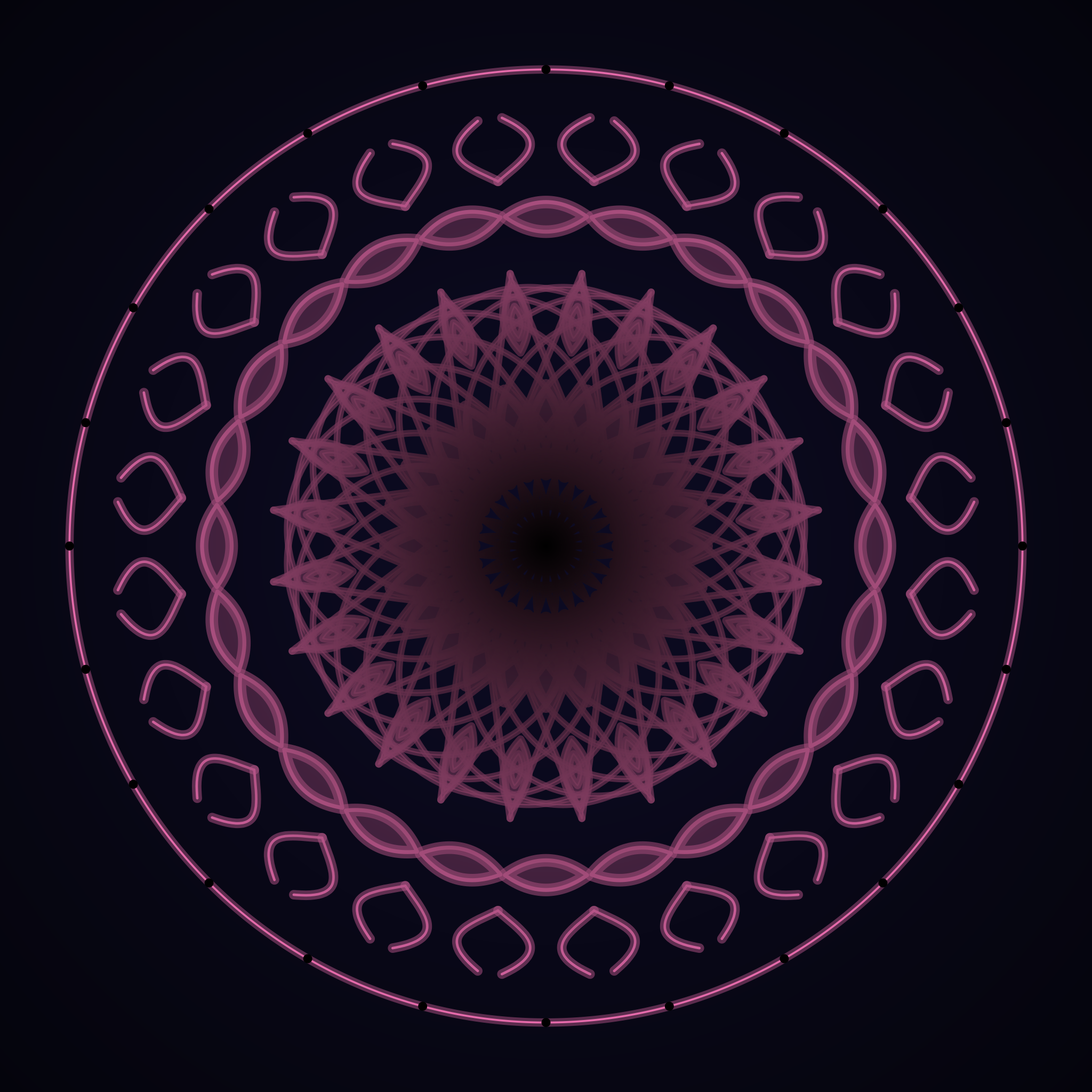
Sun Chakra · 24-fold
Open in Mandalas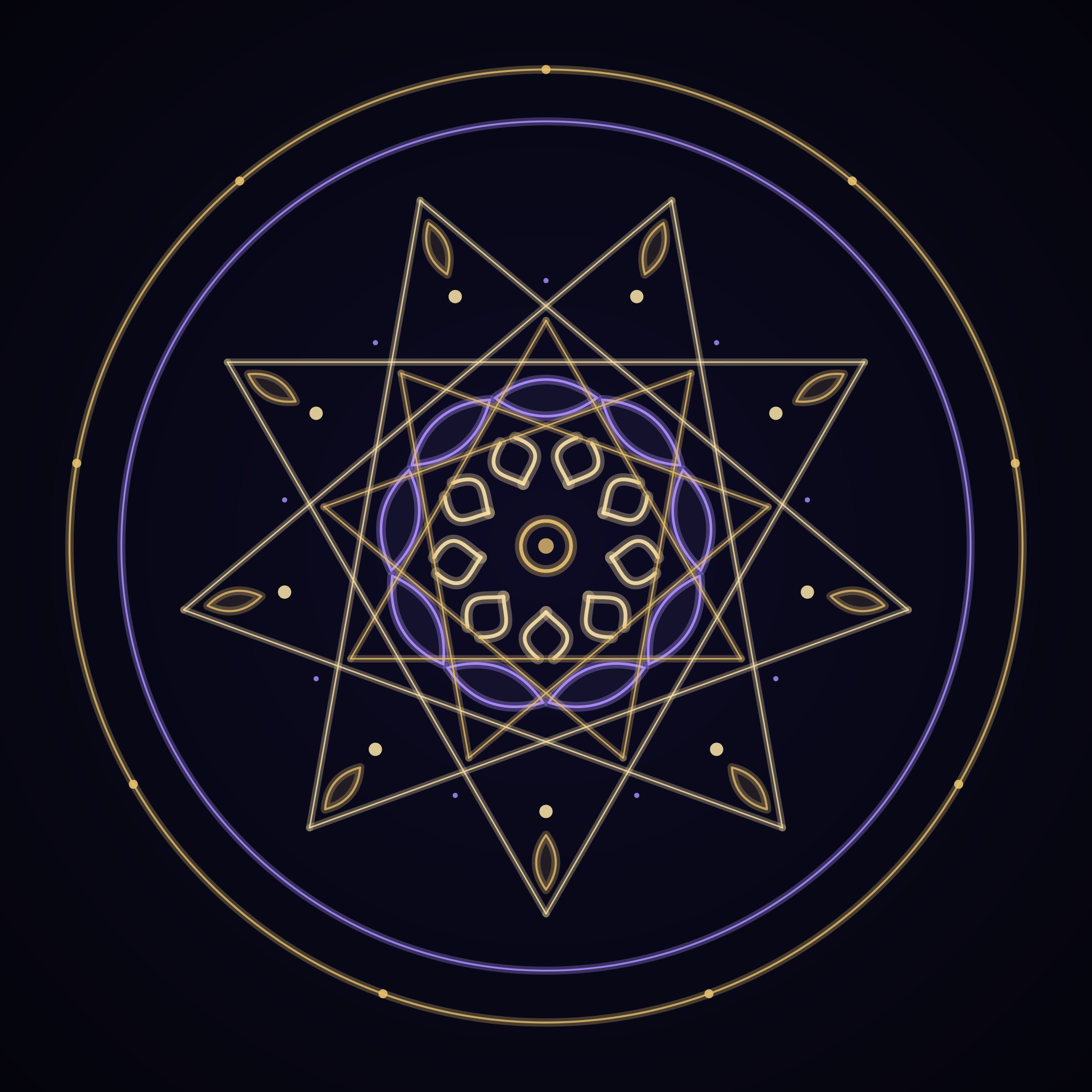
Star Temple · 9-fold
Open in Mandalas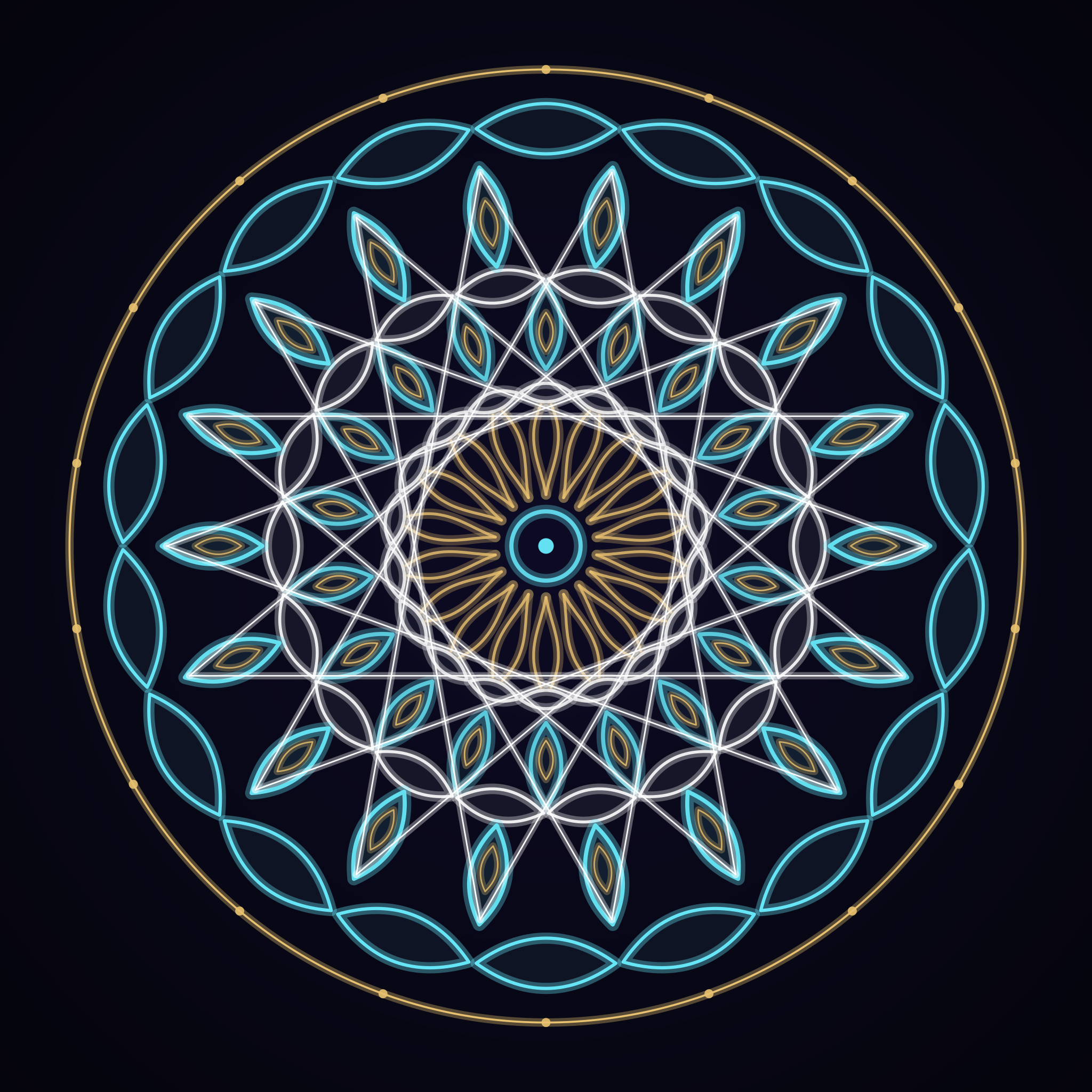
Lotus Gate · 18-fold
Open in Mandalas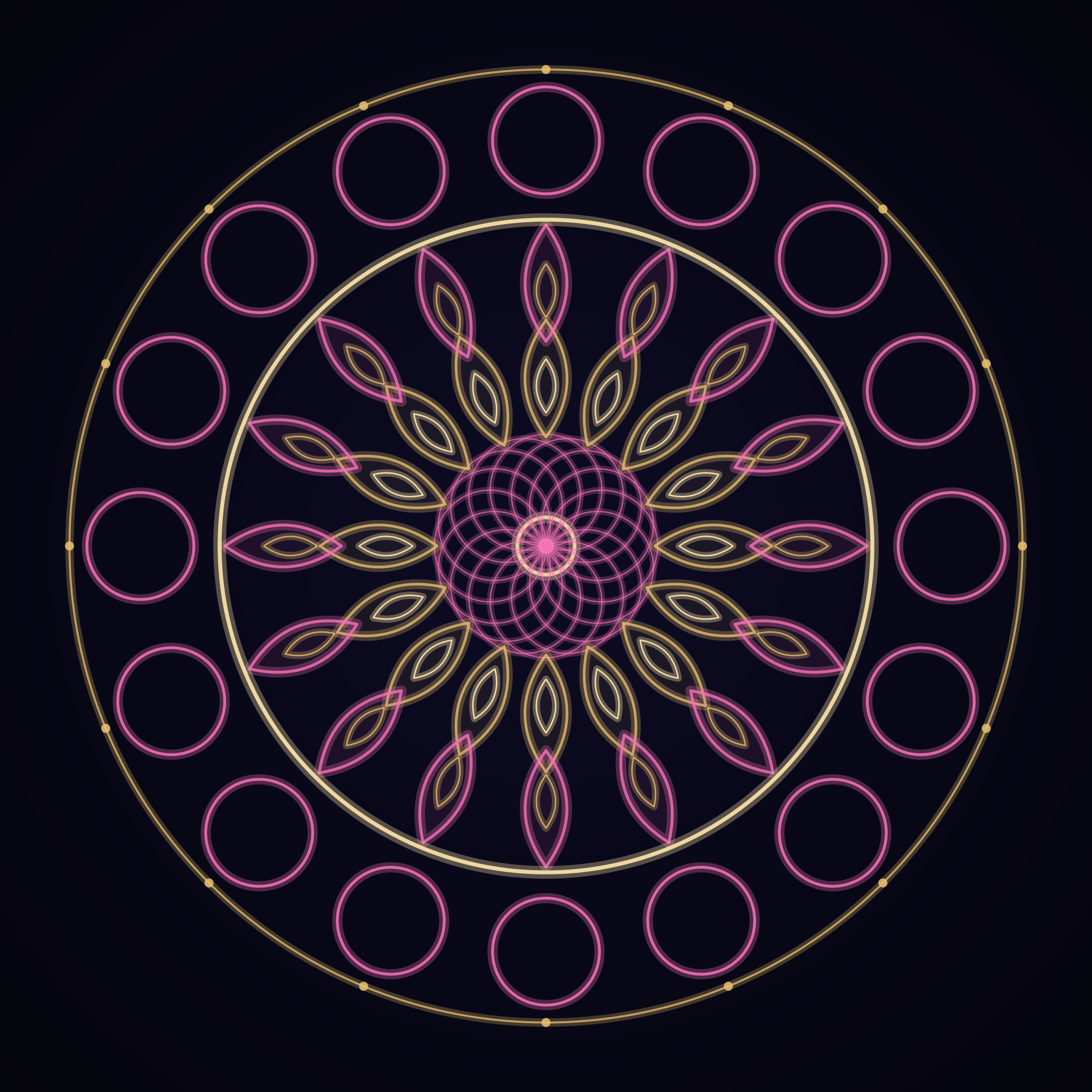
Rose Window · 16-fold
Open in Mandalas
Prism Wheel · 18-fold
Open in Mandalas
Patterns

Flower Lattice · p6m
Open in Mandalas
Alhambra Star · p4m
Open in Mandalas
Hexagram Glass · p6m
Open in Mandalas
Woven Rings · p4g
Open in Mandalas
Whirl Field · p6
Open in Mandalas