SacredForm · Harmony
The music of the spheres
From the Pythagoreans’ string to Kepler’s planets, in ratios you can hear
The music of the spheres is the ancient idea that the planets make music as they move, in the same whole-number ratios as musical harmony: half a string sounds the octave, two thirds of it the fifth. In 1619 Johannes Kepler tested it against real orbits and found that each planet’s fastest and slowest speeds come close to a musical interval. SacredForm’s Harmony mode lets you hear all of it, from a single string to the real orbits.
Free, with no account, in the browser on a computer or a phone. Any of it can be recorded as a video with its sound.
What is the music of the spheres?
The music of the spheres, also called the harmony of the spheres or musica universalis, goes back to the Pythagoreans of ancient Greece. They held that the planets, moving at their different speeds, sound notes in the ratios of the musical scale. We do not hear it, Aristotle reports them saying, because it has sounded since we were born, and a sound is noticed only against silence. Plato set the Sirens on the spindle of the heavens, each singing one note, and Boethius called it musica mundana, the music of the world, above the music of the body and the music of instruments. Kepler took the old idea further than anyone before him, and tested it against real measurements of the sky.
1 of 6
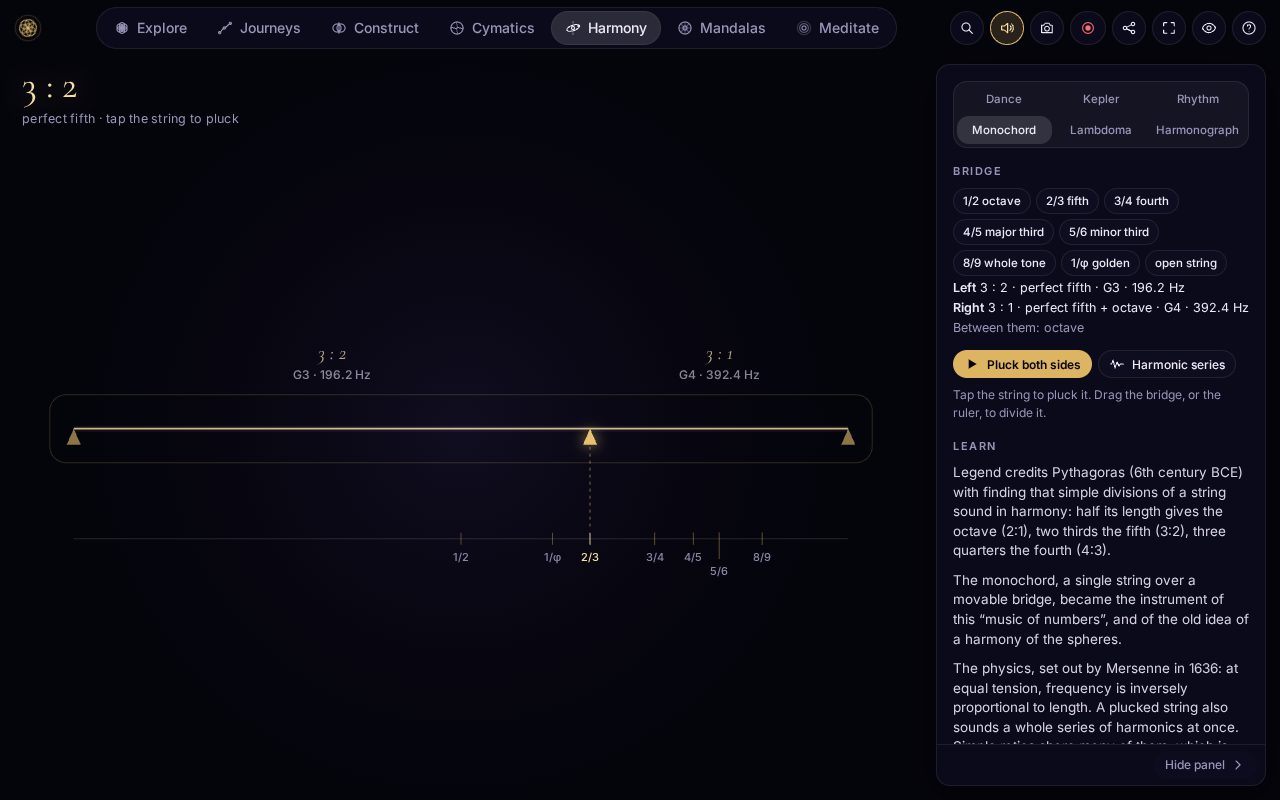
The monochord
One string over a movable bridge. Legend credits Pythagoras (6th century BCE) with finding that simple divisions of a string sound in harmony: half its length gives the octave, two thirds the fifth, three quarters the fourth. The monochord became the instrument of this “music of numbers”. In 1636 Marin Mersenne set out the laws of the vibrating string: its frequency falls in proportion as its length grows, and rises with the square root of its tension.
Tap either part of the string to pluck it, drag the bridge or the ruler to divide it, and both parts are named by ratio, interval and note. A plucked string sounds a whole series of harmonics at once, and simple ratios share many of them, which is one reason they sound consonant. Harmonic series plays them in turn.
| Part sounding | Frequency ratio | Interval | Cents |
|---|---|---|---|
| 1/2 | 2 : 1 | octave | 1200 |
| 2/3 | 3 : 2 | perfect fifth | 702 |
| 3/4 | 4 : 3 | perfect fourth | 498 |
| 4/5 | 5 : 4 | major third | 386 |
| 5/6 | 6 : 5 | minor third | 316 |
| 8/9 | 9 : 8 | major second | 204 |
| 1/φ | φ : 1 | golden ratio | 833 |
2 of 6
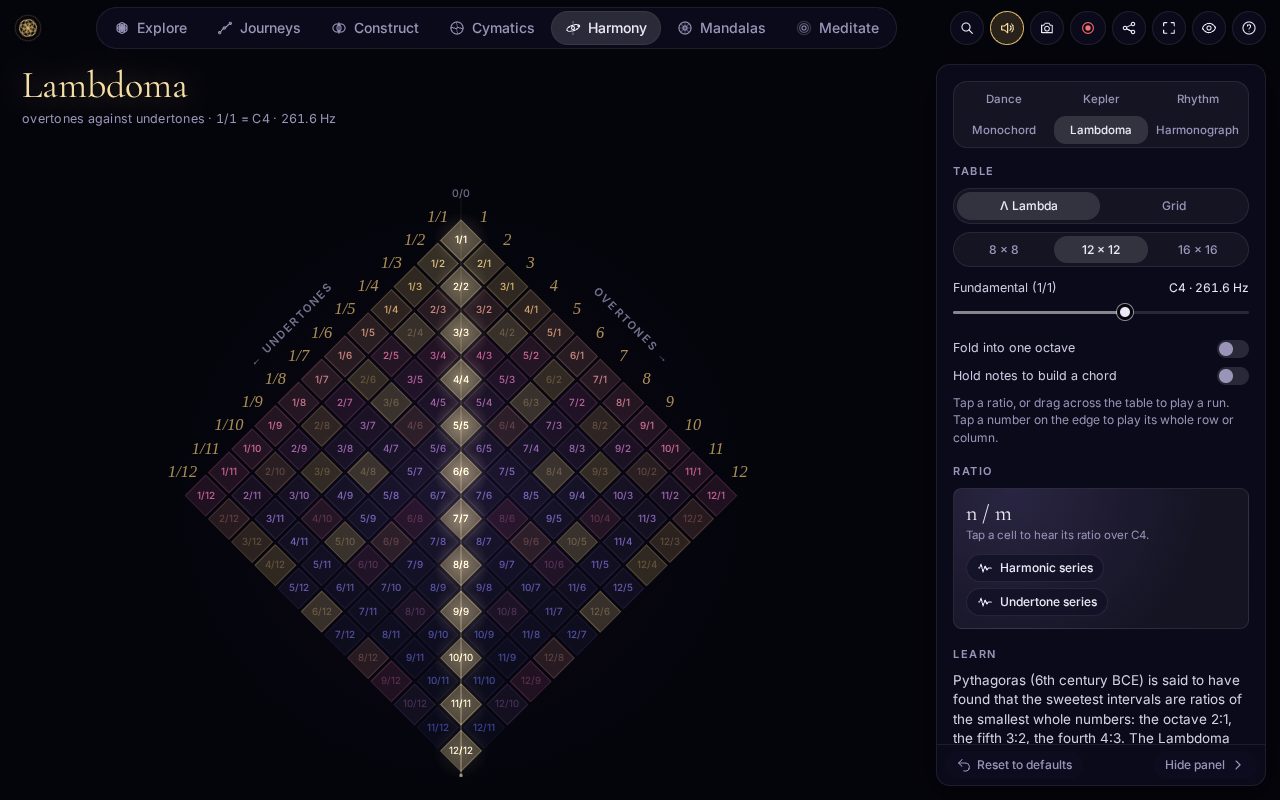
The Lambdoma
A table of every ratio n/m of small whole numbers, overtones against undertones, stood on its corner like the Greek letter Λ. Each row is a harmonic series and each column an undertone series. Equal ratios (3/2, 6/4, 9/6 …) fall on one straight ray, all the rays meet at the corner where the ratio would be 0/0, and the diagonal is the ray of 1/1, every tone meeting itself. Color shows how simple each ratio is, by James Tenney’s harmonic distance log₂(p·q).
Tap or drag across the table to play each ratio over one fundamental, or tap an edge number to play its row or column. It sounds in just intonation: only the fundamental follows the reference pitch. The idea goes back to Albert von Thimus, who in 1868 read a passage of the Neoplatonist Iamblichus as describing such a table; how much of it is truly ancient is doubted. Hans Kayser made it the center of his harmonics, and Barbara Hero built a 16 × 16 Lambdoma keyboard in the 1990s.
3 of 6
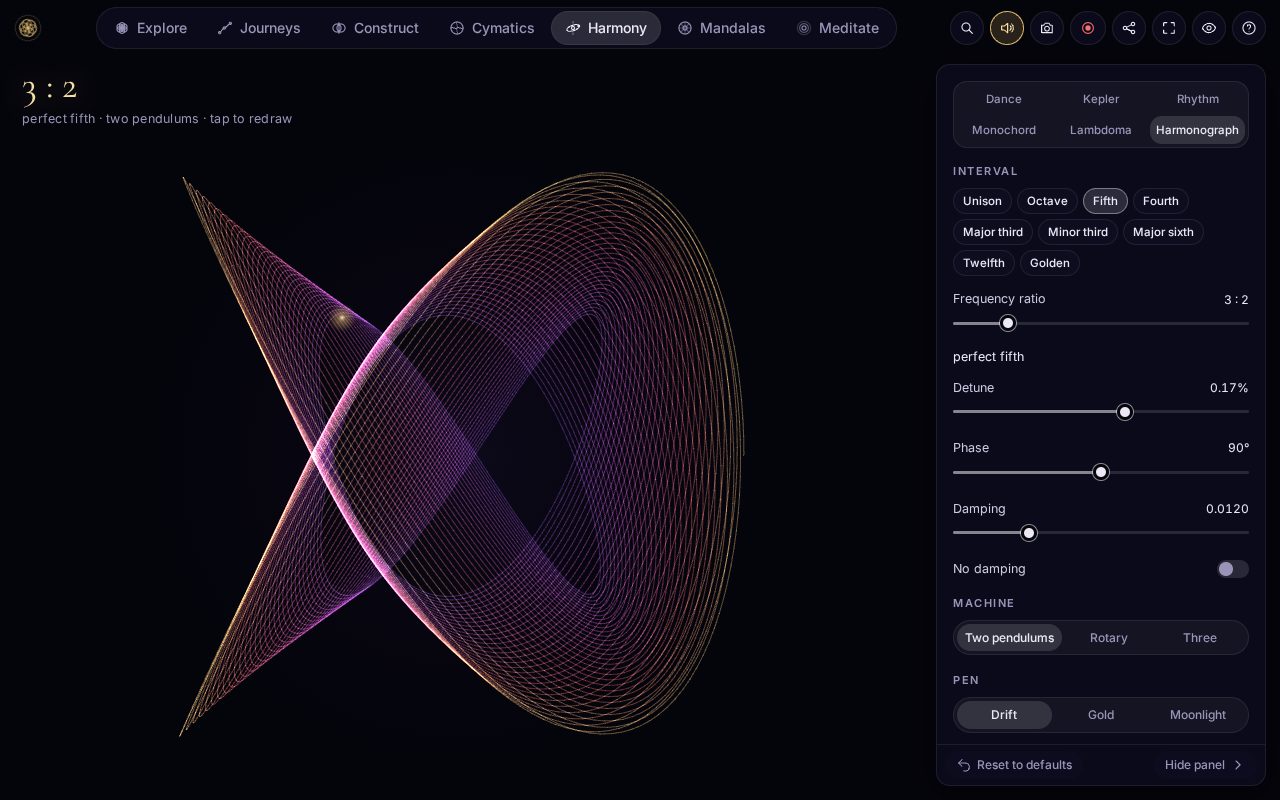
The harmonograph
A drawing machine that moves a pen with pendulums swinging at right angles. It appeared in the mid-1800s, is often credited to the Glasgow mathematician Hugh Blackburn, and was at its most popular in the 1890s. When the pendulums’ frequencies form a simple ratio, the pen retraces a closed, symmetric figure, and the ratios that close most simply are the ones the ear hears as consonant: the octave 2 : 1, the fifth 3 : 2, the fourth 4 : 3. A slight detune turns the figure slowly, the same mistuning that makes two notes beat, and friction makes every figure spiral in.
There are three machines, two pendulums, a rotary one and three pendulums together, and a finished drawing saves as an SVG for a pen plotter. See every interval drawn, and how each machine works.
4 of 6
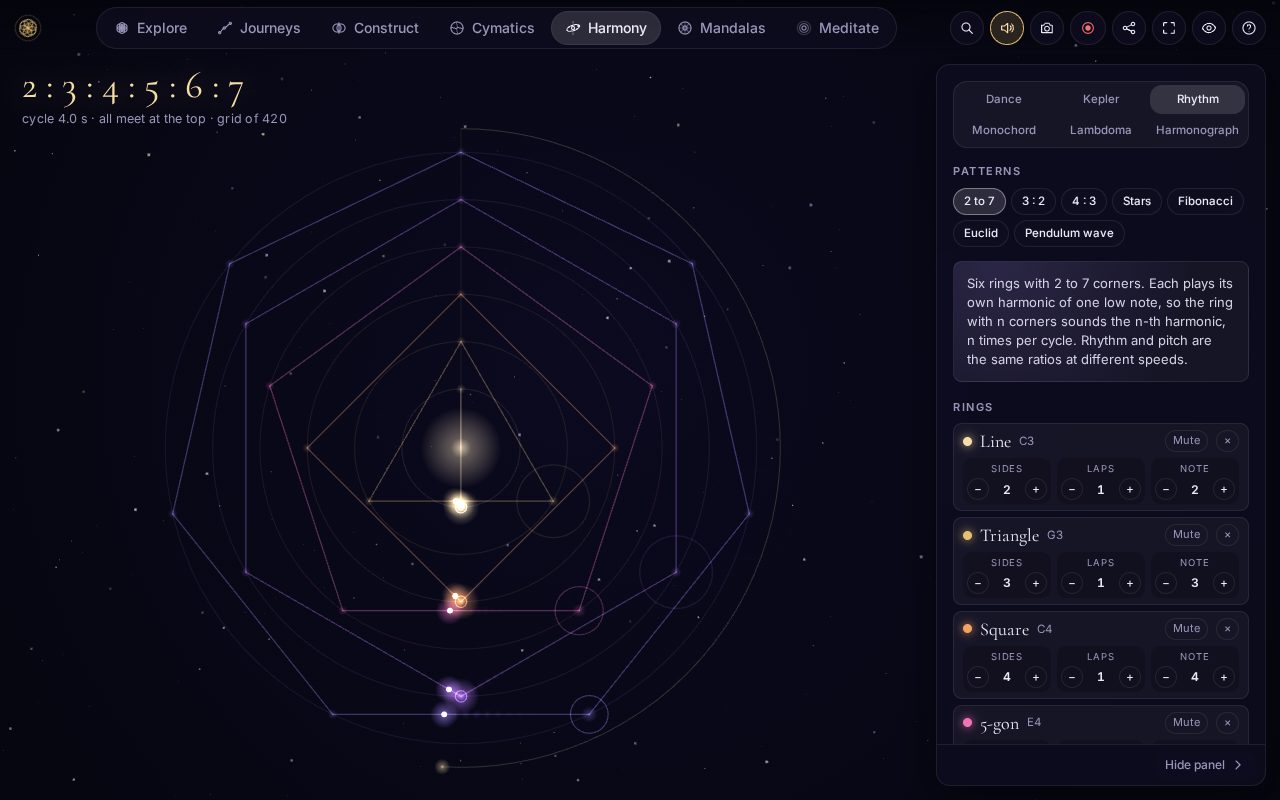
Rhythm
Polygons turned into rings of polyrhythm, where the angle between two corners is the time between two notes. It has a page of its own: the polyrhythm generator, with every pattern, the grid its rings share, and Euclidean rhythms.
5 of 6
Dance
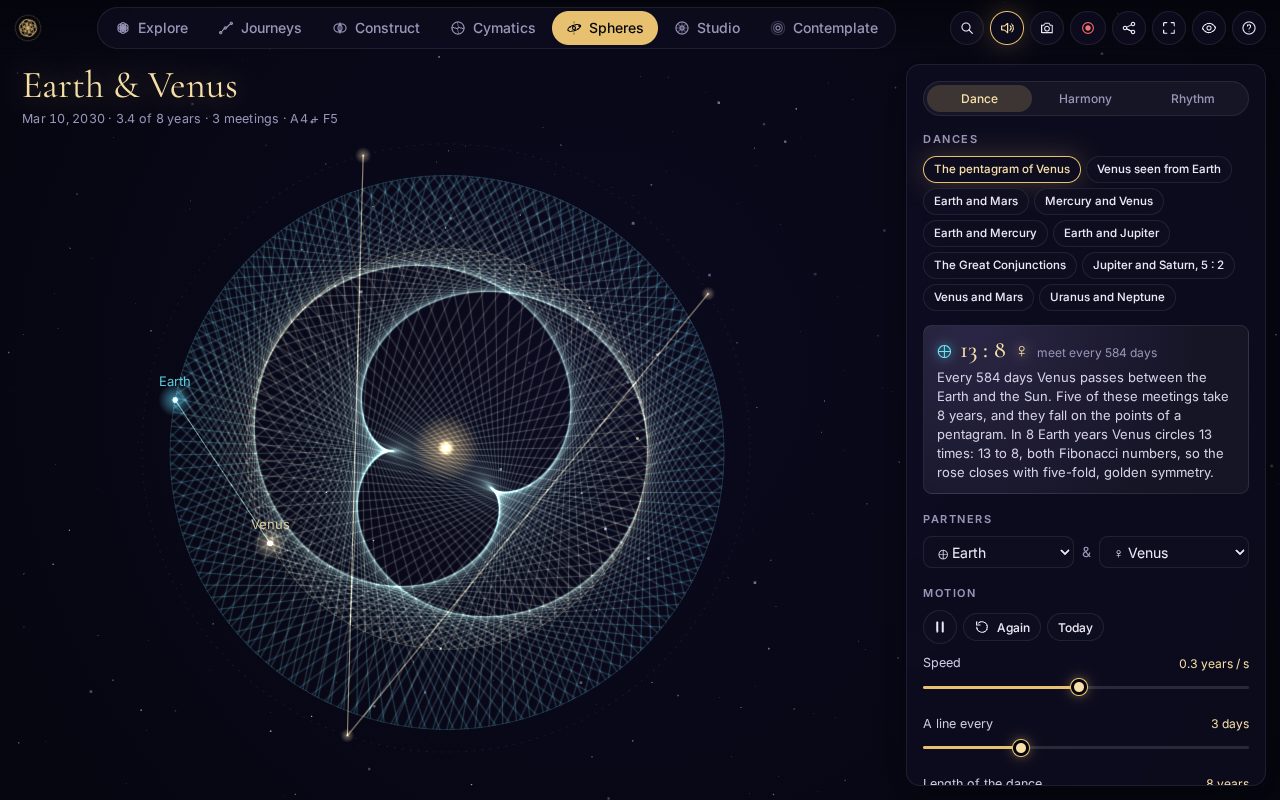
Two planets circle the Sun on their real orbits, and a line is drawn between them every few days. Over the years the lines build a rose, and the ratio of the two years decides its shape: Earth and Venus, at very nearly 13 to 8, draw the five-petaled pentagram of Venus over eight years, and Jupiter and Saturn the triangle of the Great Conjunctions. A chime sounds each time the two line up with the Sun.
Choose any two planets, how often a line is drawn and for how long, or watch one planet’s path as seen from the other. A finished drawing saves as an SVG for a pen plotter. See every planetary dance, drawn from the same orbits.
6 of 6
Kepler
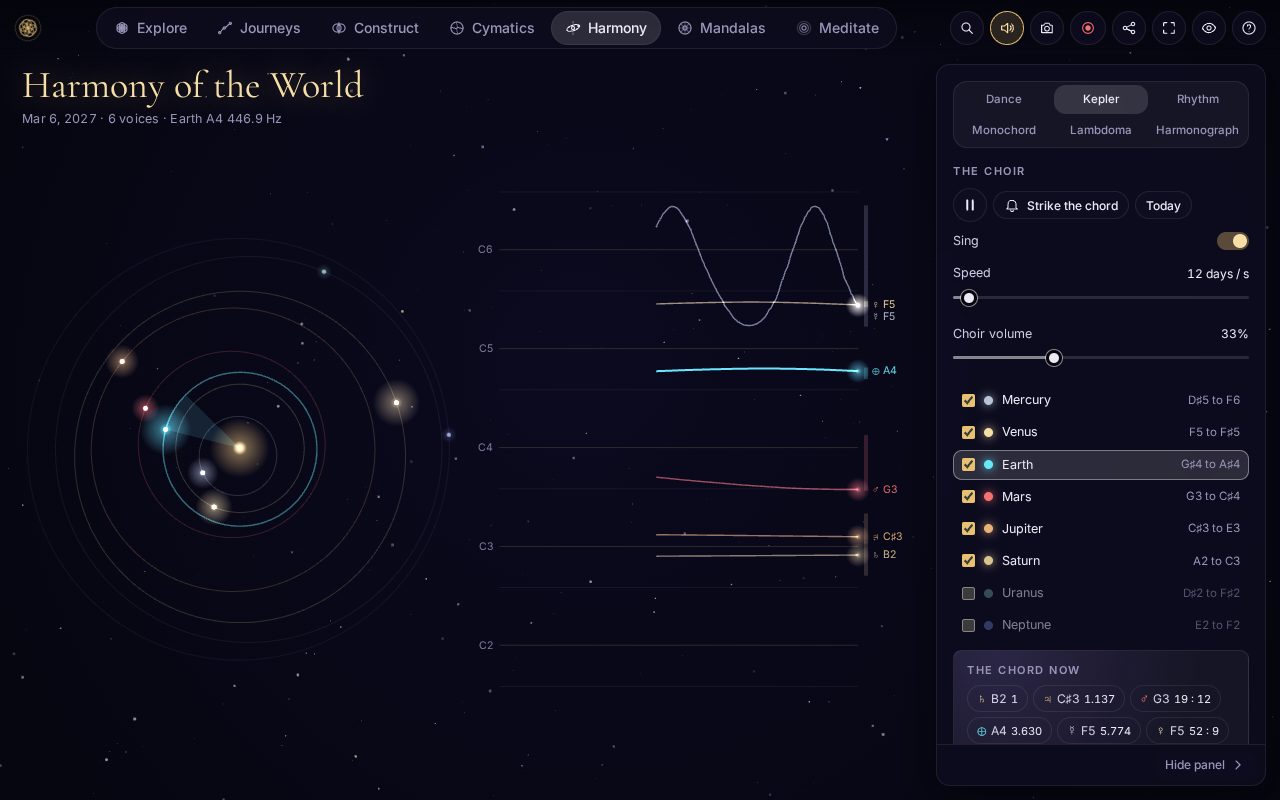
In Harmonices Mundi, “The Harmony of the World” (1619), Kepler worked out how fast each planet sweeps across the sky as seen from the Sun. A planet moves fastest at perihelion, its closest, and slowest at aphelion, and the ratio of the two was a musical interval: a major third for Saturn, a minor third for Jupiter, a fifth for Mars, a semitone for Earth.
Here each planet sings that true angular speed, raised by whole octaves until it can be heard, as Kepler did. Its pitch slides as it moves: Mercury slides wide and fast, Venus barely moves. A score draws every voice over time, the chord they make at this moment is spelled out as ratios, and the date can run forward at any speed or return to today. Strike the chord sounds them all at once. Kepler reckoned that chords of four planets come centuries apart and of five, thousands of years; a perfect chord of all six might have sounded only once, at the beginning of time.
The song of each planet
| Planet | Speeds | Cents | Nearest interval | Kepler |
|---|---|---|---|---|
| Mercury | 2.303 | 1445 | major second + octave (+41¢) | 12 : 5 (1516) |
| Venus | 1.027 | 47 | unison (+47¢) | under 25 : 24 (71) |
| Earth | 1.069 | 116 | minor second (+4¢) | 16 : 15 (112) |
| Mars | 1.455 | 649 | perfect fifth (-53¢) | 3 : 2 (702) |
| Jupiter | 1.214 | 335 | minor third (+20¢) | 6 : 5 (316) |
| Saturn | 1.242 | 375 | major third (-11¢) | 5 : 4 (386) |
| Uranus | 1.208 | 327 | minor third (+11¢) | found later |
| Neptune | 1.035 | 59 | minor second (-52¢) | found later |
Kepler worked from the observations of Tycho Brahe, the best of his day, and named each ratio after the nearest consonance, noting how far it missed: Saturn and Jupiter a little more than their thirds, Mars somewhat less than a fifth, Venus less than even the diesis. From today’s orbits, Earth, Jupiter and Saturn come within about 20 cents of the named intervals, and Mars falls about 50 cents short of its fifth, as Kepler saw. Uranus (1781) and Neptune (1846) were found long after him.
Harmonies between neighbors
| Neighbors | Widest, Kepler | Today | Narrowest, Kepler | Today |
|---|---|---|---|---|
| Saturn and Jupiter | 1 : 3 (1902) | 1930 | 1 : 2 (1200) | 1219 |
| Jupiter and Mars | 1 : 8 (3600) | 3686 | 5 : 24 (2716) | 2702 |
| Mars and Earth | 5 : 12 (1516) | 1468 | 2 : 3 (702) | 704 |
| Earth and Venus | 3 : 5 (884) | 922 | 5 : 8 (814) | 760 |
| Venus and Mercury | 1 : 4 (2400) | 2407 | 3 : 5 (884) | 915 |
The third law
Kepler found his third law in 1618, while searching for this music, and published it in Harmonices Mundi: the square of a planet’s year is proportional to the cube of its distance from the Sun, T² ∝ a³. Harmony checks it as the planets move.
| Planet | Year T | Distance a | T² / a³ |
|---|---|---|---|
| Mercury | 0.241 | 0.387 | 1.000 |
| Venus | 0.615 | 0.723 | 1.000 |
| Earth | 1.000 | 1.000 | 1.000 |
| Mars | 1.881 | 1.524 | 1.000 |
| Jupiter | 11.86 | 5.203 | 0.999 |
| Saturn | 29.46 | 9.537 | 1.000 |
| Uranus | 84.02 | 19.191 | 0.999 |
| Neptune | 164.80 | 30.069 | 0.999 |