SacredForm · Figures
4D shapes
The shapes of four dimensions, and a way to see them
A four-dimensional shape lives in a space with a fourth direction, at right angles to length, width and height. We cannot point that way, but we can see such shapes the way a flat creature could come to know a cube: by their shadows, their slices and their unfoldings. SacredForm turns the six regular 4D shapes and more in front of you, free in the browser.
Turn a shape through the fourth dimension, slice it with our space and watch the cross-section change, or slide the Dimension dial to lift a solid into its 4D cousin.
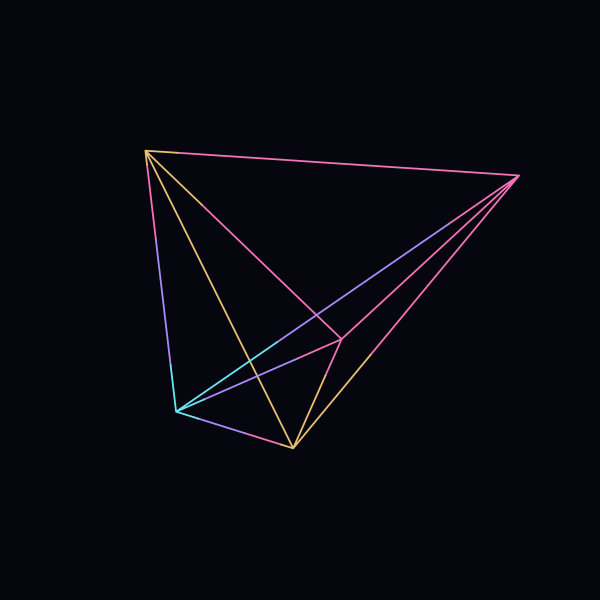
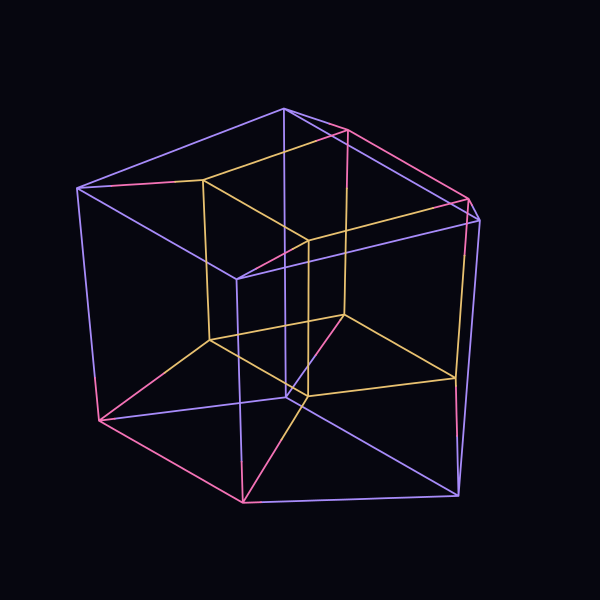
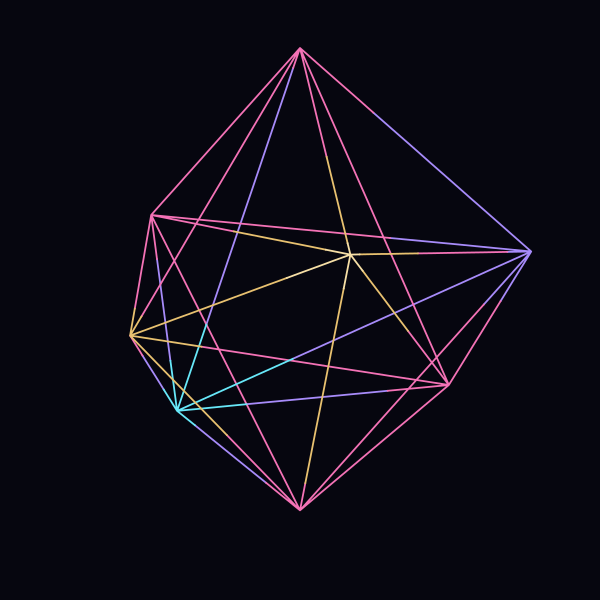
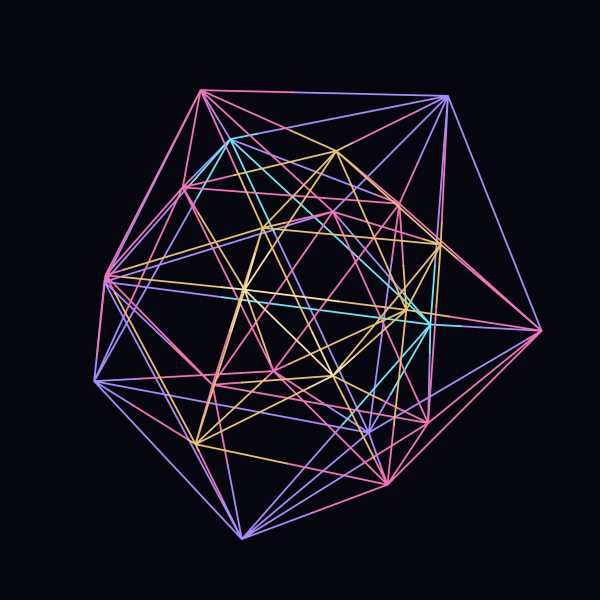
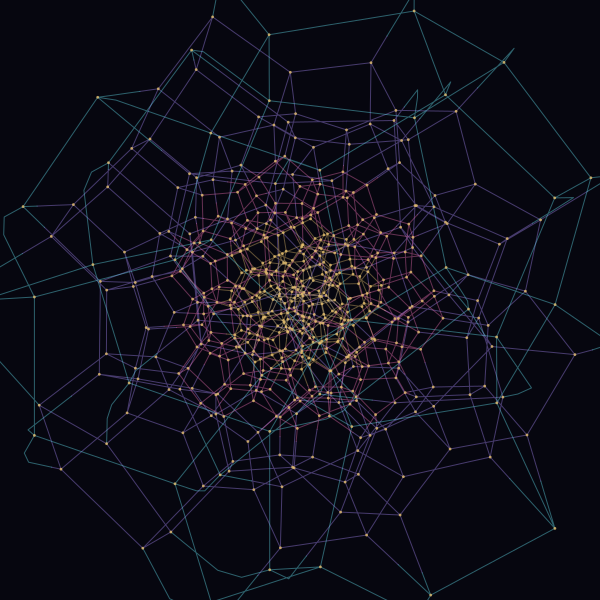
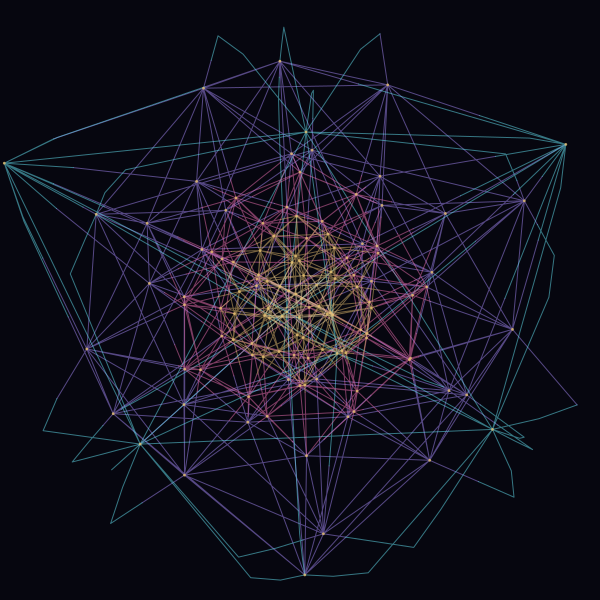
How to see the fourth dimension
Count the corners as you go up. A point has 1; drag it and you get a segment with 2; drag the segment sideways and you get a square with 4; drag the square up and you get a cube with 8; drag the cube in the fourth direction and you get the tesseract with 16. Each step doubles the corners, and the tesseract is bounded by 8 cubes as the cube is bounded by 6 squares.
- Shadows. A cube held up to a lamp throws a flat shadow, a square inside a square. A tesseract’s shadow in our space is a cube inside a cube, its corners joined. As the tesseract turns through the fourth dimension, its shadow turns itself inside out.
- Slices. A cube pushed through a flat world appears as a square that stays a square; pushed through corner first, it appears as a point that grows into a triangle, then a hexagon. A 4D shape passing through our space appears as a solid that changes shape as it goes.
- Unfoldings. A cube unfolds into six squares in the plane, a tesseract into eight cubes in space: the cross that Dalí painted.
This is the method of Edwin Abbott’s Flatland (1884), whose square learns of a third dimension from a sphere passing through his plane. SacredForm’s journeys take the same path, one dimension at a time.
The six regular 4D shapes
| Shape | Also called | Symbol | Cells | Faces | Edges | Vertices | Dual |
|---|---|---|---|---|---|---|---|
| 5-Cell | pentachoron, 4-simplex | {3,3,3} | 5 tetrahedra | 10 | 10 | 5 | itself |
| Tesseract | 8-cell, hypercube, 4-cube | {4,3,3} | 8 cubes | 24 | 32 | 16 | 16-Cell |
| 16-Cell | hexadecachoron, 4-orthoplex | {3,3,4} | 16 tetrahedra | 32 | 24 | 8 | Tesseract |
| 24-Cell | icositetrachoron, octaplex | {3,4,3} | 24 octahedra | 96 | 96 | 24 | itself |
| 120-Cell | hecatonicosachoron, dodecaplex | {5,3,3} | 120 dodecahedra | 720 | 1200 | 600 | 600-Cell |
| 600-Cell | hexacosichoron, tetraplex | {3,3,5} | 600 tetrahedra | 1200 | 720 | 120 | 120-Cell |
In three dimensions there are five regular solids; in four there are six, and in five and every dimension above only three. The Swiss mathematician Ludwig Schläfli described the six between 1850 and 1852, in a treatise not published in full until 1901, after his death. The word tesseract reached print first: Charles Howard Hinton coined it in his 1888 book A New Era of Thought.
More shapes of four dimensions
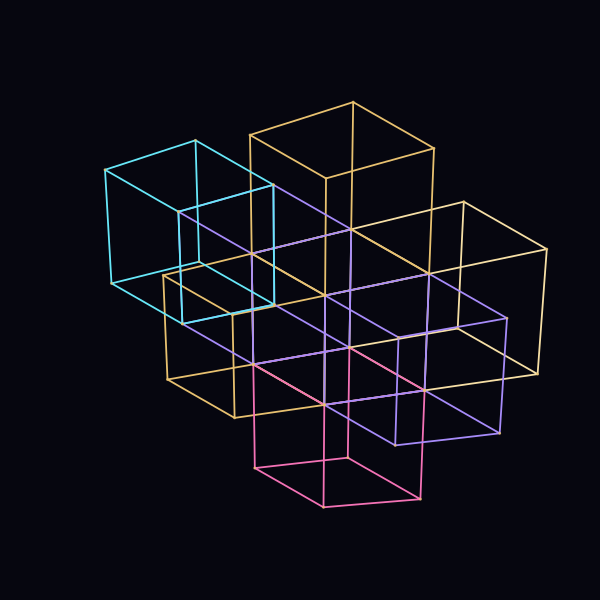 Unfolded TesseractThe Dalí cross: eight cubes folding into 4D
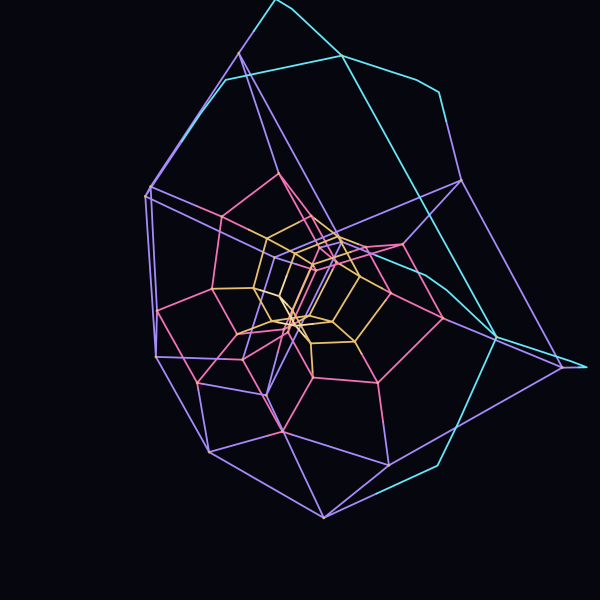 DuoprismPolygon × polygon
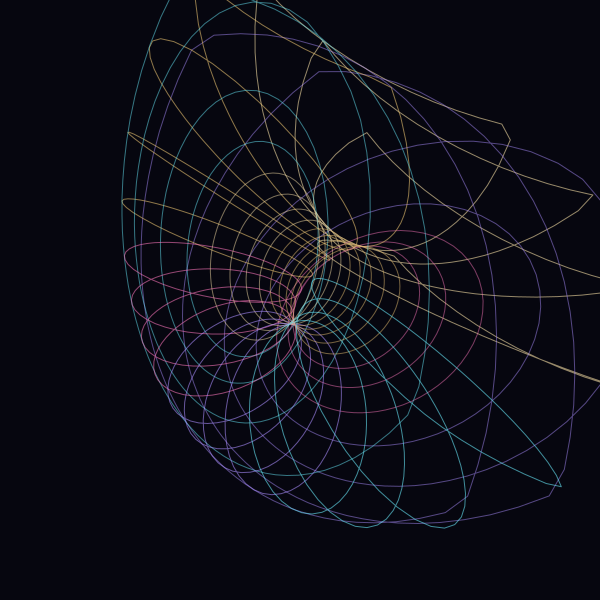 Clifford TorusA flat torus inside the 3-sphere
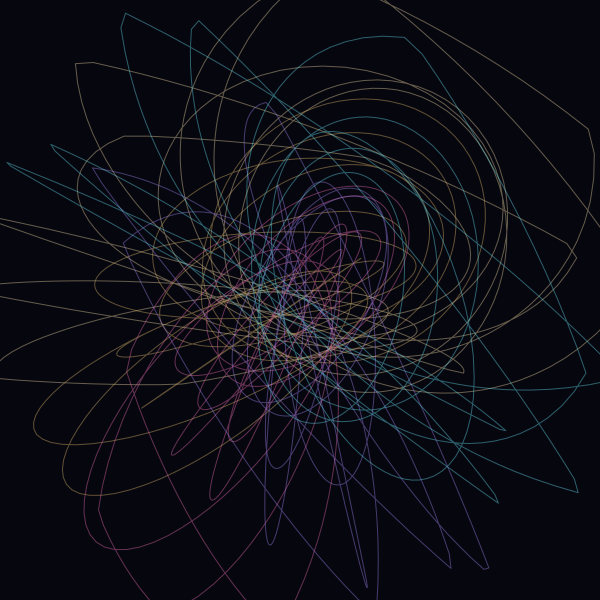 Hopf FibrationThe 3-sphere woven from circles
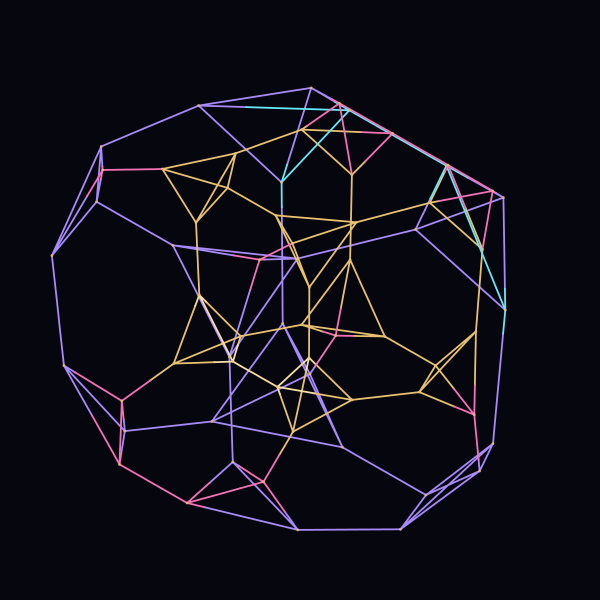 Tesseract to 16-CellTruncation in four dimensions
A duoprism is the product of two polygons, as a prism is a polygon times a segment; the Clifford torus is a torus that is perfectly flat, living on the 3-sphere; and the Hopf fibration fills the 3-sphere with circles, any two of them linked. None of them fits in our space, and SacredForm turns them like the rest.
See also
The five Platonic solids, the 3D shapes whose 4D cousins these are: the tesseract is the cube’s, the 16-cell the octahedron’s, the 5-cell the tetrahedron’s, and the 120-cell and 600-cell the dodecahedron’s and icosahedron’s.