Regular Polytopes · 4D
120-Cell
{5,3,3} · the dodecaplex
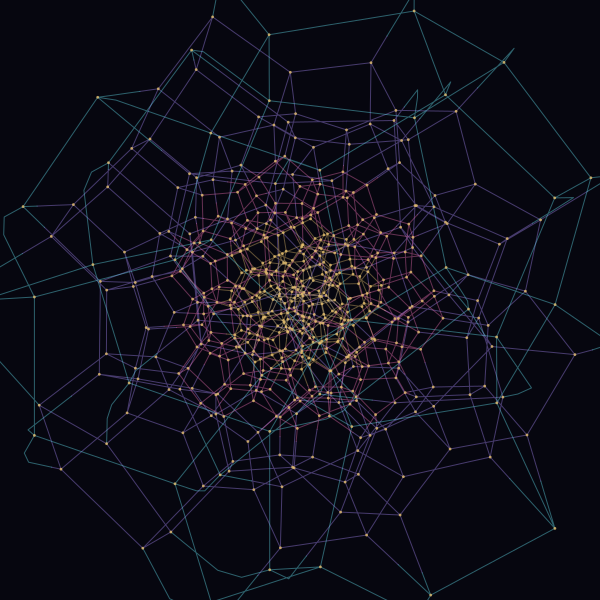
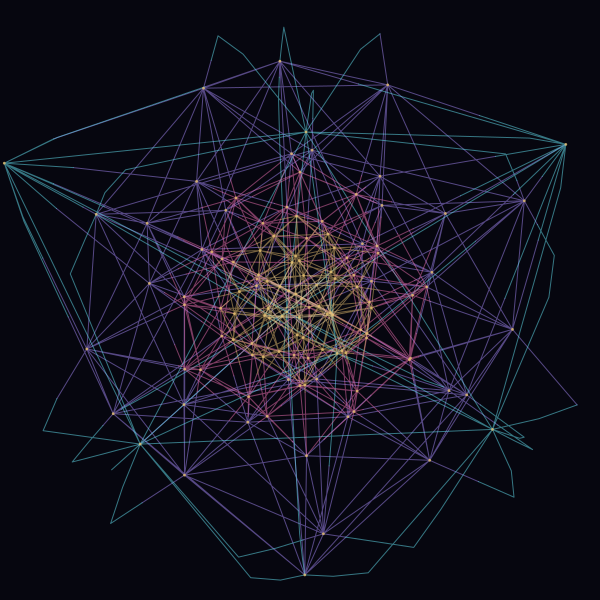
One hundred and twenty dodecahedra closing up into a round shell in 4D: the largest of the six regular 4D polytopes, with 600 corners.
- Vertices
- 600
- Edges
- 1200
- Faces
- 720
- Cells
- 120
Watch it turn through the fourth dimension, hear the chord of its edges, and slice it with our space to see it pass through.
Facts
- It is the 4D dodecahedron, and the dual of the 600-cell.
- Three dodecahedra meet at every edge, four at every corner.
- Stereographically projected, its dodecahedral cells nest like shells of soap bubbles.
Measures
With every edge one unit long. For another edge, multiply the lengths by it, the areas by its square and the volumes by its cube (the hypervolume by its fourth power).
- Circumradius (center to corner)
- 3.7025
- Inradius (center to cell)
- 3.4271
- Dihedral angle between cells
- 144.00°
- Volume of its 120 cells
- 919.574
- Hypervolume (4D content)
- 787.857
- Symmetries
- 14,400 (H4)
History and meaning
“One of the most beautiful objects in mathematics” is how John Stillwell opens his history of it, The Story of the 120-Cell (2001).
Across the dimensions
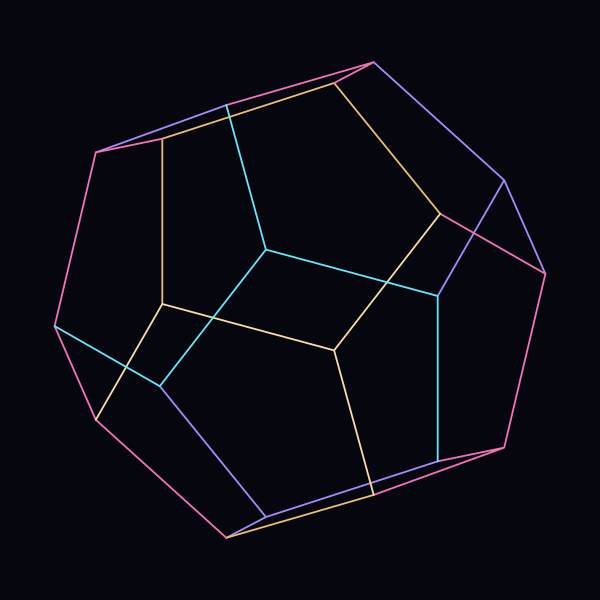
- Its cell DodecahedronBend 120 dodecahedra through the fourth dimension, three around every edge, and they close up: the 120-cell.
- Dual 600-Cell
Learn it step by step
- Journey Into the Fourth DimensionStep 9: The 120-cell
- Journey FlatlandStep 9: Soap bubbles
Read further
- Guide 4D shapesThe six regular shapes of four dimensions and more, and how to see them by their shadows, slices and unfoldings.