SacredForm · Cymatics · Plate
Chladni figures
The sand patterns of the square, round and triangular Chladni plate
Chladni figures are the patterns sand draws on a ringing plate: it is thrown off the parts that move and gathers on the lines that stay still, and each resonance draws its own figure. Below are the first figures of the square, round and triangular plates in SacredForm’s Cymatics, drawn from the same modes the app plays.
Open the Chladni plate simulator
In the app a tone drives the plate, or your voice through the microphone, or a chord sent from Explore or Harmony. Find the figures climbs through the plate’s resonances and rests on one after another until the sand settles.
How the sand draws them
Chladni sprinkled sand on a metal plate and drew a violin bow along its edge. When the bow finds one of the plate’s resonances, the plate rings in a standing wave: it divides into cells that swing up and down, each opposite to its neighbors, and between the cells run lines that do not move at all. The sand is thrown off the moving cells and comes to rest on those still lines, the nodal lines, and so it draws them.
Each resonance has its own figure. The higher its pitch, the more lines it has and the smaller the cells between them. Between resonances the plate barely moves and the sand stays put; where resonances crowd, the plate rings several at once and the sand draws their mix.
A grain only leaves the plate where the plate shakes it harder than gravity pulls, so the sand rests where the plate moves gently and hops about where it moves hard, until it reaches the lines. Where the plate is driven matters too: a resonance with a still line through the driven point cannot be rung from there. Chladni’s bow, at the edge, reaches nearly all of them; a speaker at the center reaches only figures that move at the center.
The drawings below are each plate’s first figures, lowest first, from the same modes the app plays. A plate’s pitch falls as the square of its width, so the app’s Plate size moves them all: it opens on a plate twice as wide as the smallest, where a note draws a finer figure and the very first of these lie below the tone’s range. Bring the size back to 1× to reach them, and choose Bowed at the edge: the app opens shaken at the center, which rings only the figures that move there. The square and round plates are real thin plates with free edges, which bend as metal does; a real plate’s figures still depend on its material, its thickness and how it is held, and differ in detail.
The square plate
No exact formula is known for the square plate with free edges. Its figures here are found as Walther Ritz found them in 1909: each is built from the ways a free bar bends, n lines across one way and m the other, mixed in the proportions that bend the plate least. Each is named by its largest part, (n, m), and its pitch rises roughly with n² + m².
A square looks the same turned a quarter turn, so (n, m) and (m, n) come in pairs. When n and m are both even or both odd, the plate’s stiffness splits the pair into two figures at different pitches: one its own mirror image across the diagonal from the top left corner, marked +, and one that changes sign across it, marked −, so that diagonal is always one of its lines. The first three show it plainly: a cross along the plate’s middles, then an X along its diagonals, then a ring, at pitches rising by half as much again and then a quarter more. When one of n and m is even and the other odd, the pair rings at exactly one pitch, and where the plate is driven decides how the two mix.
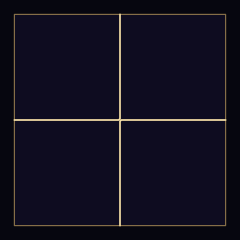
mode (1, 1, +) 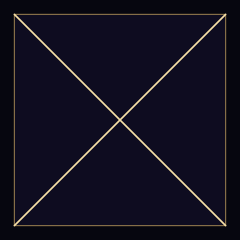
mode (2, 0, −) 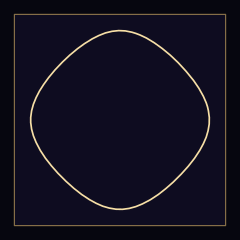
mode (2, 0, +) 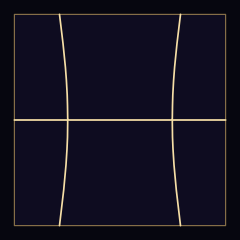
mode (2, 1) 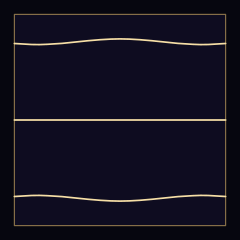
mode (3, 0) 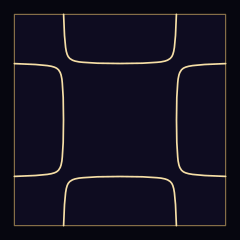
mode (2, 2, +) 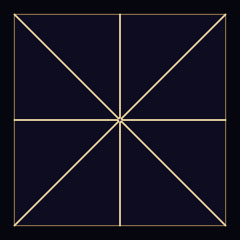
mode (3, 1, −) 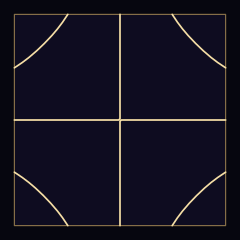
mode (3, 1, +) 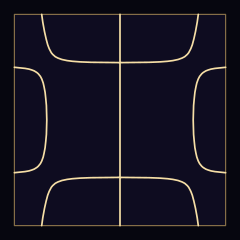
mode (3, 2) 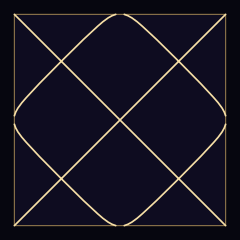
mode (4, 0, −) 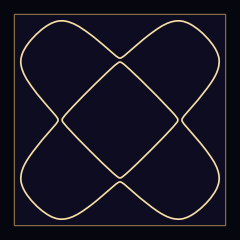
mode (4, 0, +) 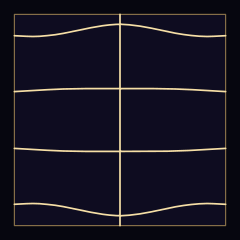
mode (4, 1) 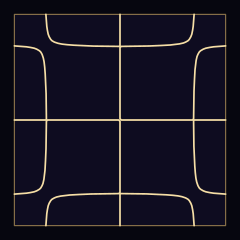
mode (3, 3, +) 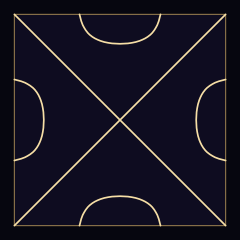
mode (4, 2, −) 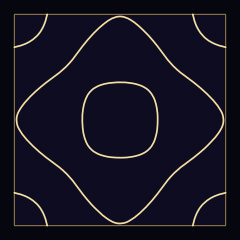
mode (4, 2, +) 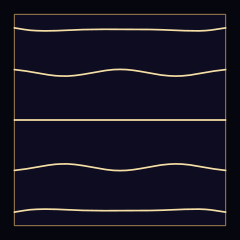
mode (5, 0)
The round plate
A round plate’s figures are made of diameters and circles, and the app names each by how many of each it has. Gustav Kirchhoff solved the free round plate exactly in 1850: its modes are (Jₙ(kr) + C·Iₙ(kr))·cos(nθ), where Jₙ is a Bessel function and Iₙ its modified form, which grows towards the rim. cos(nθ) is zero along n diameters, evenly spaced, and the radial part is zero on circles about the center. A free rim bears no bending and no shear, and those two conditions set k and C. The pitch rises with k².
Chladni found a rule of thumb for real round plates: the pitch rises roughly as (d + 2c)², for d diameters and c circles, so one more circle raises it about as much as two more diameters.
A perfectly round plate has no favored direction, so its diameters can lie at any angle: the same figure, turned. Where it is driven sets them: a bow at the rim moves the plate most where it touches, so no diameter runs through it. Driven at its center, a round plate rings only its circles.
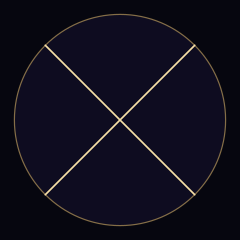
2 diameters · 0 circles 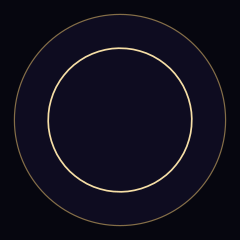
0 diameters · 1 circle 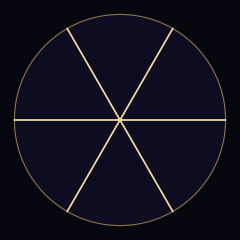
3 diameters · 0 circles 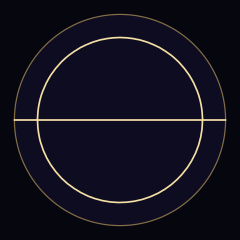
1 diameter · 1 circle 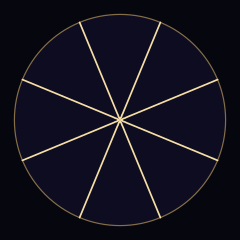
4 diameters · 0 circles 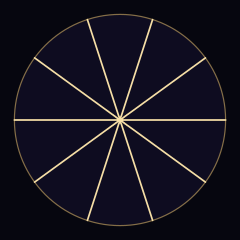
5 diameters · 0 circles 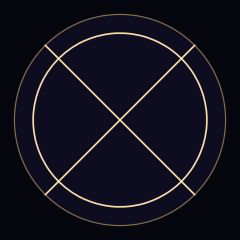
2 diameters · 1 circle 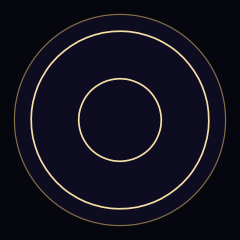
0 diameters · 2 circles 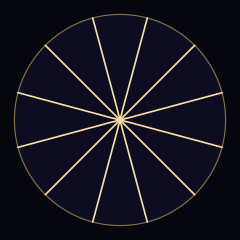
6 diameters · 0 circles 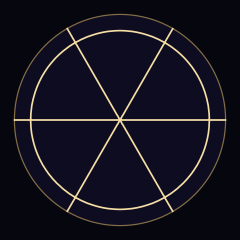
3 diameters · 1 circle 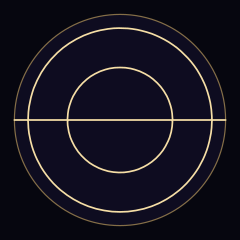
1 diameter · 2 circles 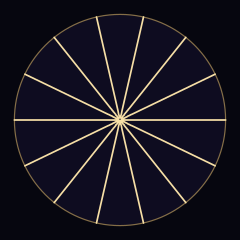
7 diameters · 0 circles
The triangular plate
No exact solution is known for a triangular plate, so the figures here are those of a triangular drum, one of the few shapes, with the rectangle and the disk, whose figures are known exactly. Gabriel Lamé found them in 1833, working out how heat flows through a triangular prism. A plate’s figures follow a drum’s away from its edges and differ near them. The triangle tiles the plane by mirroring in its sides, so each mode is built from six plane waves: one wave and its mirror images in the sides. Two whole numbers m and n name it, and its pitch rises with m² + mn + n².
Each pair (m, n) gives two figures: one is its own mirror image across the altitude from the top corner, marked +, and the other changes sign across it, marked −, so the altitude is always one of its lines. When m = n there is only the first. The two share a pitch, and where the plate is driven decides how they mix.
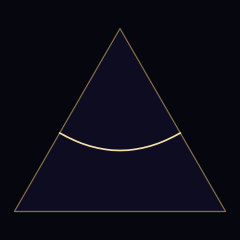
mode (1, 0, +) 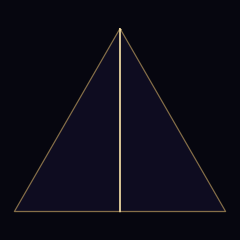
mode (1, 0, −) 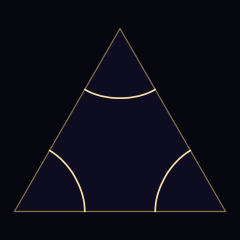
mode (1, 1) 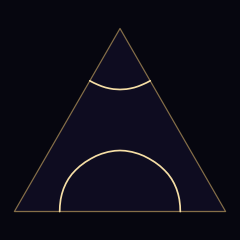
mode (2, 0, +) 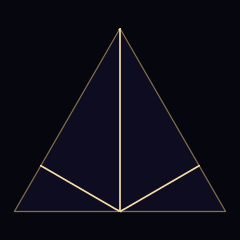
mode (2, 0, −) 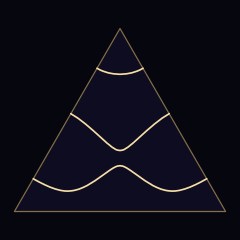
mode (2, 1, +) 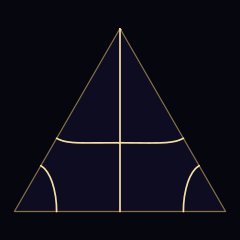
mode (2, 1, −) 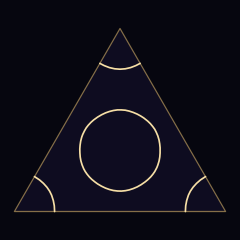
mode (3, 0, +) 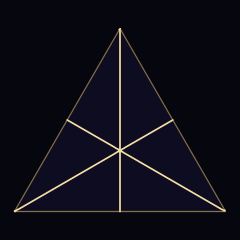
mode (3, 0, −) 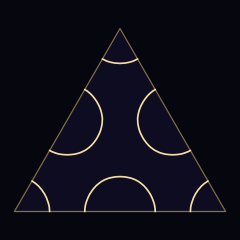
mode (2, 2) 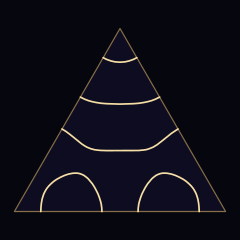
mode (3, 1, +) 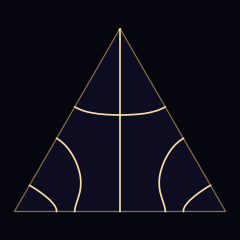
mode (3, 1, −)
History
Robert Hooke saw such lines in flour on a bowed glass plate in 1680. Ernst Chladni made them famous: he bowed sand-covered plates and published their figures in 1787, in Entdeckungen über die Theorie des Klanges (Discoveries in the Theory of Sound), and toured Europe showing them. Napoleon watched him in Paris in 1808 and funded a prize for their mathematical explanation, won in 1816 by Sophie Germain on her third attempt. A real square plate’s figures were first computed, approximately, by Walther Ritz in 1909.
In the 1960s the Swiss physician Hans Jenny revived these experiments with liquids, pastes and powders, and named the study cymatics, from the Greek kyma, “wave” (Kymatik, 1967).
Related figures
Learn it step by step
- Journey Sound Made VisibleCymatics and the music of shapes