SacredForm · Harmony · Rhythm
Polyrhythm generator
Rings of polygons that play: see and hear any rhythm against any other
A polyrhythm is two or more even beats sharing one cycle: three against two, four against three, five against four. SacredForm draws each beat as a polygon with a bead running round it, so you can see where the beats fall and hear them at once. It is free in the browser, with up to sixteen rings, Euclidean rhythms and a pendulum wave.
Free, with no account, on a computer or a phone. A link always carries the whole pattern, so a bookmark or a shared link plays it again.
The rings
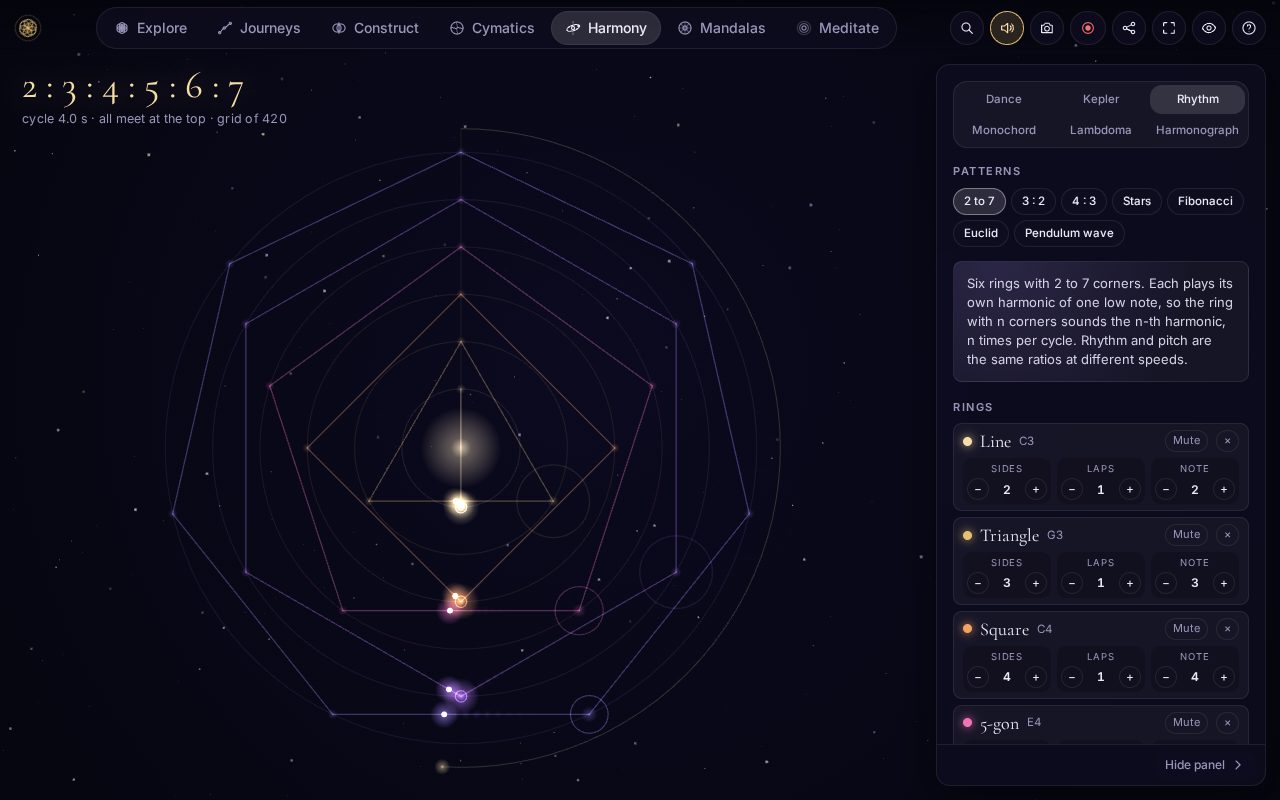
Each ring holds a polygon with a bead that travels its edges once per lap, and every corner it reaches rings a note. All the rings share one cycle and start together at the top, so a ring with three corners against one with two plays three against two, and they meet again at the top of every cycle. Rhythm becomes geometry: the angle between two corners is the time between two notes.
Tap a ring to give it another corner, hold it to mute it, and set each ring’s corners, laps and note. A ring can be a star polygon {n/s}, its bead jumping s corners at a time, or play only some of its corners as a Euclidean rhythm. The notes come from the harmonic series, a major or minor pentatonic, just major or the Pythagorean scale, as a bell, a pluck or glass, over a cycle from one second to a minute. Tap tempo sets the pace from the first ring’s beat.
Reading the grid
Lay every ring’s beats on one line of evenly spaced steps and you have the finest grid that holds them all: its length is the least common multiple of the beats. Three against two needs six steps; the beats coincide only on the first.
| 2 | x · · x · · |
|---|---|
| 3 | x · x · x · |
Four against three needs twelve, and again the two only meet at the top. Six rings of two to seven corners need 420 steps between one meeting of them all and the next.
| 3 | x · · · x · · · x · · · |
|---|---|
| 4 | x · · x · · x · · x · · |
The same ratios are intervals. Speed three against two up until the beats run into a tone and you hear a perfect fifth, which is a vibration of 3 against 2; four against three becomes a perfect fourth. In the 2 to 7 pattern each ring sounds its own harmonic of one low note, so the rhythm and the chord are the same numbers at different speeds.
A polyrhythm divides one cycle in different ways, so its rings always meet at the top. A polymeter is the other way round: patterns of different lengths on one steady pulse, such as three beats against four at the same tempo, which drift apart and line up again only every twelve beats. Every pattern in Rhythm is a polyrhythm in this sense: however many rings it has, they all share one cycle.
Patterns
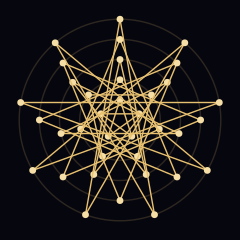
| Pattern | Rings | Beats | Grid |
|---|---|---|---|
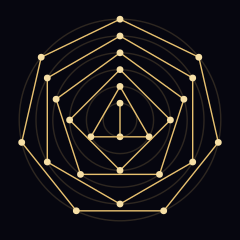
| 2 to 7 | 2, 3, 4, 5, 6, 7 | 2 : 3 : 4 : 5 : 6 : 7 | 420 |
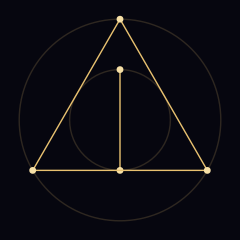
| 3 : 2 | 2, 3 | 2 : 3 | 6 |
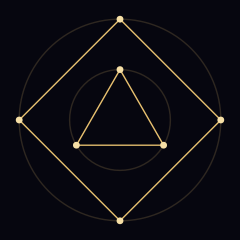
| 4 : 3 | 3, 4 | 3 : 4 | 12 |
| Stars | {5/2}, {7/2}, {7/3}, {8/3}, {9/4} | 5 : 7 : 7 : 8 : 9 | 2,520 |
| Fibonacci | 1, 2, 3, 5, 8, 13 | 1 : 2 : 3 : 5 : 8 : 13 | 1,560 |
| Euclid | 4 in 16, 3 in 8, 5 in 8, 7 in 12 | 4 : 3 : 5 : 7 | 48 |
| Pendulum wave | 15 beads, 20 to 34 laps | 20 to 34 | over a billion |
- 2 to 7: Six rings with 2 to 7 corners. Each plays its own harmonic of one low note, so the ring with n corners sounds the n-th harmonic, n times per cycle. Rhythm and pitch are the same ratios at different speeds.
- 3 : 2: Three against two, the hemiola. Speed it up far enough and the rhythm becomes a pitch: a perfect fifth has exactly this 3 : 2 ratio.
- 4 : 3: Four against three: the rhythm of a perfect fourth. The two beads only meet at the top.
- Stars: The same beats, drawn as star polygons {n/s}: the bead jumps s corners at a time, so a pentagon becomes a pentagram. Each corner still sounds once per lap.
- Fibonacci: Rings of 1, 2, 3, 5, 8 and 13 corners: the Fibonacci numbers. Neighbors share no common factor, so each neighboring pair meets only at the top of the cycle, and their ratios (5 : 3, 8 : 5, 13 : 8) close in on the golden ratio.
- Euclid: Euclidean rhythms: spread k beats as evenly as possible over n steps. 3 in 8 is the Cuban tresillo, 5 in 8 the cinquillo, 7 in 12 a common West African bell pattern. Godfried Toussaint showed in 2005 that Euclid’s algorithm generates many such traditional rhythms. The hits trace lopsided polygons.
- Pendulum wave: Fifteen beads, each circling a little faster than the one inside it: 20, 21, 22 … 34 laps a minute. They drift into waves, snakes and splits, and after exactly one minute they all line up again.
The pendulum wave follows a classic demonstration: fifteen pendulums tuned so each swings once more a minute than the one before, which part into waves and line up again at the end of the minute.
Euclidean rhythms
Spread k beats as evenly as possible over n steps and you get a Euclidean rhythm, which can be worked out with the steps of Euclid’s algorithm for the greatest common divisor. The computer scientist Godfried Toussaint showed in 2005 that many of the world’s traditional rhythms are of this kind. Drawn on a ring, the hits make lopsided polygons. Each starts on a hit, as Rhythm plays it; the traditional pattern may begin elsewhere in its cycle.
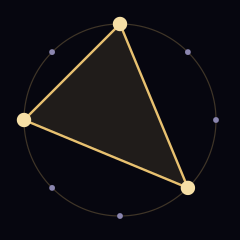
3 in 8 · x··x··x·
the tresillo of Cuban music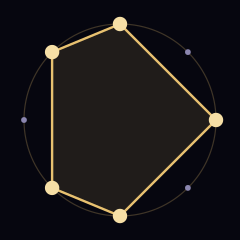
5 in 8 · x·x·xx·x
the cinquillo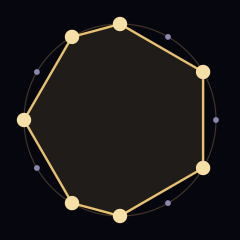
7 in 12 · x·x·x·xx·x·x
a common West African bell pattern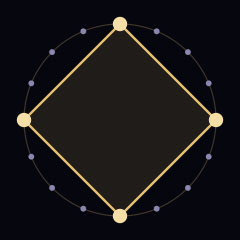
4 in 16 · x···x···x···x···
four even beats
See also the music of the spheres: the planets’ own intervals, which Rhythm sits beside in Harmony.