SacredForm · Harmony
Harmonograph and Lissajous curves
Pendulums that draw the shape of a musical interval
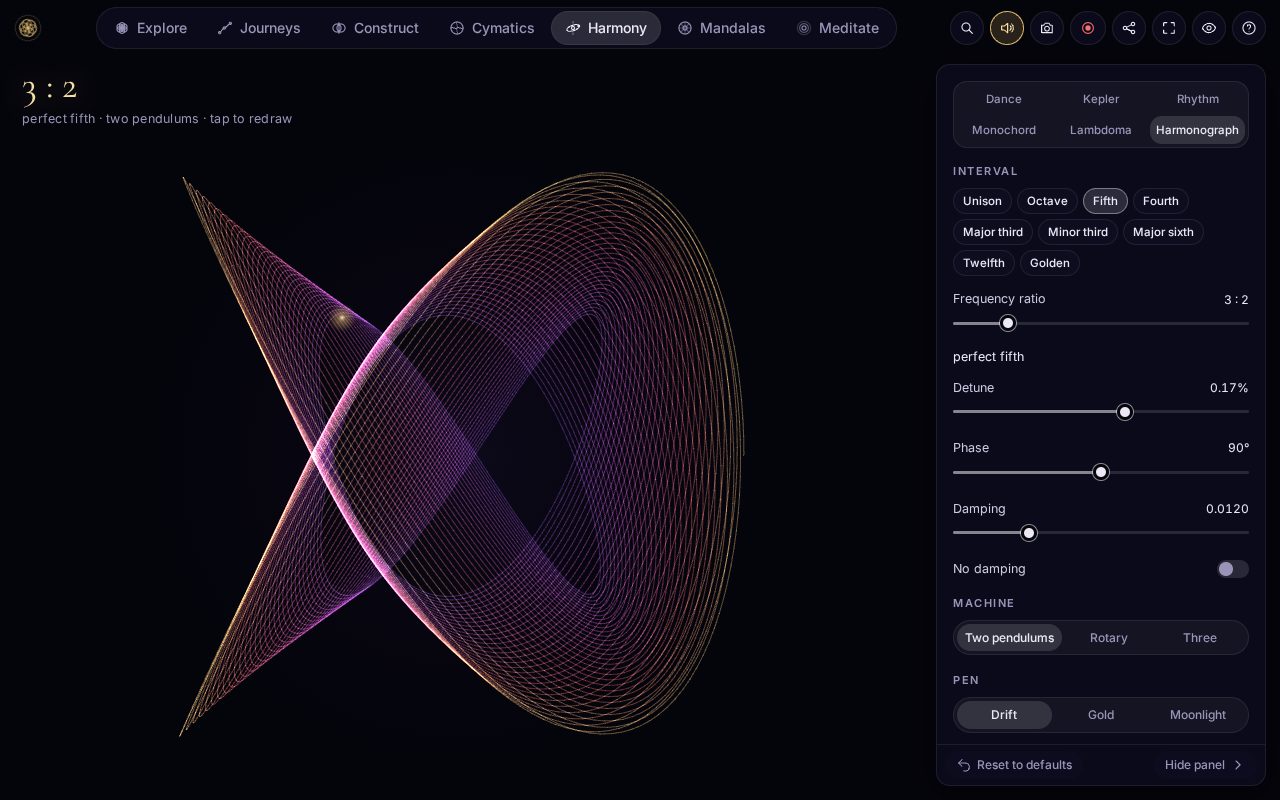
A harmonograph is a drawing machine moved by pendulums. Swinging at the ratio of a musical interval, they draw its shape: the octave, the fifth, the fourth, each a figure of its own, turning and spiraling in as the swing dies. With no damping, they draw pure Lissajous curves. Here it has two-pendulum, rotary and three-pendulum machines, and saves every drawing for a pen plotter.
Free, with no account, on a computer or a phone. Tap the drawing to let the pendulums go again.
How it draws
In the simplest harmonograph one pendulum moves the pen from side to side and another, swinging at right angles, moves it to and fro. Together they trace a Lissajous figure, the curve Nathaniel Bowditch studied in 1815 and Jules Antoine Lissajous, who gave it his name, in 1857. When the two frequencies stand in a ratio of small whole numbers the pen comes back to where it began and the figure closes; the ratios that close most simply, 2 : 1, 3 : 2, 4 : 3, are the octave, fifth and fourth that the ear hears as consonant. The golden ratio φ is no ratio of whole numbers, and its figure never closes.
A real pendulum loses a little of its swing to friction on every pass, so the figure spirals in until the pen lifts; here the swing shrinks by e−damping each cycle. A slight detune, one pendulum a hair off its interval, makes the figure turn slowly as it shrinks: the same mistuning that makes two notes beat. On a real machine the ratio is set by the pendulums’ lengths: a pendulum’s frequency goes as one over the square root of its length, so an octave needs one pendulum a quarter the length of the other.
Lissajous curves
Turn the damping off and the swing never dies. Two pendulums at right angles then draw a pure Lissajous curve, the pen at x = sin(t + δ), y = sin(r t), where r is the ratio of their frequencies and δ the phase between them. When r is a ratio of whole numbers p : q the curve closes, after q swings of the first pendulum, and the pen goes round it once and stops; a ratio such as φ never closes, and the pen weaves to and fro across a square for a while before it stops. Any detune would turn the figure, so while the damping is off the detune is held at zero.
The phase shapes the figure. At 1 : 1 the curve is an ellipse, a circle at 90° and a slanted ellipse at 45°; at 2 : 1 it is a figure of eight, folding into a parabola at 45°. The same curves appear on an oscilloscope set to draw one signal against another, where they compare a signal under test with a known reference. Every figure below is drawn by the app’s own pendulums.
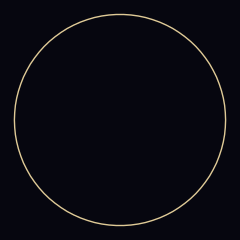
Unison, 1 : 1, at 90° 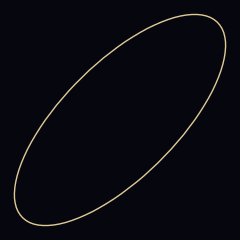
Unison, 1 : 1, at 45° 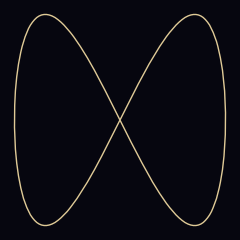
Octave, 2 : 1 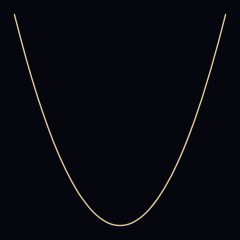
Octave, 2 : 1, at 45° 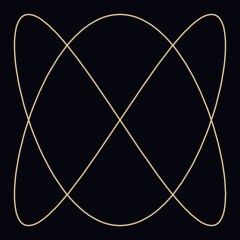
Fifth, 3 : 2 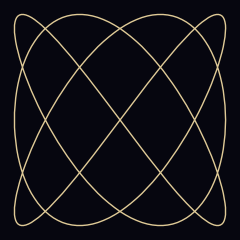
Fourth, 4 : 3
Three machines
- Two pendulums: the lateral harmonograph above, one pendulum for each direction.
- Rotary: pen and table each ride on a pendulum free to swing in any direction, so each traces a circle. When they circle the same way, a ratio p : q draws p − q lobes; when they circle against each other, p + q. The fifth, 3 : 2, draws one lobe or five.
- Three pendulums: the two lateral pendulums move the pen over a table that circles on a third, which wraps the figure round itself.
Choose an interval or set any ratio, and adjust the detune, the phase between the pendulums and the damping, or turn the damping off. The pen can draw in gold, in moonlight, or drifting from gold through rose and violet to cyan as the swing fades, at any width and speed. A finished drawing saves as an SVG in millimeters, one path per color so each can be its own pen, ready for a pen plotter.
The intervals
| Interval | Ratio | Cents | Rotary lobes |
|---|---|---|---|
| Unison | 1 : 1 | 0 | a line or a circle |
| Octave | 2 : 1 | 1200 | 3 or 1 |
| Fifth | 3 : 2 | 702 | 5 or 1 |
| Fourth | 4 : 3 | 498 | 7 or 1 |
| Major third | 5 : 4 | 386 | 9 or 1 |
| Minor third | 6 : 5 | 316 | 11 or 1 |
| Major sixth | 5 : 3 | 884 | 8 or 2 |
| Twelfth | 3 : 1 | 1902 | 4 or 2 |
| Golden | φ : 1 | 833 | never closes |
The intervals, drawn
Each figure below is traced by the app’s own pendulums, at its starting phase and detune, with the swing dying faster than its default so the figure stays open.
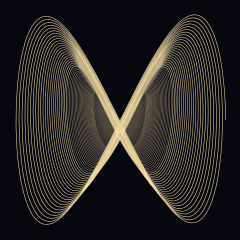
Octave, 2 : 1 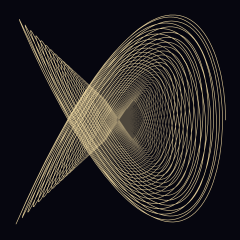
Fifth, 3 : 2 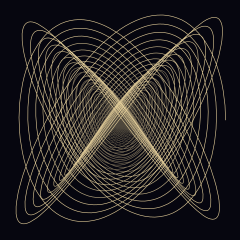
Fourth, 4 : 3 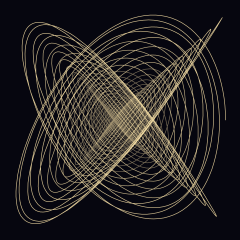
Major third, 5 : 4 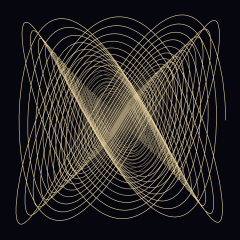
Major sixth, 5 : 3 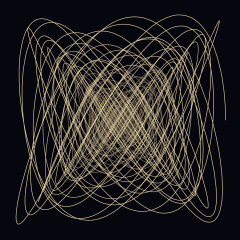
Golden, φ : 1 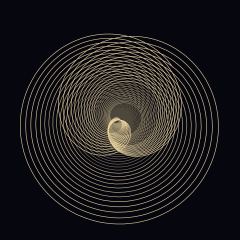
Fifth, rotary, circling together 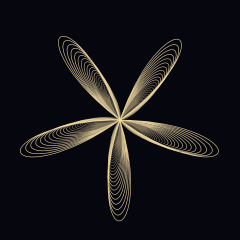
Fifth, rotary, circling against
History
Harmonographs appeared in the mid-1800s, and no single inventor is known. They are often credited to the Glasgow mathematician Hugh Blackburn, who in 1844 described a pendulum that swings two ways at once; the name harmonograph dates from the 1870s. They were at their most popular in the 1890s.
The harmonograph is in SacredForm’s Harmony mode, beside the monochord, the Lambdoma, the polyrhythm rings and the planets: see the music of the spheres.