SacredForm · Mandalas · Pattern
The seventeen wallpaper groups
Every way a pattern can repeat across the plane
A wallpaper pattern repeats in two directions across the whole plane. Besides those slides it may come back onto itself by turning about a point, by reflecting in a mirror line, or by a glide: a reflection and a slide along the same line at once. All the moves that leave a pattern unchanged make up its symmetry group, and however different two patterns look, there are only seventeen groups they can have.
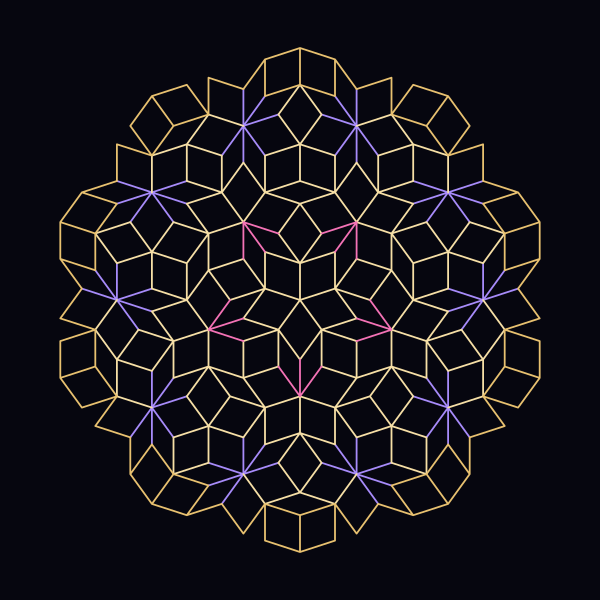
The reason is the lattice. A pattern that repeats can only turn onto itself by a half, a third, a quarter or a sixth of a turn. Fivefold turns do not fit a lattice, which is why the Penrose tiling, full of fivefold stars, never repeats. Those four turns, with mirrors and glides set every way the lattice allows, make exactly seventeen groups. Evgraf Fedorov proved it in 1891, and George Pólya found the same seventeen independently in 1924. It is often said that all of them appear in the tilework of the Alhambra; how many really do is still argued over.
To tell them apart, find the smallest turn that brings the pattern back onto itself: a sixth, a quarter, a third, a half, or none. Then look for mirrors, and for glides that are not mirrors. If there are mirrors, see whether every center of turning lies on one. Those questions single out each group, and the sections below follow them.
That opens Mandalas on its Pattern side, and each group below has a link of its own; any of the seventeen can be chosen under Symmetry. Then draw: each stroke is repeated by the group as you make it. Show symmetry axes marks the mirrors, glides and centers as the pictures here do.
Reading the pictures
Each picture repeats one flag by its group, as Mandalas does. The flag has no symmetry of its own, so every symmetry in the picture is the group’s: a turned flag comes from a turn, a mirror-image flag from a mirror or a glide. The faint grid is the lattice, and in the brighter cell the group’s symmetries are marked the usual way: mirrors as solid lines, glide axes dashed, and each center of turning as a small polygon with as many sides as its order, a lens for a half turn.
Each group has two names. The international one, which Mandalas uses, starts with p for a primitive cell or c for a centered one; its first digit, where there is one, is the highest turn, and m and g stand for mirrors and glides. John Conway’s orbifold name counts what the pattern has: a digit before the star is a center of turning on no mirror, the star means mirrors, a digit after it is a point where that many mirrors meet, × is a glide no mirror accounts for, and o means slides alone.
Mandalas, and so these pictures, draws the groups with no turn or a half turn on a square lattice, which can carry any of them, and the rest on the square or hexagonal lattice they need. The lattice named under each group is the most general one it allows.
No turns
Nothing short of a whole turn brings these back onto themselves. Without turns a pattern can still have mirrors, glides, both or neither, and those four choices are the four groups.
-
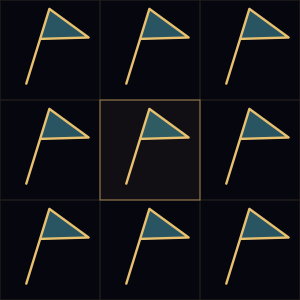
p1 o
Slides only: no turns, mirrors or glides.
-
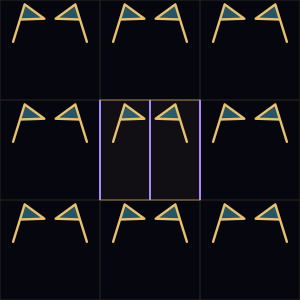
pm **
Parallel mirrors, and no turns or glides.
-
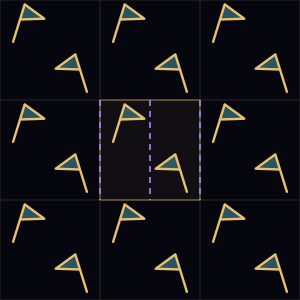
pg ××
Parallel glides, and no turns or mirrors.
-
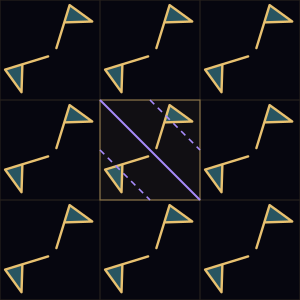
cm *×
Parallel mirrors with a glide halfway between each pair, and no turns.
Half turns
The highest turn is a half turn. p2 has nothing more. The other four have mirrors or glides in two directions at right angles: mirrors both ways (pmm), mirrors one way and glides the other (pmg), glides both ways (pgg), or mirrors both ways with half turns off them as well (cmm).
-
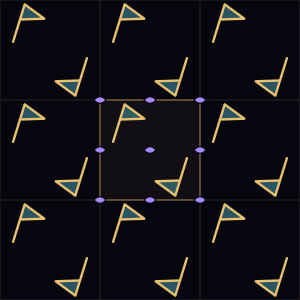
p2 2222
Half turns about four kinds of center, and no mirrors or glides.
-
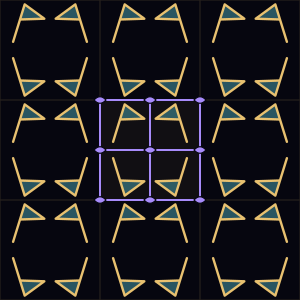
pmm *2222
Mirrors in two directions at right angles, with a half turn wherever two cross, and no glides.
Seen in brickwork in stack bond, each brick straight above the one below.
-
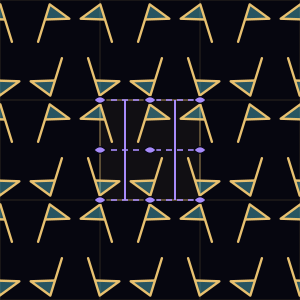
pmg 22*
Mirrors in one direction and glides square to them, with half turns on the glides, midway between the mirrors.
-
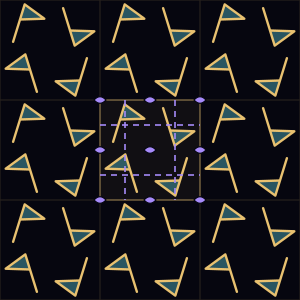
pgg 22×
Glides in two directions at right angles, half turns off them, and no mirrors.
-
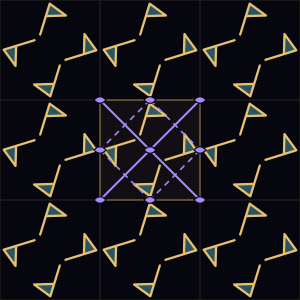
cmm 2*22
Mirrors in two directions at right angles, half turns where they cross and more between them, and glides.
Seen in brickwork in running bond, each row set half a brick along.
Quarter turns
A quarter turn needs a square lattice. p4 has no mirrors. In p4m mirrors pass through every center of turning, along the square’s sides and diagonals; in p4g they miss the quarter-turn centers.
-
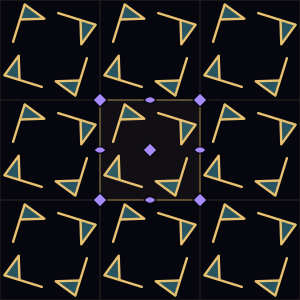
p4 442
Quarter turns about two kinds of center, half turns about a third, and no mirrors or glides.
Seen in the Pythagorean tiling of large and small squares.
-
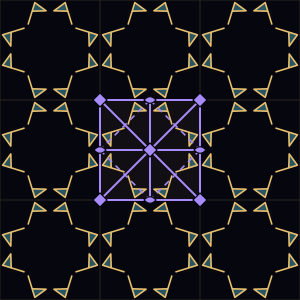
p4m *442
Mirrors in four directions through every center: quarter turns where four meet, half turns where two meet. Glides between them.
Seen in plain square tiles, and a chessboard.
-
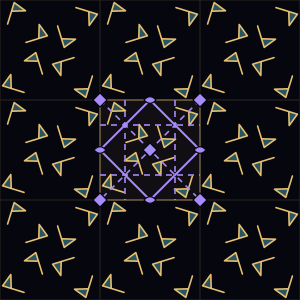
p4g 4*2
Quarter turns on no mirror, mirrors in two directions crossing at half turns, and glides.
Seen in basketweave paving, pairs of bricks laid alternately across and along.
Third turns
A third turn needs a hexagonal lattice. p3 has no mirrors. p3m1 and p31m both have mirrors in three directions: in p3m1 every center of turning lies on them, in p31m some do not.
-
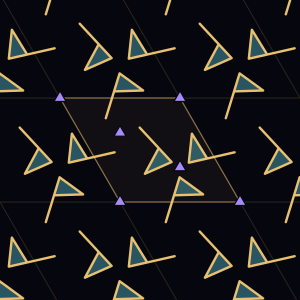
p3 333
Third turns about three kinds of center, and no mirrors or glides.
-
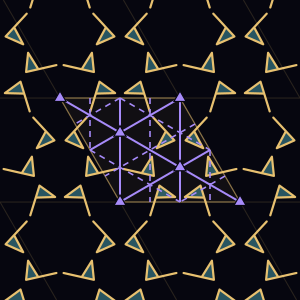
p3m1 *333
Mirrors in three directions, with every center of a third turn where three of them meet. Glides between them.
-
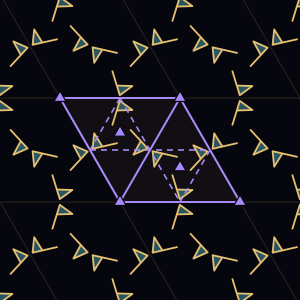
p31m 3*3
Mirrors in three directions: one kind of third-turn center where three meet, another off the mirrors. Glides between them.
Sixth turns
A sixth turn also needs the hexagonal lattice. p6 has no mirrors; p6m has mirrors through every center, the symmetry of the honeycomb.
-
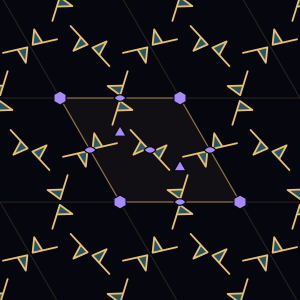
p6 632
Sixth turns, with third and half turns between them, and no mirrors or glides.
-
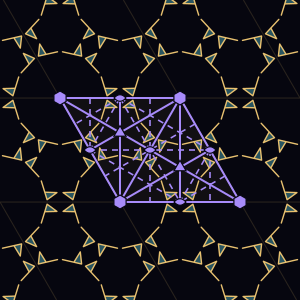
p6m *632
Mirrors in six directions through every center: sixth turns where six meet, third turns where three meet, half turns where two meet. Glides between them.
Seen in a honeycomb, and the Flower of Life drawn on without end.