Pattern & Tiling · 2D
Islamic Star Pattern
Hankin’s polygons-in-contact method
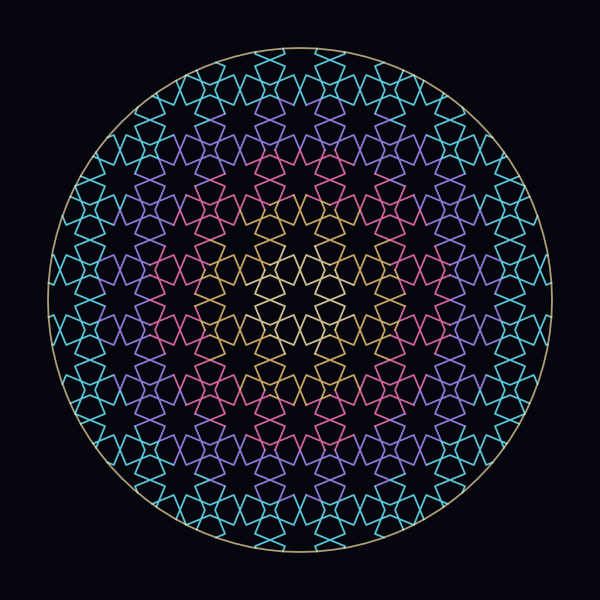
Lay down a tiling of polygons, then from the middle of every edge send out two rays at the same angle until they meet. One angle, dragged slowly, blossoms into stars and rosettes.
- Method
- Hankin 1925
- Rule
- 1 angle
Watch it draw itself line by line, hear the chord of its lines, and slide the Dimension dial to raise its form in space.
Facts
- On the 4.8.8 tiling, 67.5° (the default) grows sharp eight-pointed stars. At 45° each becomes the khatam, two crossed squares.
- The trihexagonal tiling at 60° gives six-pointed stars and hexagons.
- Rays cross each shared edge at the same angle on both sides, so the lines run on unbroken from tile to tile.
History and meaning
Craftsmen from Iran to Morocco (zellij) and Moorish Spain built vast star patterns with compass and straightedge, and left few written methods. E. H. Hankin, a British scientist in India, described this “polygons in contact” method in 1925 after studying historic patterns there. Whether the old masters worked exactly this way is still debated.
Across the dimensions
- Wraps into Star Pattern PolyhedronTake a little angle away at every corner and the tiling folds shut into a solid, the star pattern running unbroken over every edge.
Read further
- Guide The seventeen wallpaper groupsEvery way a pattern can repeat across the plane, each drawn.