Platonic Solids · 3D
Dodecahedron
{5,3} · The heavens
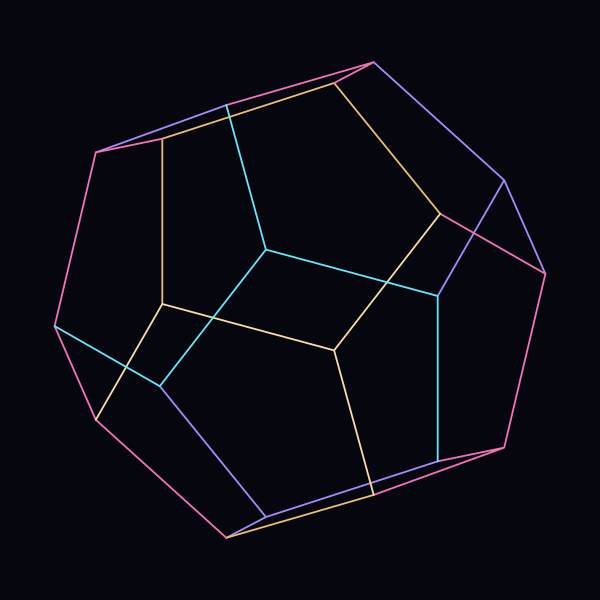
Twelve pentagons, woven from the golden ratio. Plato said the god used it “for arranging the constellations on the whole heaven”.
- Vertices
- 20
- Edges
- 30
- Faces
- 12
- Dihedral
- 116.57°
Turn it in your hands, strike it to hear the chord of its edges, slice it with a plane or lift it into four dimensions.
Facts
- Each face is a regular pentagon, whose diagonals are φ times its edge.
- Five cubes fit inside it, each using 8 of its 20 corners, so every corner is shared by two cubes.
- Its dual is the icosahedron.
- Its 4D cousin, the 120-cell, is made of 120 dodecahedra.
Measures
With every edge one unit long. For another edge, multiply the lengths by it, the areas by its square and the volumes by its cube.
- Circumradius (center to corner)
- 1.4013
- Midradius (center to edge)
- 1.3090
- Inradius (center to face)
- 1.1135
- Surface area
- 20.6457
- Volume
- 7.6631
- Dihedral angle
- 116.57°
- Symmetries
- 120 (icosahedral, Ih)
History and meaning
Plato says nothing more about it. Today it is often paired with aether, Aristotle’s fifth element of the heavens, though Aristotle never made the match. About 130 hollow bronze dodecahedra survive from Roman Gaul and its neighbors (2nd to 4th century CE); what they were for is still unknown.
Across the dimensions
- Cell of 120-CellBend 120 dodecahedra through the fourth dimension, three around every edge, and they close up: the 120-cell.
- Dual Icosahedron
Learn it step by step
- Journey The Golden ThreadStep 8: The dodecahedron
Read further
- Guide The five Platonic solidsAll five side by side: their faces, duals and angles, why there are only five, and what Plato, Euclid and Kepler made of them.