Journey 2 of 10 · 9 steps
The Golden Thread
φ from stars to sunflowers
One number, φ ≈ 1.618, links the pentagram, the spiral, the sunflower and the icosahedron, and runs on into four dimensions.
In the app each step moves: figures draw themselves, rise from the page, turn and slice, and the narration can be read aloud. Here they are held still, one picture each.
-
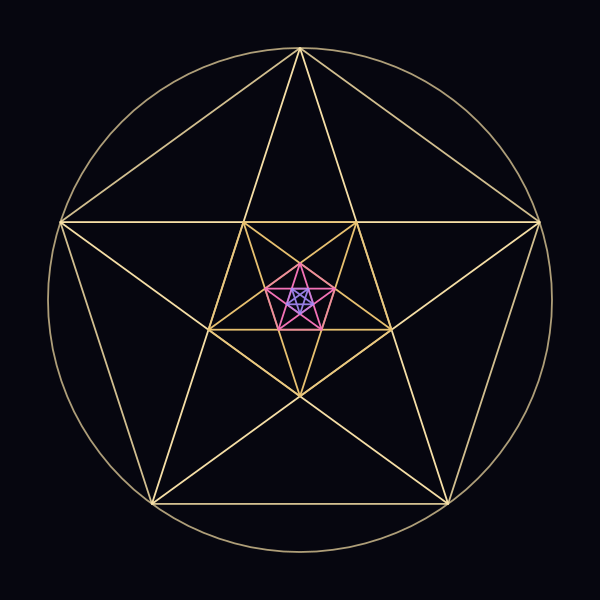
Step 1 · Pentagram
The golden cut
Where two lines of a pentagram cross, each is cut so that the whole is to the long part as the long part is to the short. That ratio is φ = (1 + √5) ÷ 2 ≈ 1.618. Inside the star is a pentagon, inside that another star, without end.
-
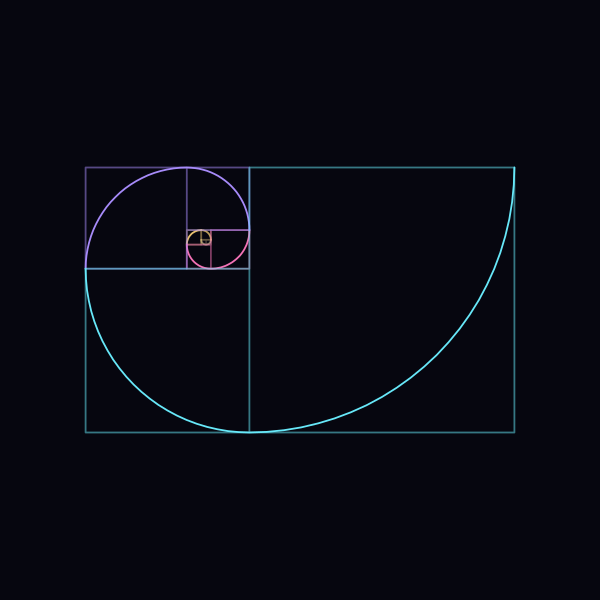
Step 2 · Golden Spiral
Squares that grow
Squares with sides 1, 1, 2, 3, 5, 8, 13…, each the sum of the two before. Their ratios close in on φ, and a quarter circle in each square traces a near twin of the golden spiral.
-
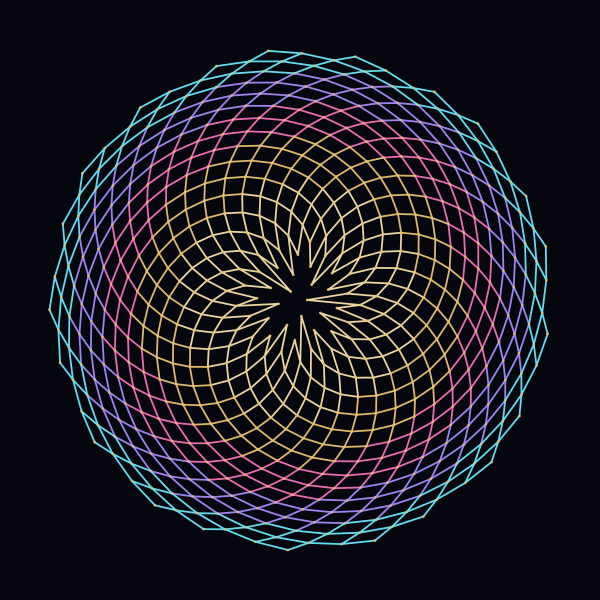
Step 3 · Phyllotaxis
The golden angle
In a sunflower head each new seed sits about 137.5° around from the last: a full turn divided by φ². The lines pick out the spirals this makes, 21 one way and 34 the other: neighboring Fibonacci numbers.
-

Step 4 · Phyllotaxis
Why exactly that angle?
Let the angle drift by under a degree either way. Most angles line the seeds up in spokes with gaps. Near 137.5° they pack evenly, because φ is the number hardest to approximate by fractions.
-
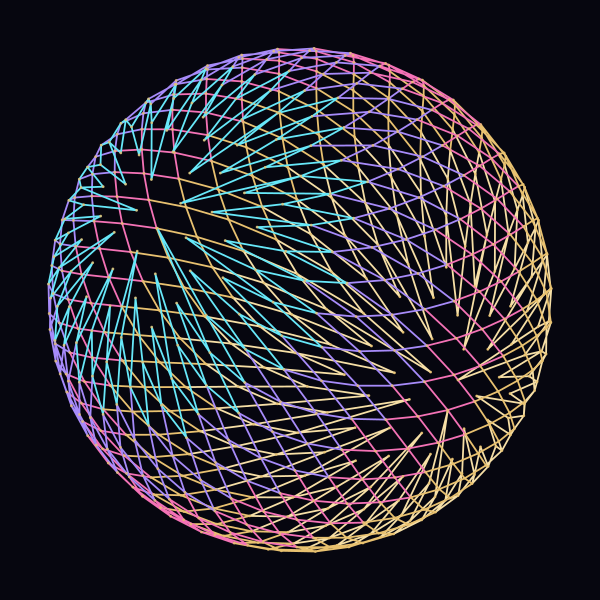
Step 5 · Fibonacci Sphere
A golden sphere
From above, a sunflower again. It rises into a ball: the same golden step, wound down a sphere, spreads points over it almost perfectly evenly.
-
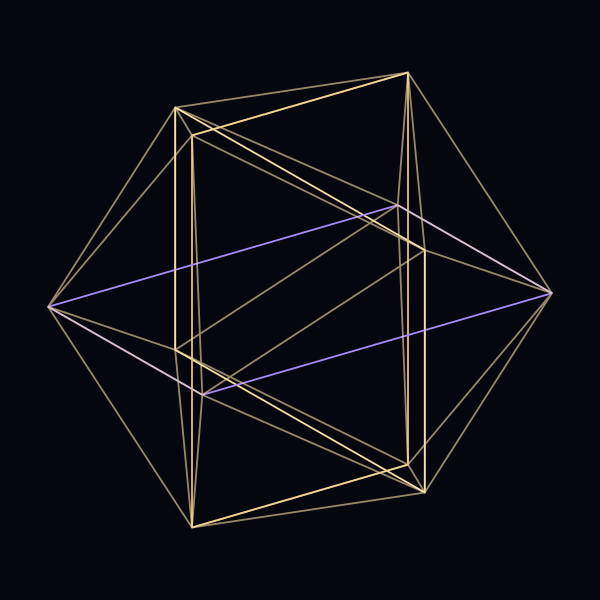
Step 6 · Golden Rectangles
Three golden rectangles
Three rectangles with sides in the ratio 1 : φ, set at right angles through one another. Their twelve corners…
-
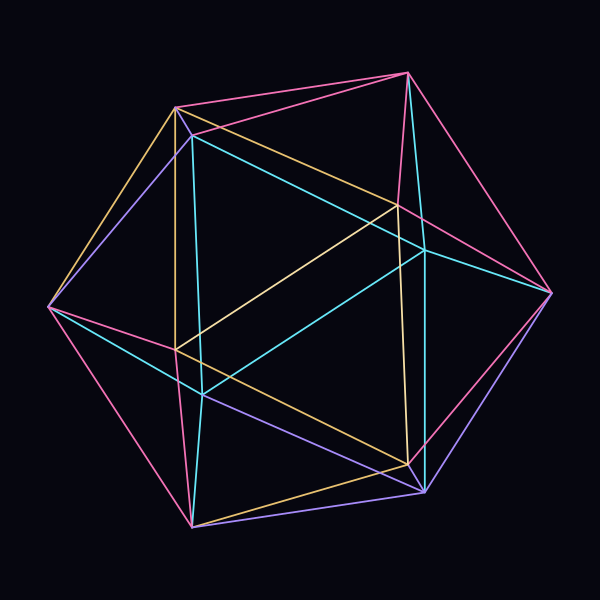
Step 7 · Icosahedron
…are the icosahedron
…are exactly the twelve corners of the icosahedron, Plato’s solid for water. Every coordinate is 0, ±1 or ±φ.
-
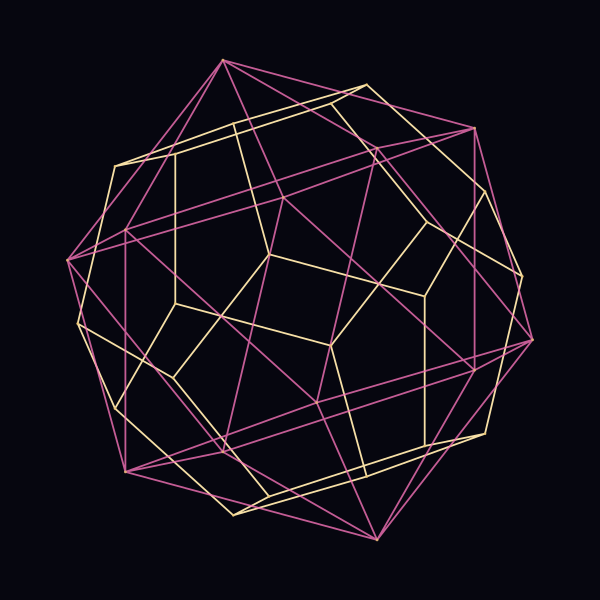
Step 8 · Dodecahedron
The dodecahedron
The icosahedron’s dual, drawn with it here, is the dodecahedron: twelve pentagons, each with diagonals φ times its edge. Plato wrote that the god used it for the whole heaven.
-
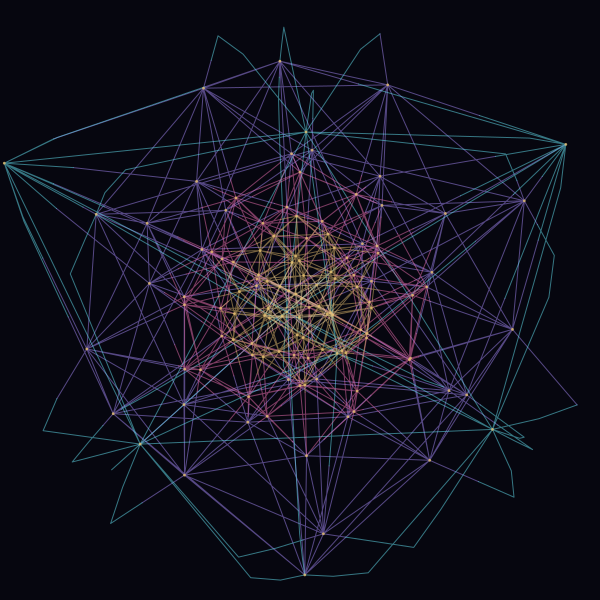
Step 9 · 600-Cell
Into hyperspace
In four dimensions the icosahedron’s counterpart is the 600-cell: 120 corners, 600 tetrahedra, and edges 1/φ of its radius. Here the thread ends: above four dimensions, no regular shape is built on φ.