Spheres & Flow · 3D
Fibonacci Sphere
The golden angle wrapped around a ball
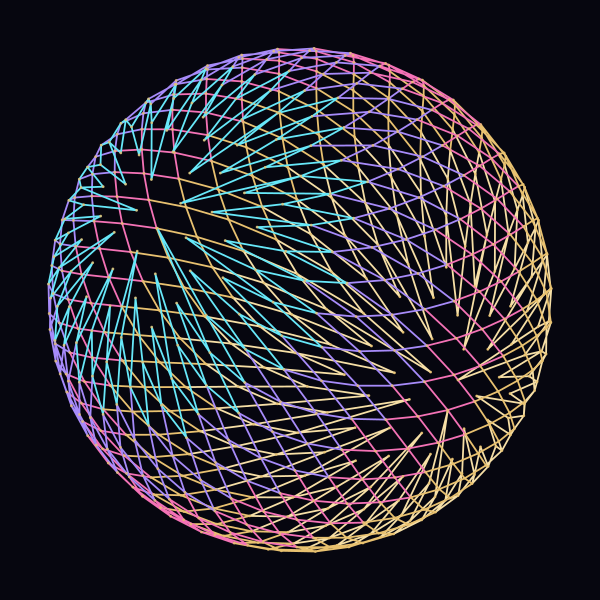
Points spiraling down a sphere, each a golden angle past the last. They spread almost perfectly evenly, and from the pole you see a sunflower.
- Step
- 137.5°
- Evenness
- near optimal
Turn it in your hands, strike it to hear the chord of its edges, and slice it with a plane.
Facts
- It is used to spread points evenly over a globe for maps, lighting and simulations.
- Point i of n sits at height z = 1 − (2i + 1)/n, on the circle of radius √(1 − z²), turned i golden angles (π(3 − √5) ≈ 137.5°) about the axis. Equal steps in height cut equal areas from a sphere (Archimedes’ hat-box theorem), so each point gets an equal share.
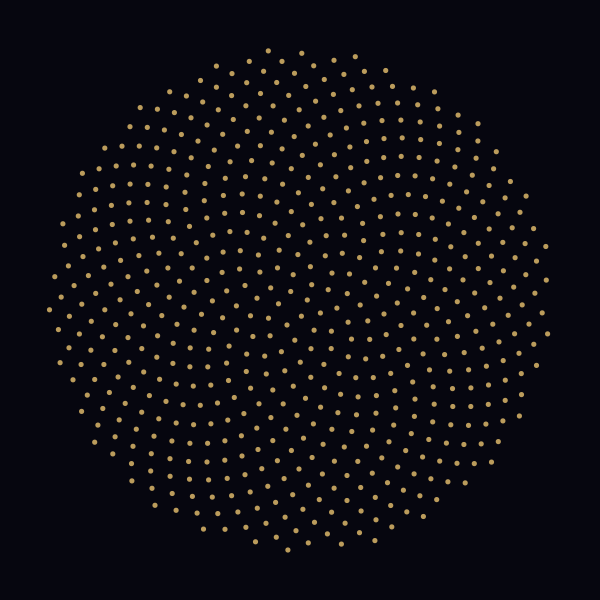
- Look from the top (flatten to 2D) and it becomes phyllotaxis.
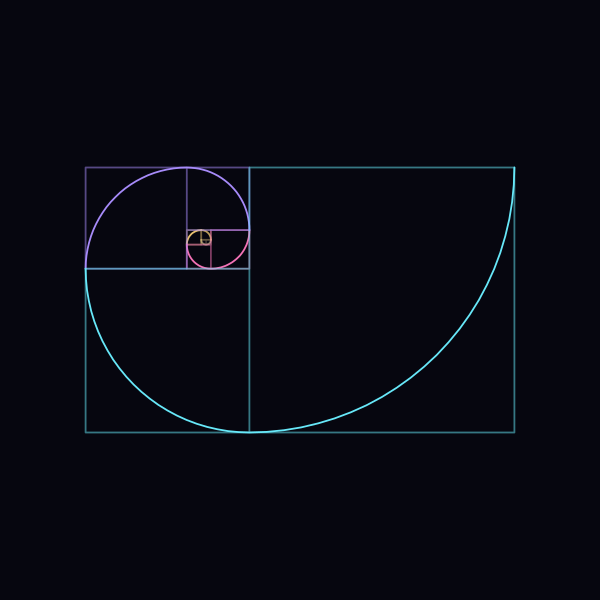
- The threads follow Fibonacci neighbors, just like sunflower spirals.
The algorithm
To place n points almost evenly on a sphere, step down it in equal heights and turn by the golden angle, about 137.51°, at each step. In JavaScript, for a sphere of radius 1:
const golden = Math.PI * (3 - Math.sqrt(5)); // ≈ 137.51°
function fibonacciSphere(n) {
  const points = [];
  for (let i = 0; i < n; i++) {
    const z = 1 - (2 * i + 1) / n;     // equal steps in height
    const r = Math.sqrt(1 - z * z);    // radius of the circle at that height
    const a = i * golden;              // turn by the golden angle
    points.push([r * Math.cos(a), r * Math.sin(a), z]);
  }
  return points;
}
Equal steps in height cut the sphere into bands of equal area, by Archimedes’ hat-box theorem, so each point gets an equal share of the surface. The golden angle is the turn least like any simple fraction of a circle, so the points never settle into spokes: the same reason a sunflower packs its seeds with it.
Why it beats a grid
A grid of latitude and longitude crowds its points at the poles and spreads them at the equator. The Fibonacci lattice gives each point almost exactly the same area: Álvaro González showed in 2010 that measuring areas on the globe with it cuts the error of a latitude–longitude grid with as many points by at least 40%. It is used to sample the Earth evenly in geoscience and to spread directions evenly over a sphere in computer graphics.
Across the dimensions
- Its shadow PhyllotaxisWrap the sunflower around a ball: the golden angle spreads points almost evenly over a sphere.
Learn it step by step
- Journey The Golden ThreadStep 5: A golden sphere