Ratio & Proportion · 2D
Golden Spiral
Fibonacci squares and quarter arcs
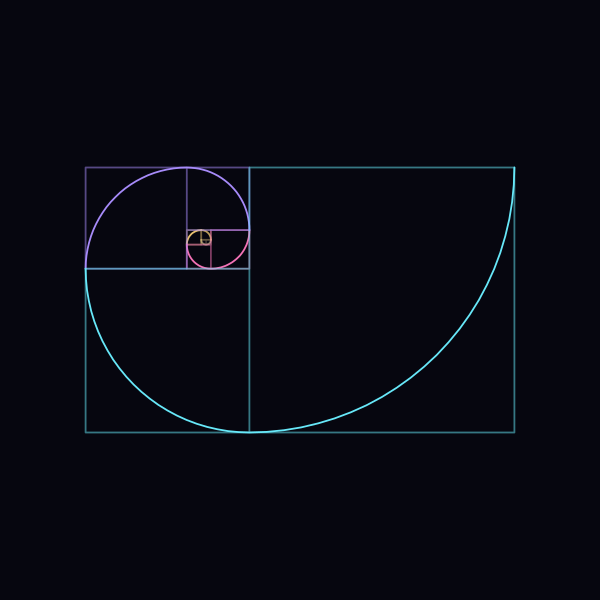
Squares whose sides follow the Fibonacci numbers, each with a quarter circle. The spiral widens by about φ every quarter turn.
- Growth / turn
- φ⁴ ≈ 6.85
- Fₙ₊₁ ÷ Fₙ
- → φ
Watch it draw itself line by line, hear the chord of its lines, and slide the Dimension dial to raise its form in space.
Facts
- Fibonacci: 1, 1, 2, 3, 5, 8, 13, …: each number is the sum of the two before.
- The ratio of neighbors closes in on φ ≈ 1.618: 8 ÷ 5 = 1.6, 13 ÷ 8 = 1.625, 21 ÷ 13 ≈ 1.615.
- Made of quarter circles, this spiral only approximates the true golden spiral, a logarithmic spiral that grows smoothly.
- Remove a square from a golden rectangle and a smaller golden rectangle remains.
- Nautilus shells are logarithmic spirals too, but usually not with the golden growth rate.
History and meaning
Leonardo of Pisa (Fibonacci) brought the sequence to Europe in his Liber Abaci of 1202, through a puzzle about breeding rabbits. Indian scholars of poetic meter had found it centuries earlier. It took Fibonacci’s name only in the 19th century, from Édouard Lucas.
Golden spiral or Fibonacci spiral?
They are not quite the same. A true golden spiral is a logarithmic spiral that grows by exactly φ ≈ 1.618 every quarter turn, and so by φ⁴ ≈ 6.854 every full turn, with its curvature changing smoothly all the way. The Fibonacci spiral drawn here is its familiar approximation: a quarter circle in each square of a Fibonacci tiling, which jumps in curvature where one square meets the next. As the squares grow, the ratio of neighboring Fibonacci numbers approaches φ, and the Fibonacci spiral comes ever closer to the golden one.
Is it found in nature?
Less often than is claimed. The nautilus shell is a logarithmic spiral, but it widens about 3 times a turn, not the golden spiral’s 6.9. The arms of spiral galaxies are often modeled as logarithmic spirals, but their pitch changes with distance from the center. The sunflower’s spirals come from the golden angle between successive seeds, and are closer to Fermat’s spiral than to any logarithmic one: the golden ratio is in the angle, not in the spiral’s growth.
Across the dimensions
- Slice of Golden ShellThe spiral gains a body that widens by φ every quarter turn: a shell whose middle slice is the flat spiral.
Learn it step by step
- Construct it The Golden CutDivide AB at G so that AB : AG = AG : GB.
- Construct it Golden RectangleExtend the square into a golden rectangle.
- Journey The Golden ThreadStep 2: Squares that grow
- Journey The Plane RisesStep 7: A shell