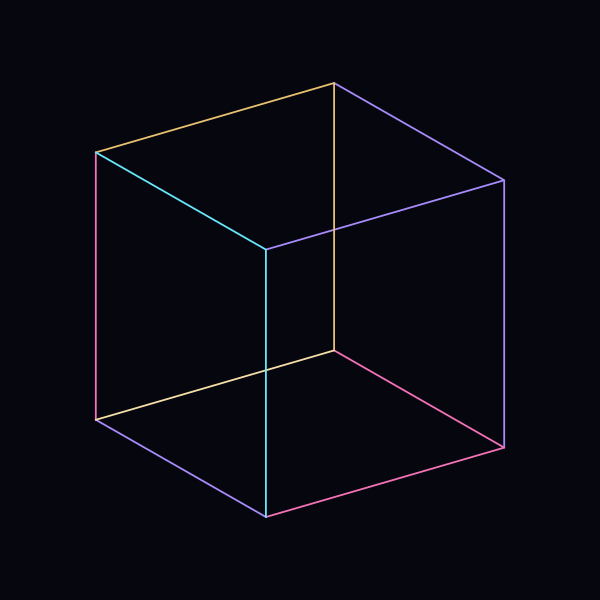
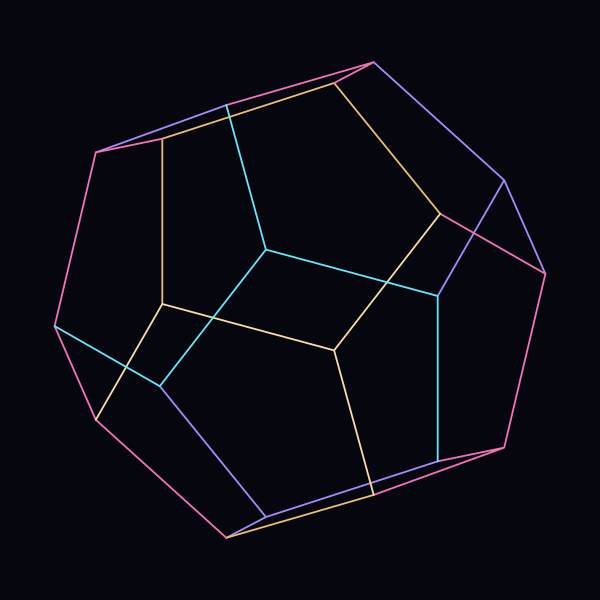
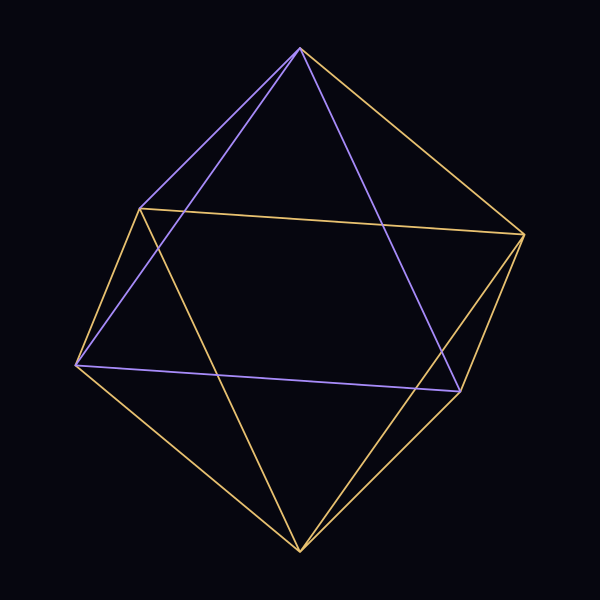
Cosmos · 3D
Kepler’s Cosmic Mystery
Mysterium Cosmographicum, 1596
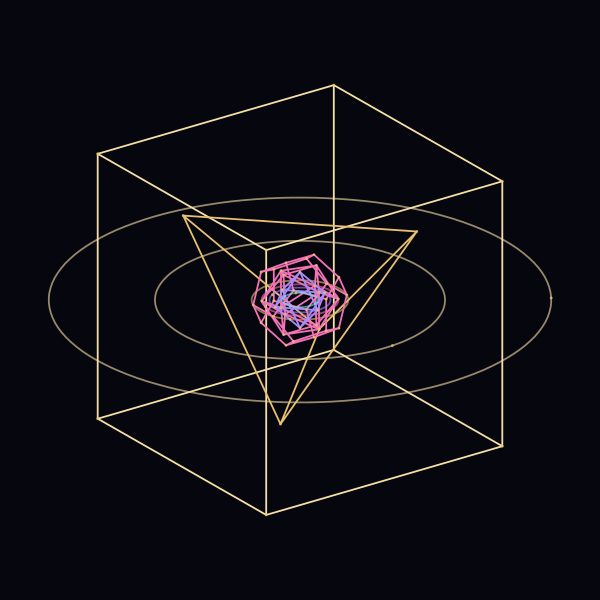
Young Kepler’s dream: the five Platonic solids nested between the orbits of the six known planets, each held between an inner and outer sphere.
- Solids
- 5
- Planets
- 6
- Year
- 1596
Turn it in your hands, strike it to hear the chord of its edges, and slice it with a plane.
Facts
- Order from outside: Saturn, cube, Jupiter, tetrahedron, Mars, dodecahedron, Earth, icosahedron, Venus, octahedron, Mercury.
- Each solid touches the sphere outside at its corners and the sphere inside at its face centers. For Mercury Kepler bent the rule and used the circle inside the octahedron’s middle square, which fit better.
- The sizes came out within about 10% of the measured orbits for most planets.
- Kepler never gave it up (he reissued the book with notes in 1621), but it was his laws of elliptical orbits that proved right.
History and meaning
Kepler believed he had glimpsed God’s geometric plan for the heavens. The model was wrong, but trying to make it fit sent him to Tycho Brahe’s observations, and from them to the true laws of planetary motion.
Read further
- Guide Planetary dancesRoses drawn between two planets on their real orbits, from the pentagram of Venus to the Great Conjunctions.