Platonic Solids · 3D
Octahedron
{3,4} · Air
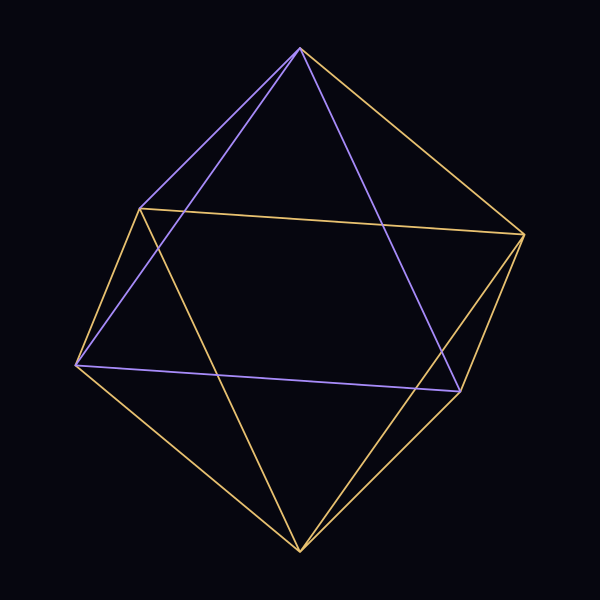
Eight triangles: two square pyramids base to base. Plato gave it to air, which he placed between fire and water in sharpness and mobility.
- Vertices
- 6
- Edges
- 12
- Faces
- 8
- Dihedral
- 109.47°
Turn it in your hands, strike it to hear the chord of its edges, slice it with a plane or lift it into four dimensions.
Facts
- Seen straight down onto a face, its shadow is a hexagram inside a hexagon.
- Its dual is the cube; together they form a compound whose edges cross at right angles.
- Fuller’s Jitterbug folds down to it: the vector equilibrium twists through the icosahedron into the octahedron.
- Crystals of magnetite, diamond and fluorite often grow as octahedra.
Measures
With every edge one unit long. For another edge, multiply the lengths by it, the areas by its square and the volumes by its cube.
- Circumradius (center to corner)
- 0.7071
- Midradius (center to edge)
- 0.5000
- Inradius (center to face)
- 0.4082
- Surface area
- 3.4641
- Volume
- 0.4714
- Dihedral angle
- 109.47°
- Symmetries
- 48 (octahedral, Oh)
History and meaning
In the Timaeus the element solids can break apart into their triangles and regroup. One particle of air, eight triangles, splits into two particles of fire, four triangles each.
Across the dimensions
Learn it step by step
- Journey GenesisStep 9: The octahedron
- Journey The Breathing SolidStep 6: Octahedron
Read further
- Guide The five Platonic solidsAll five side by side: their faces, duals and angles, why there are only five, and what Plato, Euclid and Kepler made of them.