Regular Polytopes · 4D
16-Cell
{3,3,4} · the 4D cross-polytope
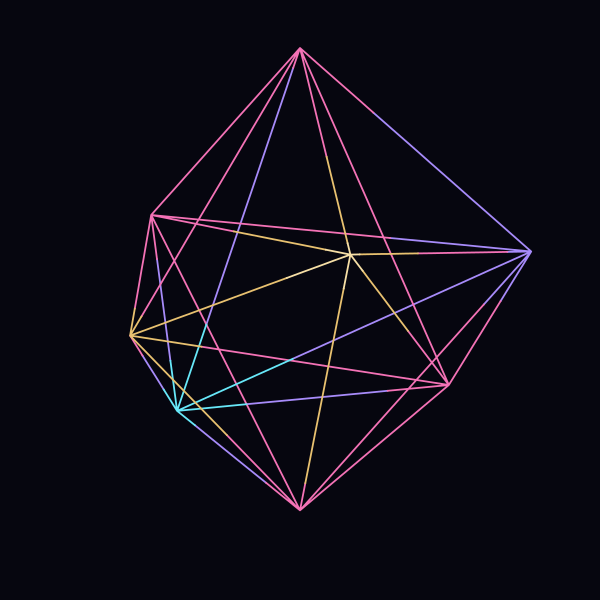
One point at each end of four perpendicular axes. The 4D octahedron, bounded by sixteen tetrahedra.
- Vertices
- 8
- Edges
- 24
- Faces
- 32
- Cells
- 16
Watch it turn through the fourth dimension, hear the chord of its edges, and slice it with our space to see it pass through.
Facts
- Every vertex joins every other except its opposite.
- Its shadow along W is an octahedron with two points at the center.
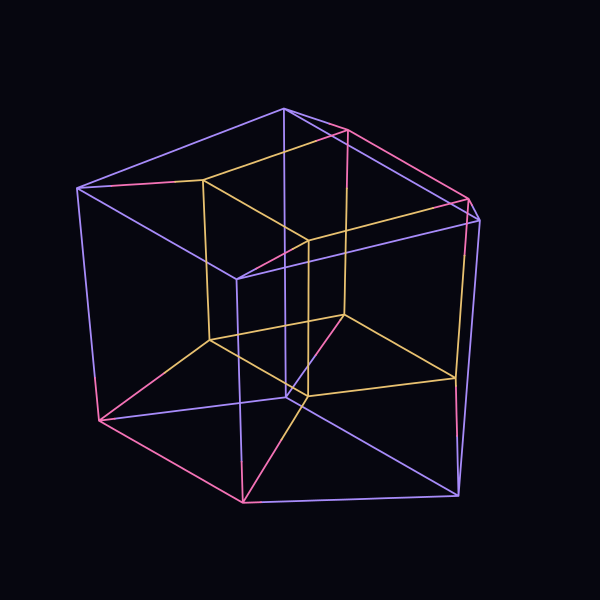
- Its dual is the tesseract.
Measures
With every edge one unit long. For another edge, multiply the lengths by it, the areas by its square and the volumes by its cube (the hypervolume by its fourth power).
- Circumradius (center to corner)
- 0.7071
- Inradius (center to cell)
- 0.3536
- Dihedral angle between cells
- 120.00°
- Volume of its 16 cells
- 1.8856
- Hypervolume (4D content)
- 0.1667
- Symmetries
- 384 (B4)
Across the dimensions
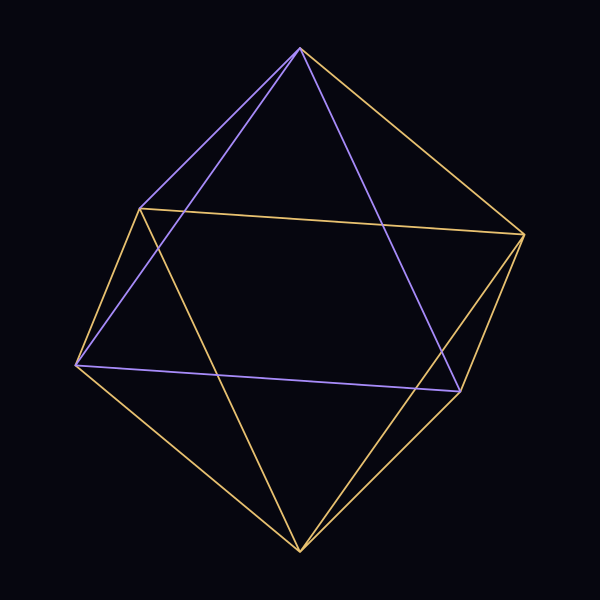
- Its equator OctahedronAdd two points on a fourth axis, one each side, joined to all six corners: the 16-cell.
- Dual Tesseract
Learn it step by step
- Journey Into the Fourth DimensionStep 7: The 16-cell
Read further
- Guide 4D shapesThe six regular shapes of four dimensions and more, and how to see them by their shadows, slices and unfoldings.