Regular Polytopes · 4D
Tesseract
{4,3,3} · the hypercube
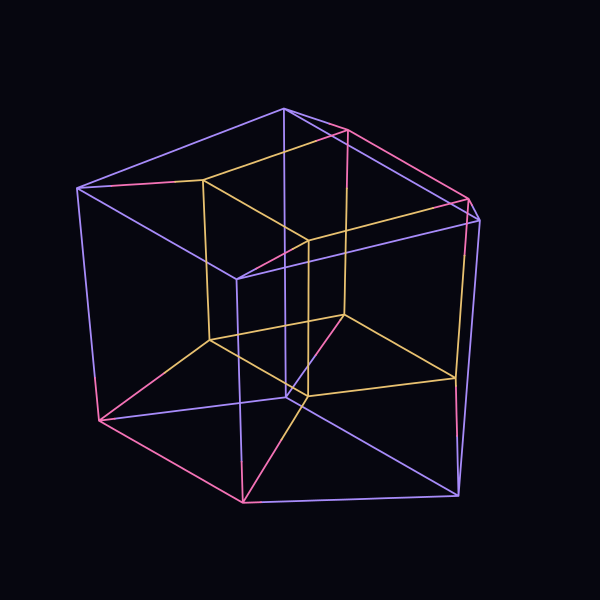
A cube swept through a fourth direction. In perspective it is a cube inside a cube; rotate it through W and the inside turns out.
- Vertices
- 16
- Edges
- 32
- Faces
- 24
- Cells
- 8
Watch it turn through the fourth dimension, hear the chord of its edges, and slice it with our space to see it pass through.
Facts
- Square: 4 corners. Cube: 8. Tesseract: 16. Each dimension doubles them.
- It is bounded by 8 cubes, just as a cube is bounded by 6 squares.
- Four edges meet at every corner, hence the name: Greek for “four rays”.
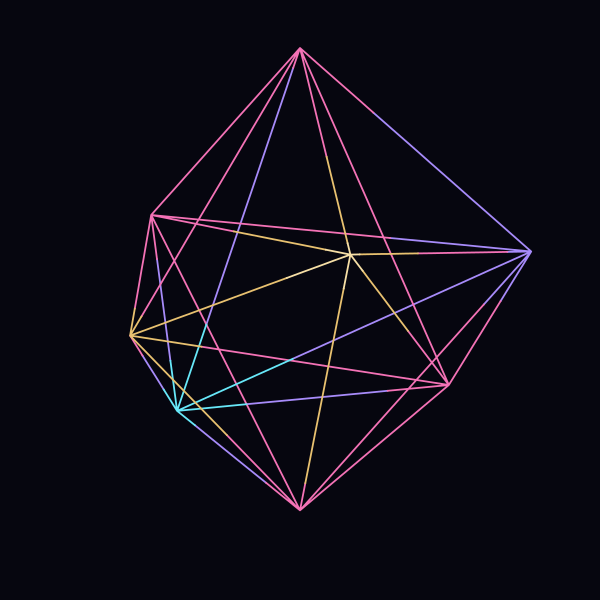
- Its dual is the 16-cell.
Measures
With every edge one unit long. For another edge, multiply the lengths by it, the areas by its square and the volumes by its cube (the hypervolume by its fourth power).
- Circumradius (center to corner)
- 1.0000
- Inradius (center to cell)
- 0.5000
- Dihedral angle between cells
- 90.00°
- Volume of its 8 cells
- 8.0000
- Hypervolume (4D content)
- 1.0000
- Symmetries
- 384 (B4)
History and meaning
Charles Howard Hinton coined the word in A New Era of Thought (1888), and trained himself to “see” the fourth dimension with sets of colored cubes. Salvador Dalí painted Christ on its unfolded net.
Across the dimensions
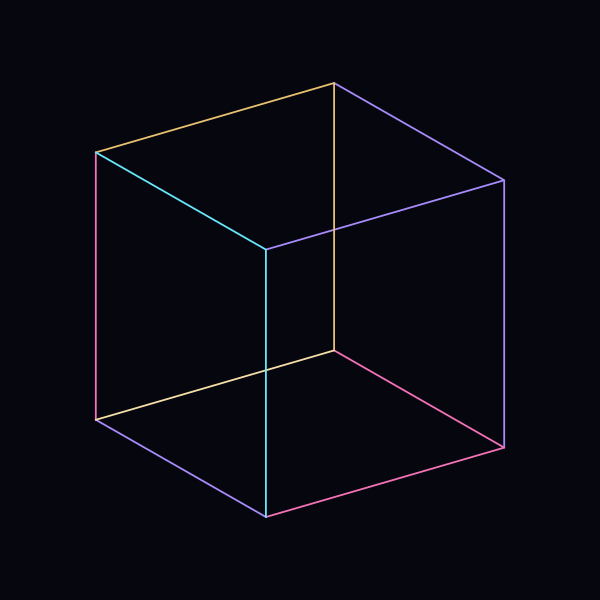
- Its cell CubeDrag the cube through the fourth direction: the tesseract. Squash W flat and the cube returns.
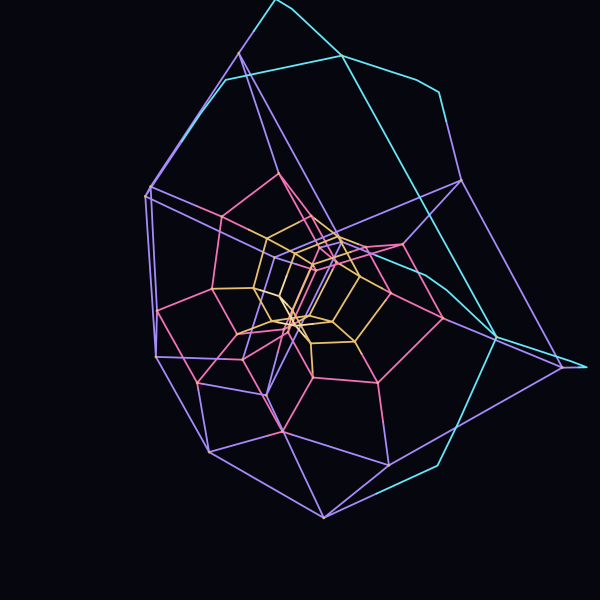
- Its shadow Rhombic DodecahedronLook at the tesseract corner-first and its shadow is exactly the rhombic dodecahedron.
- Dual 16-Cell
Learn it step by step
- Journey Into the Fourth DimensionStep 3: Now do it again
- Journey FlatlandStep 4: A cube that appears
Read further
- Guide 4D shapesThe six regular shapes of four dimensions and more, and how to see them by their shadows, slices and unfoldings.