Regular Polytopes · 4D
5-Cell
{3,3,3} · the 4D simplex
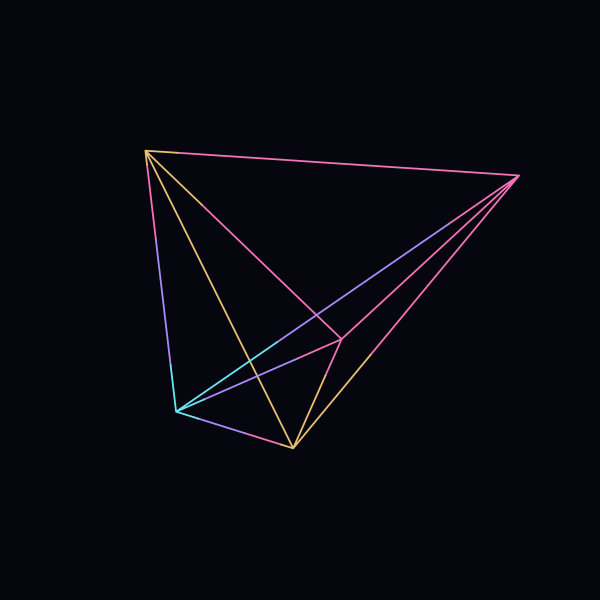
Five points, each joined to every other: the simplest shape in four dimensions, bounded by five tetrahedra.
- Vertices
- 5
- Edges
- 10
- Faces
- 10
- Cells
- 5
Watch it turn through the fourth dimension, hear the chord of its edges, and slice it with our space to see it pass through.
Facts
- Point → segment → triangle → tetrahedron → 5-cell: add one point, join it to all.
- Every pair of its 5 vertices is joined: seen from the right side, it is a pentagram inside a pentagon.
- It is its own dual. Its other name, pentachoron, means “five rooms”.
Measures
With every edge one unit long. For another edge, multiply the lengths by it, the areas by its square and the volumes by its cube (the hypervolume by its fourth power).
- Circumradius (center to corner)
- 0.6325
- Inradius (center to cell)
- 0.1581
- Dihedral angle between cells
- 75.52°
- Volume of its 5 cells
- 0.5893
- Hypervolume (4D content)
- 0.0233
- Symmetries
- 120 (A4)
The simplest shape in four dimensions
The 5-cell, also called the pentachoron, pentatope or 4-simplex, is to four dimensions what the triangle is to the plane and the tetrahedron to space: the fewest corners that can enclose a region. Its 5 vertices are each joined to all the others, giving 10 edges and 10 triangular faces, and every 4 vertices bound one of its 5 tetrahedral cells. It is its own dual, and the first of the six regular convex shapes of four dimensions, which Ludwig Schläfli found in a treatise of 1850 to 1852 that was published only in 1901, after his death. See all six.
Across the dimensions
- Its cell TetrahedronAdd a fifth point in the fourth direction, joined to all four: the 5-cell, with this tetrahedron as one of its five cells.
- Dual Itself: it is self-dual.
Learn it step by step
- Journey Into the Fourth DimensionStep 6: The simplest
- Journey FlatlandStep 6: The 5-cell
Read further
- Guide 4D shapesThe six regular shapes of four dimensions and more, and how to see them by their shadows, slices and unfoldings.