Platonic Solids · 3D
Tetrahedron
{3,3} · Fire
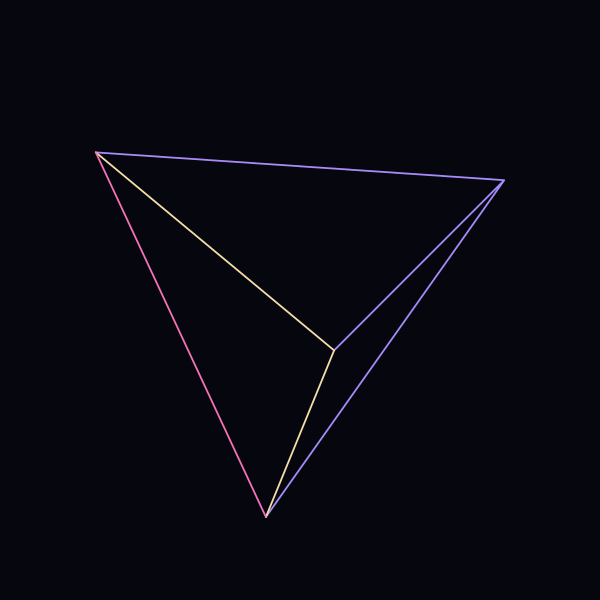
Four triangles: the simplest solid, and the simplest frame that cannot be pushed out of shape. Plato gave it to fire, for its sharp points.
- Vertices
- 4
- Edges
- 6
- Faces
- 4
- Dihedral
- 70.53°
Turn it in your hands, strike it to hear the chord of its edges, slice it with a plane or lift it into four dimensions.
Facts
- It is its own dual: put a corner at the center of each face and you get another tetrahedron.
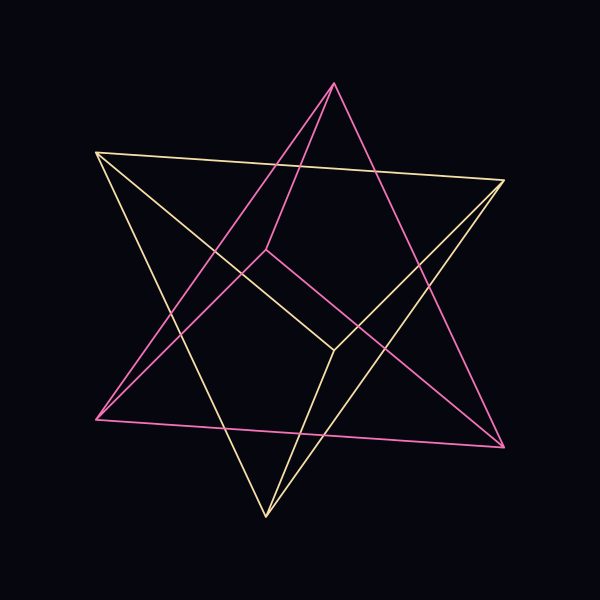
- Two interlocked tetrahedra make the star tetrahedron, often called the Merkaba.
- Seen straight down one corner, its shadow is a triangle with a “Y” inside.
- The four bonds of a carbon atom in methane (CH₄) and in diamond point to the corners of a tetrahedron.
Measures
With every edge one unit long. For another edge, multiply the lengths by it, the areas by its square and the volumes by its cube.
- Circumradius (center to corner)
- 0.6124
- Midradius (center to edge)
- 0.3536
- Inradius (center to face)
- 0.2041
- Surface area
- 1.7321
- Volume
- 0.1179
- Dihedral angle
- 70.53°
- Symmetries
- 24 (tetrahedral, Td)
History and meaning
In the Timaeus (about 360 BCE) Plato built the four elements from regular solids. Fire is the tetrahedron: fewest faces, so the lightest, sharpest and most mobile, able to cut its way through everything else.
Across the dimensions
- Cell of 5-CellAdd a fifth point in the fourth direction, joined to all four: the 5-cell, with this tetrahedron as one of its five cells.
- Dual Itself: it is self-dual.
Learn it step by step
- Journey FlatlandStep 3: A square in a tetrahedron
Read further
- Guide The five Platonic solidsAll five side by side: their faces, duals and angles, why there are only five, and what Plato, Euclid and Kepler made of them.