Platonic Solids · 3D
Cube
{4,3} · Earth
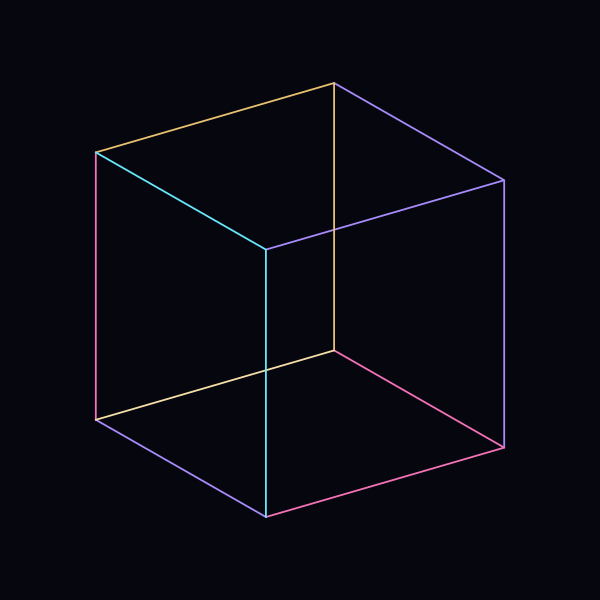
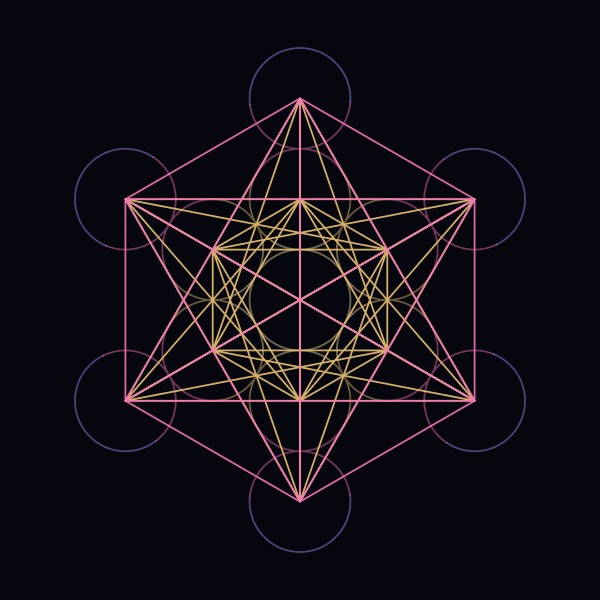
Six squares, stable and grounded. Seen down a corner it becomes a hexagon: the cube hidden in Metatron’s Cube.
- Vertices
- 8
- Edges
- 12
- Faces
- 6
- Dihedral
- 90°
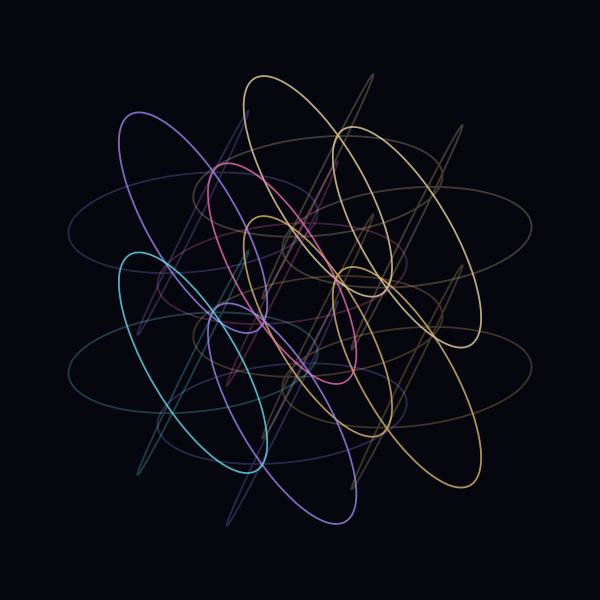
Turn it in your hands, strike it to hear the chord of its edges, slice it with a plane or lift it into four dimensions.
Facts
- Seen corner-on, its near and far corners meet in the middle and its shadow is a regular hexagon cut into six triangles.
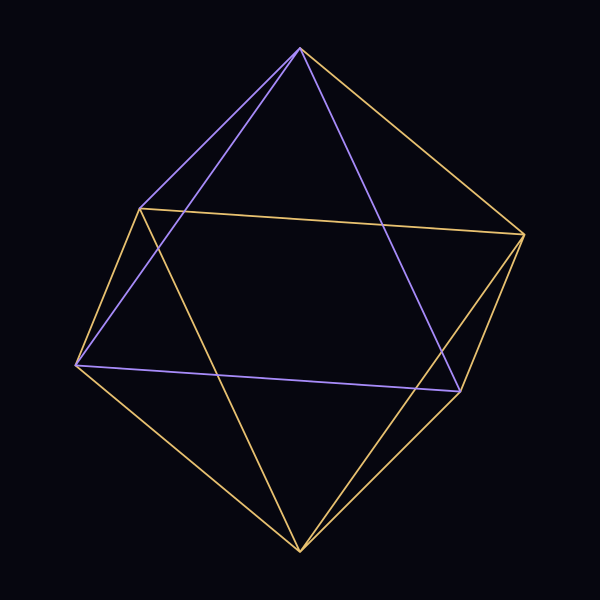
- Its dual is the octahedron: put a corner at the center of each face.
- Two tetrahedra fit inside it, each using alternate corners: together they make the star tetrahedron.
- It is the only Platonic solid that fills space by itself.
Measures
With every edge one unit long. For another edge, multiply the lengths by it, the areas by its square and the volumes by its cube.
- Circumradius (center to corner)
- 0.8660
- Midradius (center to edge)
- 0.7071
- Inradius (center to face)
- 0.5000
- Surface area
- 6.0000
- Volume
- 1.0000
- Dihedral angle
- 90.00°
- Symmetries
- 48 (octahedral, Oh)
History and meaning
Plato gave the cube to earth, the hardest element to move. Its squares are built from a different right triangle than the faces of the other three element solids, so in the Timaeus earth alone can never turn into another element.
Across the dimensions
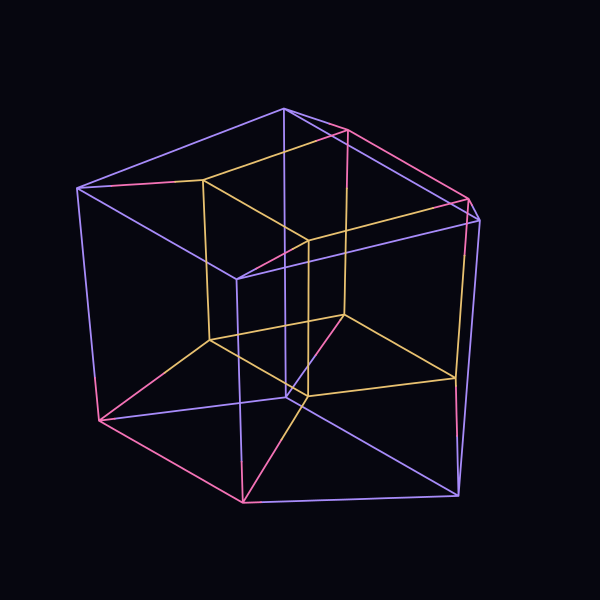
- Cell of TesseractDrag the cube through the fourth direction: the tesseract. Squash W flat and the cube returns.
- Dual Octahedron
Learn it step by step
- Journey GenesisStep 7: The hidden cube
- Journey Into the Fourth DimensionStep 1: A square
- Journey FlatlandStep 1: A square that appears
- Journey Sound Made VisibleStep 5: Shapes that ring
- Journey The Archimedean FamilyStep 1: A cube and its dual
Read further
- Guide The five Platonic solidsAll five side by side: their faces, duals and angles, why there are only five, and what Plato, Euclid and Kepler made of them.