Transformations · 3D
The Jitterbug
Vector equilibrium → icosahedron → octahedron
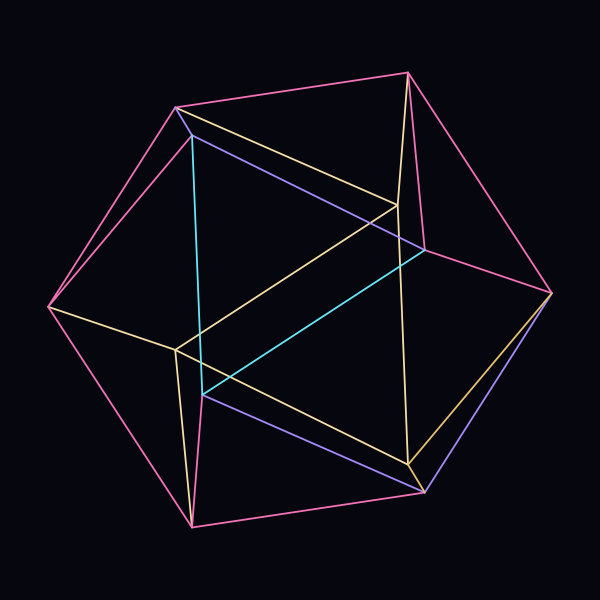
Buckminster Fuller’s pulsing structure: the twelve corners of the vector equilibrium twist and close in, through the icosahedron, down to the octahedron.
- Triangles
- 8
- Edges
- 24
- Edge length
- constant
Turn it in your hands, strike it to hear the chord of its edges, and slice it with a plane.
Facts
- The eight triangles never change size: they only turn and move inward, on hinged corners.
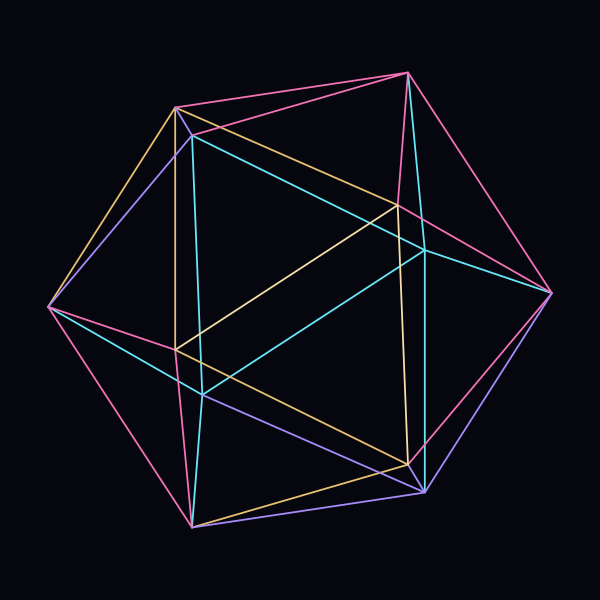
- At phase ≈ 0.382 (= 1 − 1/φ) the twelve corners form a perfect icosahedron.
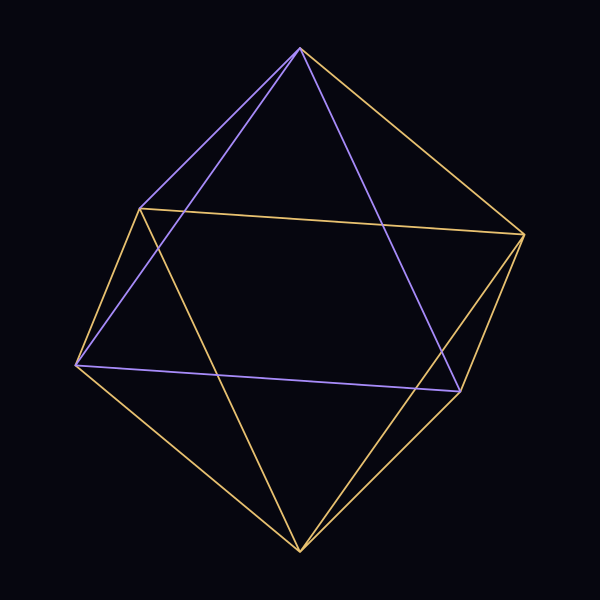
- At the end the corners meet in pairs, twelve becoming six: the octahedron.
- Fuller saw the vector equilibrium as nature’s zero point: the balance from which every form contracts.
History and meaning
Fuller found it in the late 1940s, twisting a model with rigid struts and rubber joints, and named it after the dance of the day. He built much of his synergetic geometry around it.
Learn it step by step
- Journey The Breathing SolidStep 3: Equilibrium