Transformations · 3D
Dodecahedron to Icosahedron
Truncation through the golden solids

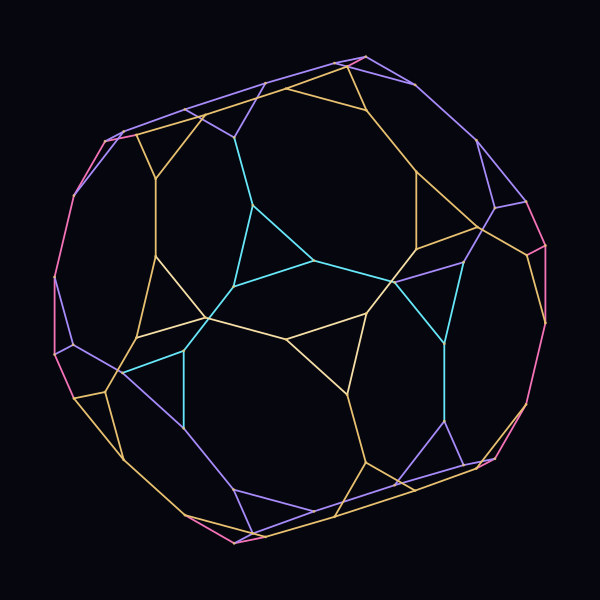
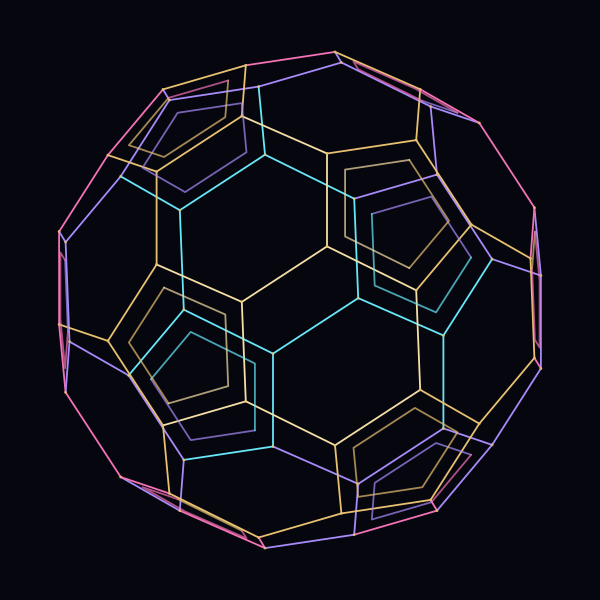
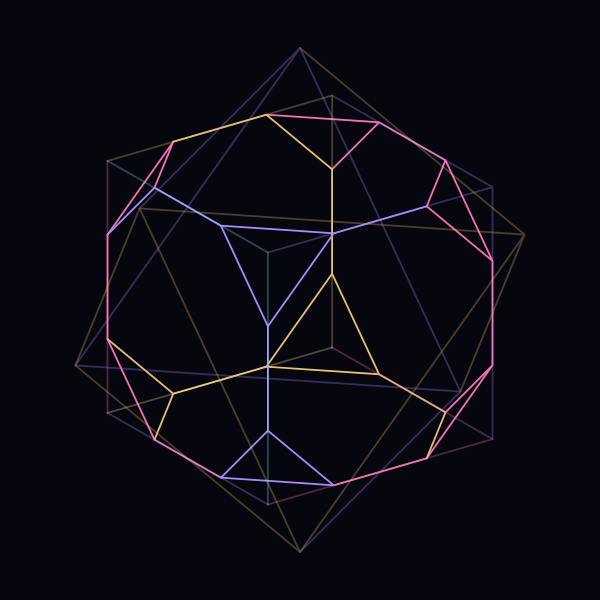
The golden version: cut the dodecahedron’s corners and its pentagons turn to decagons and back, while the cut corners grow through the soccer ball’s hexagons into the icosahedron’s faces.
- Solids
- 5
- Archimedean
- 3
- Symmetries
- 120
Turn it in your hands, strike it to hear the chord of its edges, and slice it with a plane.
Facts
- For regular decagons the first cut runs 1/(φ√5) ≈ 0.276 of the way along each edge.
- Two thirds of the way to the icosahedron it passes the truncated icosahedron: the soccer ball, and the cage of the carbon-60 molecule.
- The dodecahedron and the icosahedron are duals: cut either all the way and you reach the other.
- At the midpoint the icosidodecahedron’s edges form six great decagons.
History and meaning
Kepler drew these cut solids in Harmonices Mundi (1619), the book in which he also stated his third law of planetary motion.
Learn it step by step
- Journey The Archimedean FamilyStep 10: The golden family