Archimedean Solids · 3D
Truncated Icosahedron
The buckyball · 5.6.6
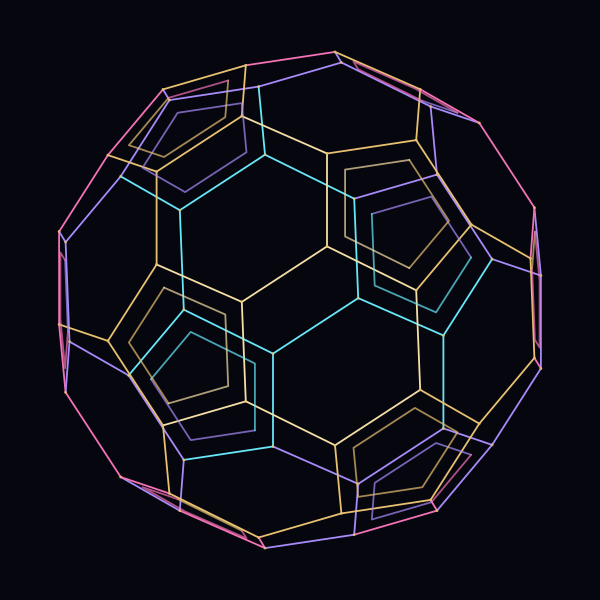
Slice every corner off an icosahedron a third of the way along each edge: twelve pentagons and twenty hexagons, the pattern of a soccer ball and of the carbon-60 molecule.
- Vertices
- 60
- Edges
- 90
- Faces
- 12 ⬟ + 20 ⬢
Turn it in your hands, strike it to hear the chord of its edges, and slice it with a plane.
Facts
- Every vertex joins one pentagon and two hexagons (5.6.6).
- Carbon-60, buckminsterfullerene, has an atom at each of its 60 corners. It was found in 1985 and won its discoverers the 1996 Nobel Prize in Chemistry.
- The black-and-white soccer ball took this pattern with Adidas’s Telstar at the 1970 World Cup.
- Its twelve pentagons sit exactly where the icosahedron’s corners were.
- Any ball-shaped cage of pentagons and hexagons, three at each corner, needs exactly twelve pentagons.
Measures
With every edge one unit long. For another edge, multiply the lengths by it, the areas by its square and the volumes by its cube.
- Circumradius (center to corner)
- 2.4780
- Midradius (center to edge)
- 2.4271
- Surface area
- 72.6073
- Volume
- 55.2877
- Dihedral angle, pentagon and hexagon
- 142.62°
- Dihedral angle, hexagon and hexagon
- 138.19°
- Symmetries
- 120 (icosahedral, Ih)
History and meaning
Piero della Francesca gave the first known picture and description of it in the 15th century, and Leonardo da Vinci drew it for Pacioli’s Divina proportione (1509). The C60 molecule was named after Buckminster Fuller because it resembles his geodesic domes.
Across the dimensions
- Dual The pentakis dodecahedron, which the app draws inside it.
Learn it step by step
- Journey The Archimedean FamilyStep 11: The soccer ball