Catalan Solids · 3D
Rhombic Triacontahedron
Thirty golden rhombi
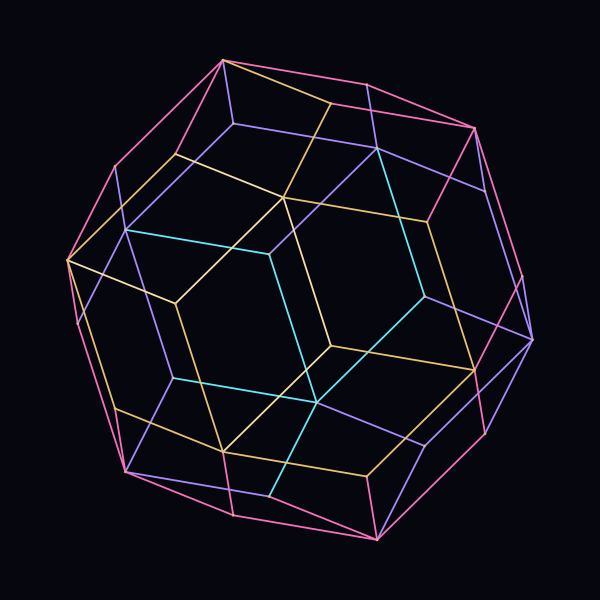
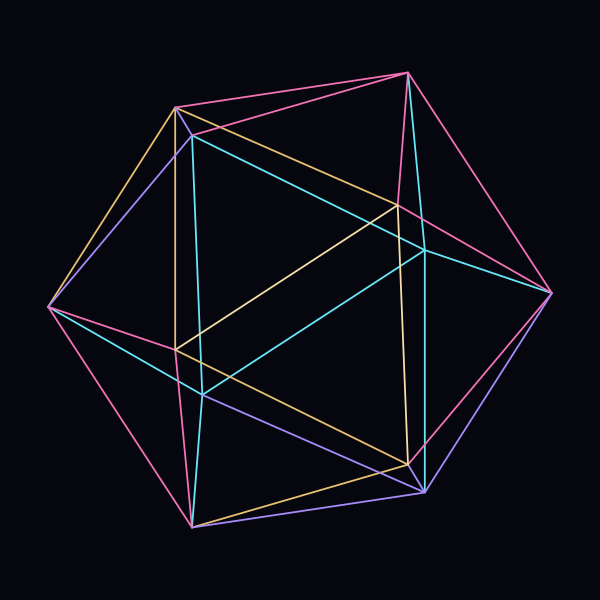
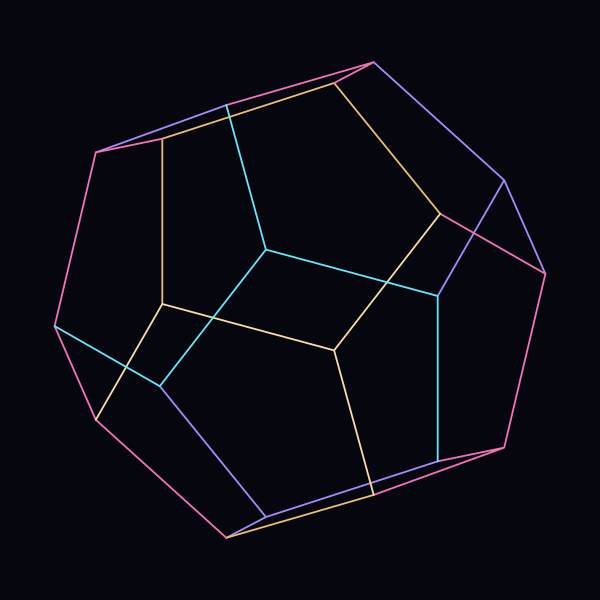
Thirty rhombi, each with diagonals in the golden ratio. Its corners combine an icosahedron and a dodecahedron, so the two golden solids share one skin.
- Vertices
- 12 + 20
- Edges
- 60
- Faces
- 30
- Diagonals
- 1 : φ
Turn it in your hands, strike it to hear the chord of its edges, and slice it with a plane.
Facts
- Each face is a golden rhombus: its long diagonal is φ times the short one.
- Its 12 five-fold corners are an icosahedron, its 20 three-fold corners a dodecahedron.
- It is the dual of the icosidodecahedron, and the 3D shadow of a six-dimensional cube.
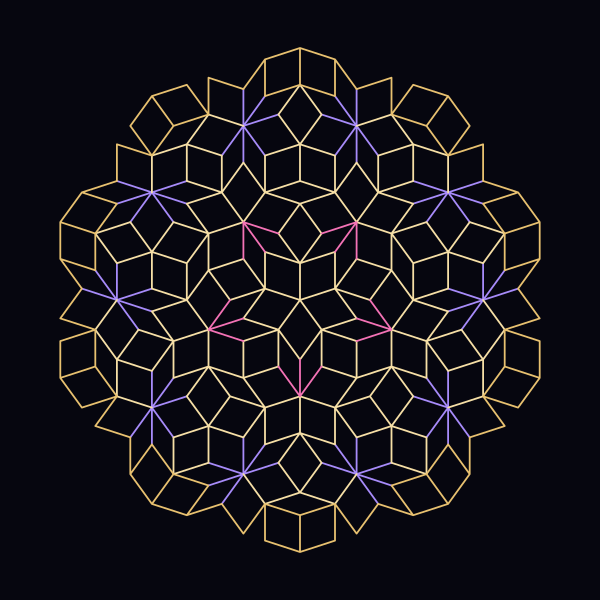
- It splits into 20 golden rhombohedra, 10 pointed and 10 flat: the two cells of the 3D Penrose tiling.
Measures
With every edge one unit long. For another edge, multiply the lengths by it, the areas by its square and the volumes by its cube.
- Midradius (center to edge)
- 1.4472
- Inradius (center to face)
- 1.3764
- Surface area
- 26.8328
- Volume
- 12.3107
- Dihedral angle
- 144.00°
- Symmetries
- 120 (icosahedral, Ih)
History and meaning
Kepler is credited with finding it, and drew it in Harmonices Mundi (1619). Today thirty-sided dice are made in this shape.
Across the dimensions
- Dual Icosidodecahedron