Archimedean Solids · 3D
Truncated Dodecahedron
3.10.10 · t{5,3}
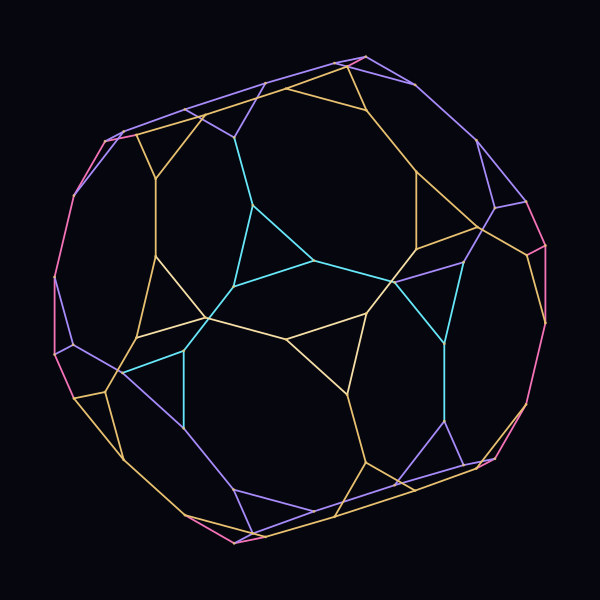
Slice the twenty corners off a dodecahedron until each pentagon becomes a regular decagon. Twenty small triangles sit where the corners were.
- Vertices
- 60
- Edges
- 90
- Triangles
- 20
- Decagons
- 12
Turn it in your hands, strike it to hear the chord of its edges, and slice it with a plane.
Facts
- For regular decagons the cut runs 1/(φ√5) ≈ 0.276 of the way along each edge.
- Every corner joins one triangle and two decagons (3.10.10).
- Cut deeper and the decagons shrink to pentagons again: the icosidodecahedron.
- Its dual, the triakis icosahedron, is an icosahedron with a low pyramid on every face.
Measures
With every edge one unit long. For another edge, multiply the lengths by it, the areas by its square and the volumes by its cube.
- Circumradius (center to corner)
- 2.9694
- Midradius (center to edge)
- 2.9271
- Surface area
- 100.991
- Volume
- 85.0397
- Dihedral angle, triangle and decagon
- 142.62°
- Dihedral angle, decagon and decagon
- 116.57°
- Symmetries
- 120 (icosahedral, Ih)
History and meaning
Kepler drew it in Harmonices Mundi (1619), the first complete list of the thirteen, where he also described the endless families of prisms and antiprisms.
Across the dimensions
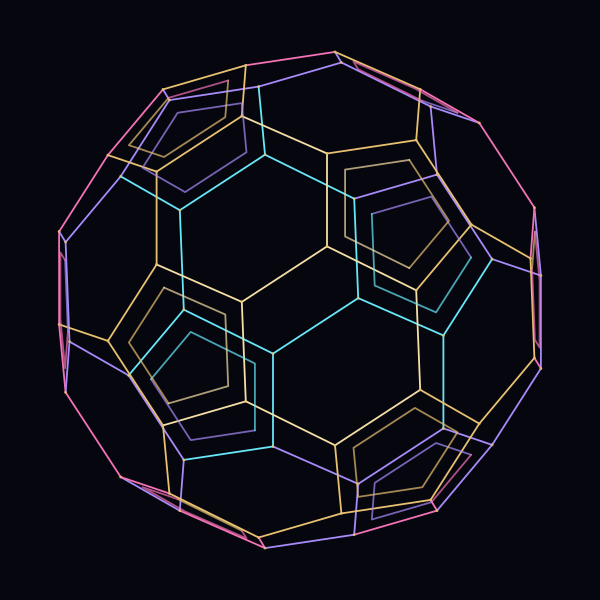
- Dual The triakis icosahedron, which the app draws inside it.