Archimedean Solids · 3D
Rhombicosidodecahedron
3.4.5.4 · rr{5,3}
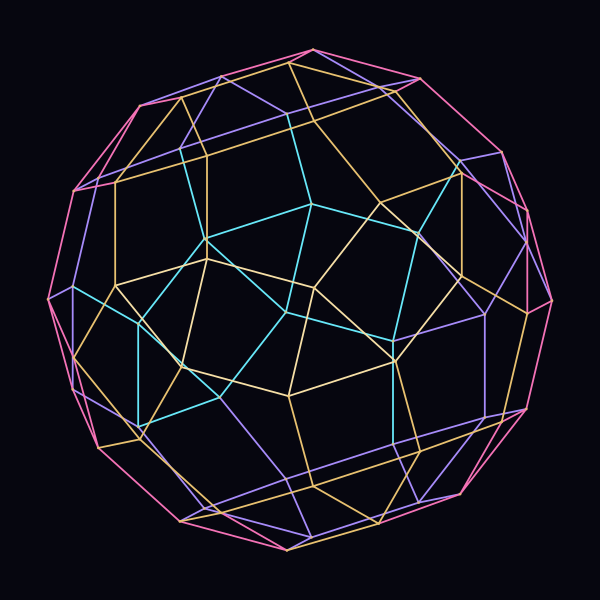
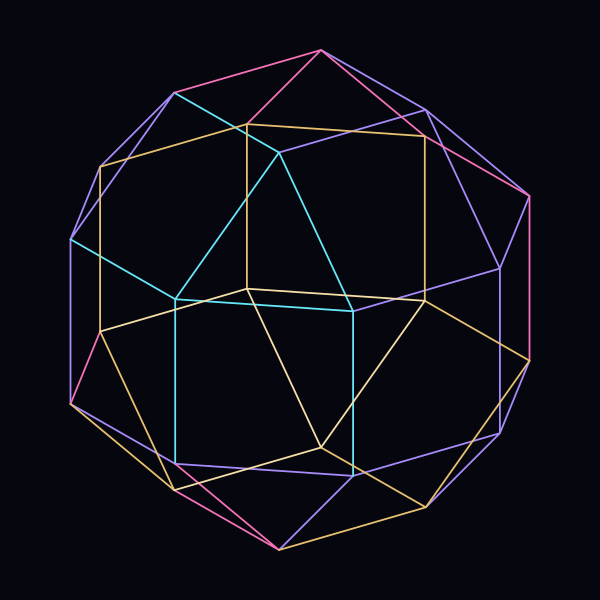
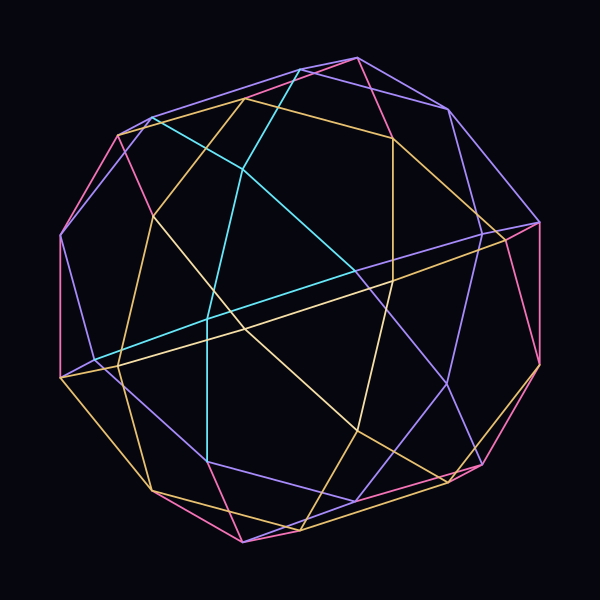
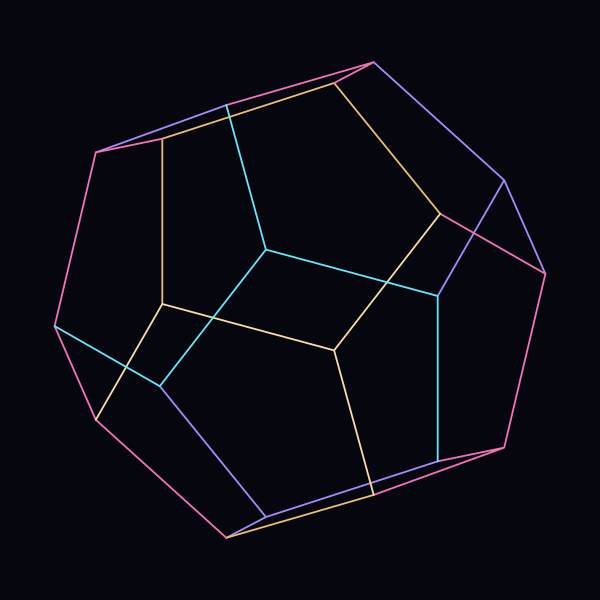
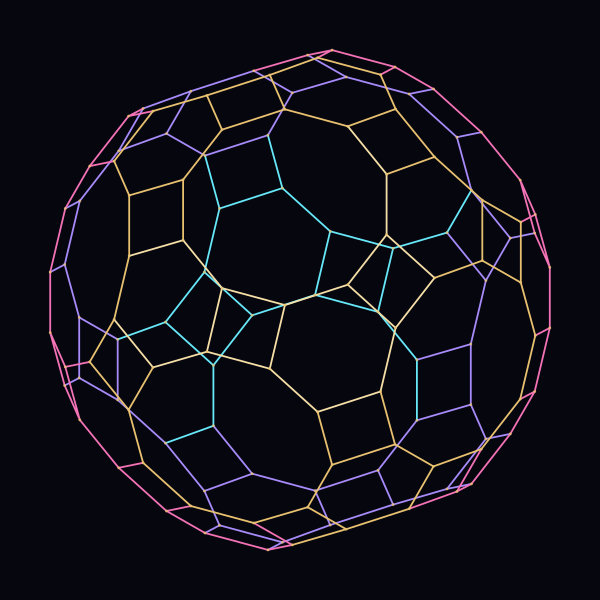
Twenty triangles, thirty squares and twelve pentagons: the dodecahedron’s faces pushed outward, with squares across its edges and triangles at its corners.
- Vertices
- 60
- Edges
- 120
- Faces
- 20 ▲ + 30 ■ + 12 ⬟
Turn it in your hands, strike it to hear the chord of its edges, and slice it with a plane.
Facts
- Every corner joins a triangle, a square, a pentagon and a square (3.4.5.4).
- Its thirty squares lie across the thirty edges of the dodecahedron and the icosahedron at once: it records both golden solids.
- Lift off a cap of five squares around a pentagon, give it a tenth of a turn and put it back: a new solid, the gyrate rhombicosidodecahedron.
- The Zometool connector is built on it, with golden rectangles in place of the squares.
Measures
With every edge one unit long. For another edge, multiply the lengths by it, the areas by its square and the volumes by its cube.
- Circumradius (center to corner)
- 2.2330
- Midradius (center to edge)
- 2.1763
- Surface area
- 59.3060
- Volume
- 41.6153
- Dihedral angle, triangle and square
- 159.09°
- Dihedral angle, square and pentagon
- 148.28°
- Symmetries
- 120 (icosahedral, Ih)
History and meaning
Kepler named it in 1619 a cut “icosidodecahedral rhombus”, his name for the rhombic triacontahedron. Its thirty squares face the same way as that solid’s thirty rhombi, its triangles as the icosahedron’s faces and its pentagons as the dodecahedron’s.
Across the dimensions
- Dual The deltoidal hexecontahedron, which the app draws inside it.