Unfoldings · 4D
Unfolded Tesseract
The Dalí cross: eight cubes folding into 4D
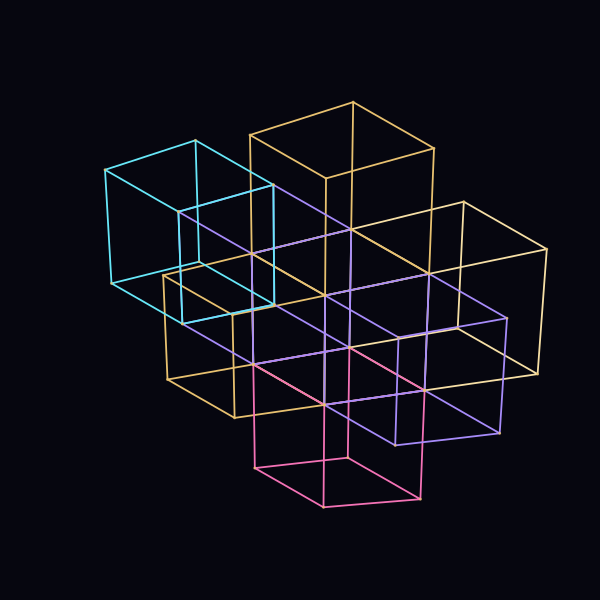
Unfold a cube and you get a cross of six squares. Unfold a tesseract and you get this: eight cubes in a cross. Fold it and every cube swings through the fourth dimension until they close into a hypercube.
- Cubes
- 8
- Folds
- 90° each, into W
- Nets
- 261
Watch it turn through the fourth dimension, hear the chord of its edges, and slice it with our space to see it pass through.
Facts
- Six cubes swing up from the central one; the last cube folds twice and caps the far side.
- At full fold, the central cube and the capping cube are opposite cells of the tesseract.
- Just as the cube has 11 flat nets, the tesseract has 261 different 3D nets.
History and meaning
Salvador Dalí painted Christ on this net in Crucifixion (Corpus Hypercubus), 1954. In Robert Heinlein’s 1941 story “And He Built a Crooked House” a house built in its shape folds up in an earthquake into a real tesseract.
From a cube’s net to a tesseract’s
A cube can be unfolded into six squares lying flat, a cross of four with one on each side, and folded back up by bending each square 90° out of the plane. A tesseract can be unfolded the same way, one dimension up: its eight cubes laid out in ordinary space, a column of four with one on each side of the second cube. Fold each cube 90° into the fourth dimension and they close into the tesseract. A cube has 11 different nets; a tesseract has 261.
The word tesseract was coined by Charles Howard Hinton in his 1888 book A New Era of Thought; he first spelled it tessaract.
Dalí’s hypercube
Salvador Dalí painted Christ on this net in 1954, in Crucifixion (Corpus Hypercubus): the cross is the unfolded tesseract, a figure from a higher dimension laid out in ours. The painting has hung in the Metropolitan Museum of Art in New York since 1955.
Read further
- Guide 4D shapesThe six regular shapes of four dimensions and more, and how to see them by their shadows, slices and unfoldings.