Archimedean Solids · 3D
Snub Cube
3.3.3.3.4 · sr{4,3}
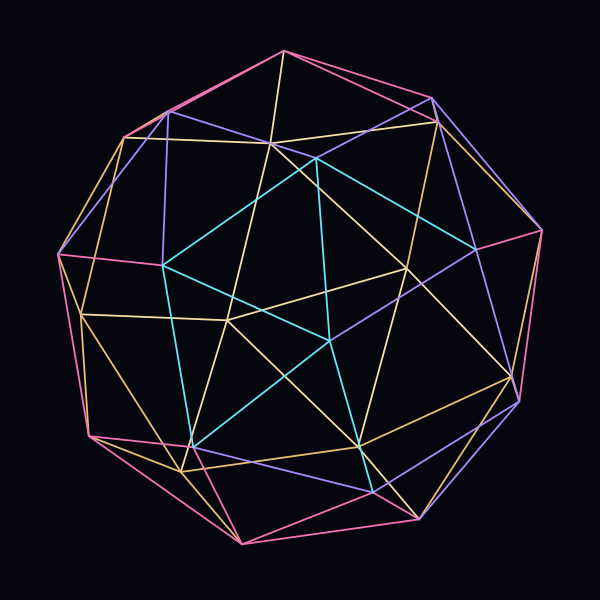
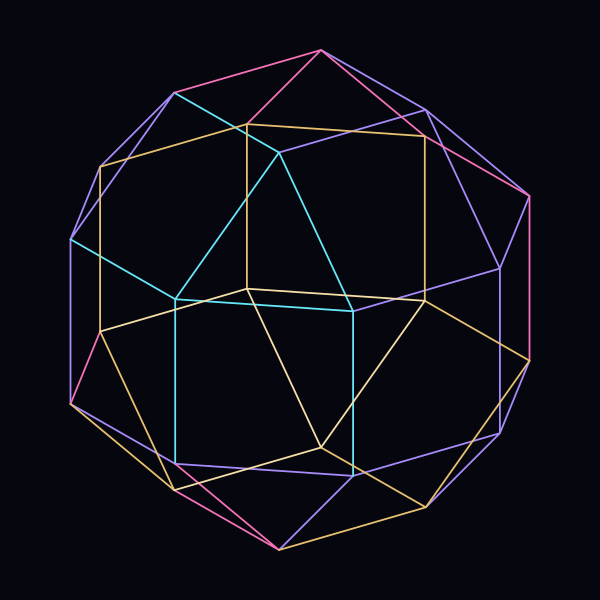
Six squares, each ringed by triangles and turned a little, so the whole solid twists: 32 triangles and 6 squares, in a left-handed and a right-handed form.
- Vertices
- 24
- Edges
- 60
- Faces
- 32 ▲ + 6 ■
- Hands
- 2
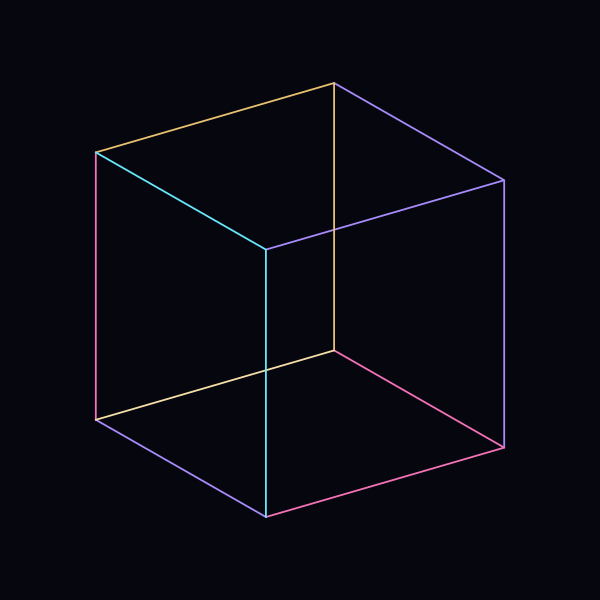
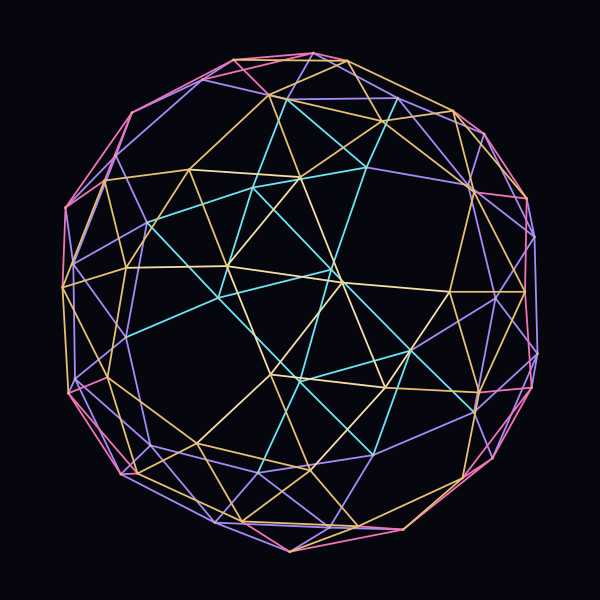
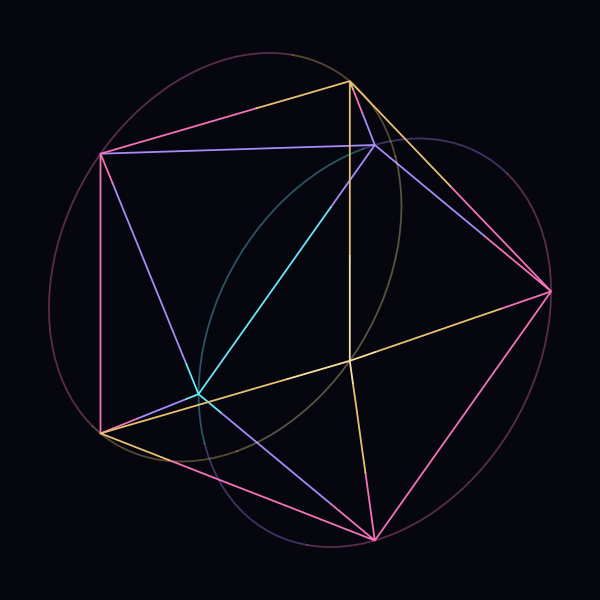
Turn it in your hands, strike it to hear the chord of its edges, and slice it with a plane.
Facts
- It is chiral: no turn will lay it on its mirror image.
- Its coordinates need the tribonacci constant t ≈ 1.83929, the root of t³ = t² + t + 1. It is to the tribonacci numbers 1, 1, 2, 4, 7, 13 … what φ is to the Fibonacci numbers.
- Four triangles and a square meet at every corner (3.3.3.3.4).
- Its dual, the pentagonal icositetrahedron, has 24 identical irregular pentagons.
Measures
With every edge one unit long. For another edge, multiply the lengths by it, the areas by its square and the volumes by its cube.
- Circumradius (center to corner)
- 1.3437
- Midradius (center to edge)
- 1.2472
- Surface area
- 19.8564
- Volume
- 7.8895
- Dihedral angle, triangle and triangle
- 153.23°
- Dihedral angle, triangle and square
- 142.98°
- Symmetries
- 24 (octahedral turns only, O)
History and meaning
Kepler named it cubus simus, the snub-nosed cube, in 1619.
Faces, edges and vertices
The snub cube has 38 faces, 32 equilateral triangles and 6 squares, with 60 edges and 24 vertices; 24 − 60 + 38 = 2, as Euler’s formula requires of every convex solid. Four triangles and a square meet at each corner. Twenty-four of the triangles each touch a square, and the other eight sit where the faces of an octahedron would be, surrounded only by triangles.
Why it twists
Each square sits a little turned against the cube it came from, so the whole solid has a sense of rotation, like a pinwheel: it is chiral, made in a left-handed and a right-handed form that are mirror images and cannot be turned into each other. Of the thirteen Archimedean solids only two are chiral, the snub cube and the snub dodecahedron.
How it is made
Pull the six faces of a cube outward, give each a small twist, and fill the gaps between them with triangles: that is the snub cube. The same move on the octahedron’s eight faces gives the same solid, which is why H. S. M. Coxeter called it the snub cuboctahedron. It also comes from the truncated cuboctahedron: keep every other corner and let the shape relax until its edges are equal.
With the tribonacci constant t ≈ 1.83929 (t³ = t² + t + 1), one hand of it has its corners at the even permutations of (±1, ±1/t, ±t) with an even number of plus signs, together with the odd permutations with an odd number of plus signs. Those 24 points are joined by 60 edges of length 1.6097, and lie on a sphere of radius 1.3437 edges, as the measures above give.
Across the dimensions
- Dual The pentagonal icositetrahedron, which the app draws inside it.
Learn it step by step
- Journey The Archimedean FamilyStep 9: Give it a twist