Archimedean Solids · 3D
Truncated Octahedron
4.6.6 · t{3,4}
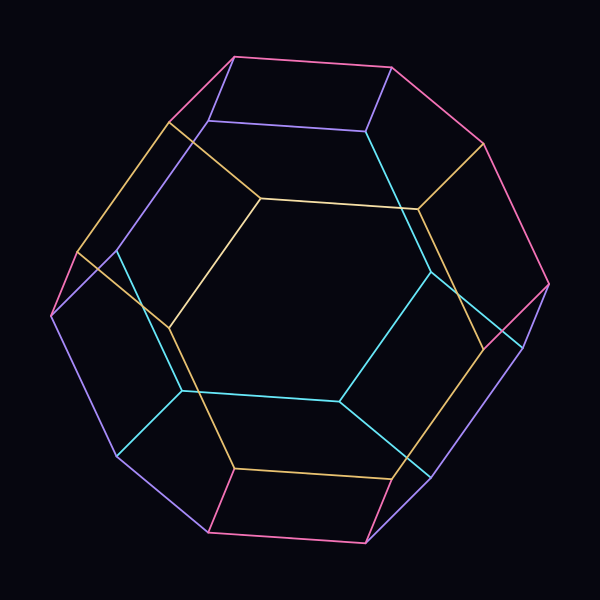
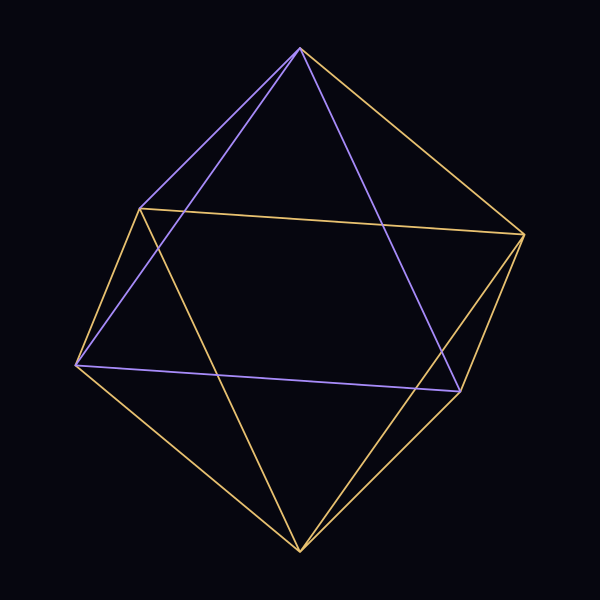
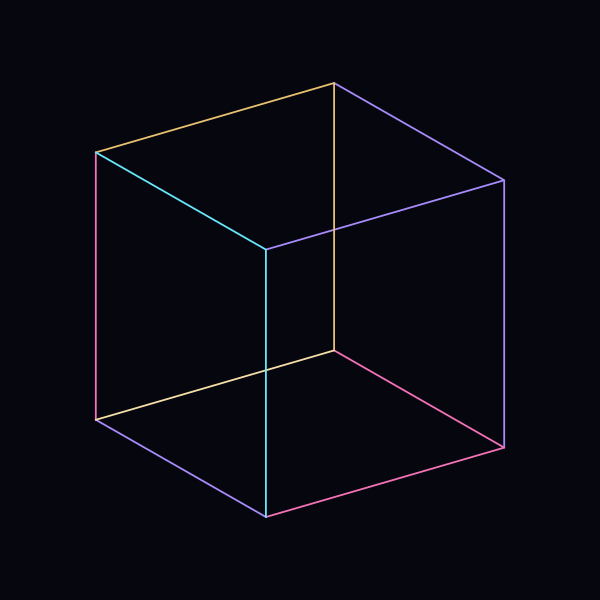
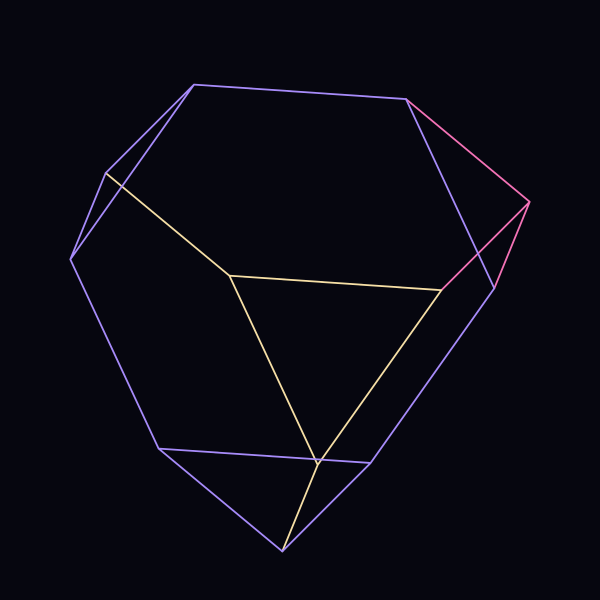
Cut the six corners off an octahedron a third of the way in: eight hexagons and six squares. The one Archimedean solid that fills space by itself.
- Vertices
- 24
- Edges
- 36
- Faces
- 6 ■ + 8 ⬢
- Fills space
- yes
Turn it in your hands, strike it to hear the chord of its edges, and slice it with a plane.
Facts
- Copies of it fill space with no gaps, each touching fourteen neighbors: eight across its hexagons and six across its squares.
- Its 24 corners are the 24 orderings of 1, 2, 3, 4: the permutohedron, seen in the space where those points lie.
- It is the cell each atom claims in a body-centered cubic crystal, such as iron.
- Every corner joins one square and two hexagons (4.6.6).
Measures
With every edge one unit long. For another edge, multiply the lengths by it, the areas by its square and the volumes by its cube.
- Circumradius (center to corner)
- 1.5811
- Midradius (center to edge)
- 1.5000
- Surface area
- 26.7846
- Volume
- 11.3137
- Dihedral angle, square and hexagon
- 125.26°
- Dihedral angle, hexagon and hexagon
- 109.47°
- Symmetries
- 48 (octahedral, Oh)
History and meaning
In 1887 Lord Kelvin asked how to divide space into equal cells with the least wall, as a foam does, and answered with slightly curved truncated octahedra. His answer stood for over a century, until Weaire and Phelan found a better foam in 1993.
Across the dimensions
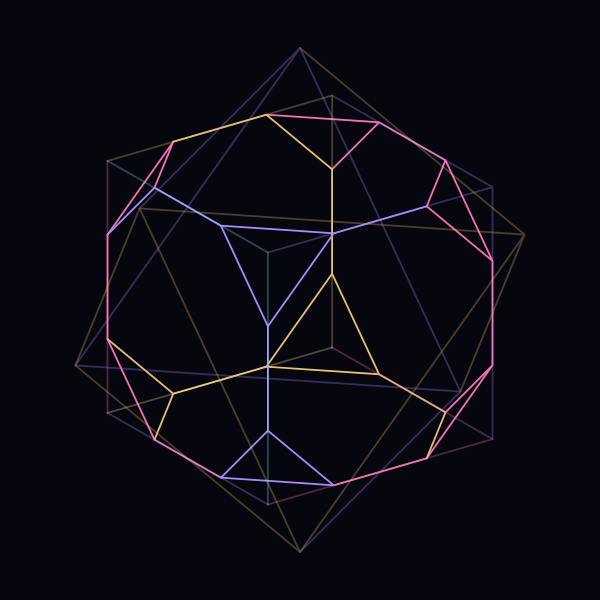
- Dual The tetrakis hexahedron, which the app draws inside it.
Learn it step by step
- Journey The Archimedean FamilyStep 6: Two thirds of the way