Archimedean Solids · 3D
Truncated Tetrahedron
3.6.6 · t{3,3}
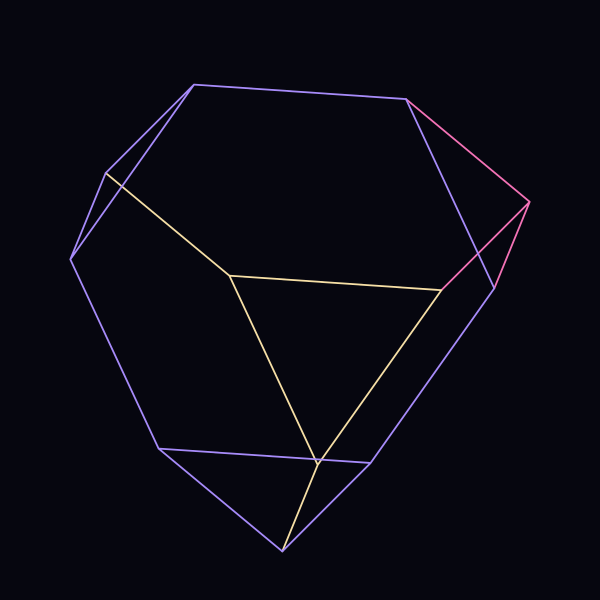
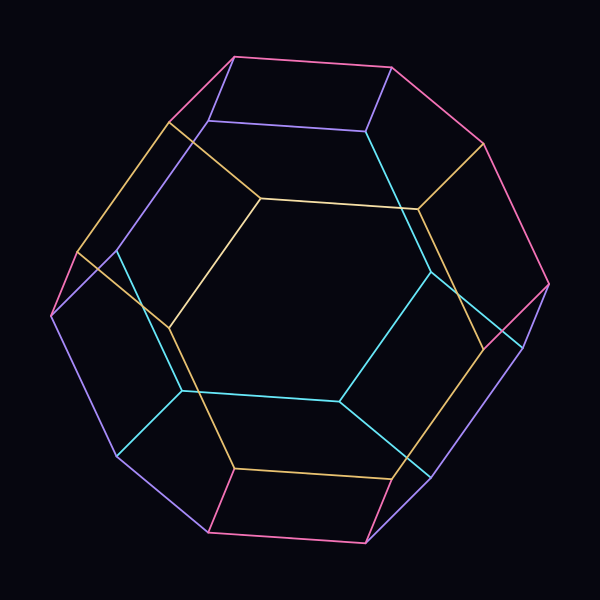
Cut the four corners off a tetrahedron a third of the way along each edge: four triangles and four hexagons. The simplest of Archimedes’ thirteen solids.
- Vertices
- 12
- Edges
- 18
- Faces
- 4 ▲ + 4 ⬢
Turn it in your hands, strike it to hear the chord of its edges, and slice it with a plane.
Facts
- One triangle and two hexagons meet at every corner: that is what 3.6.6 means.
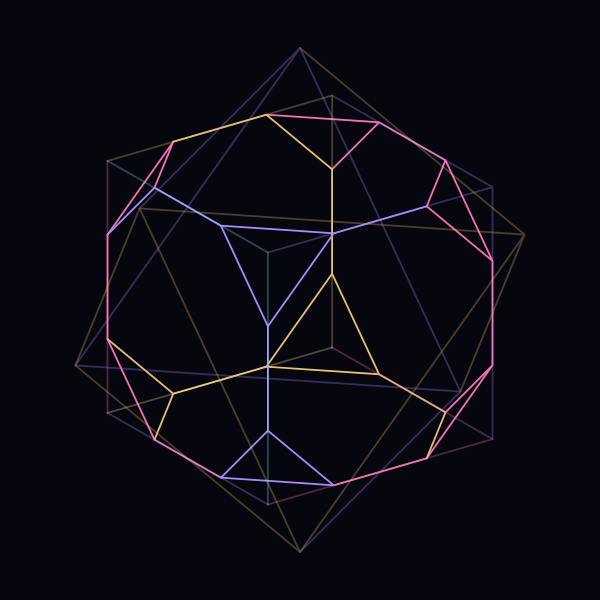
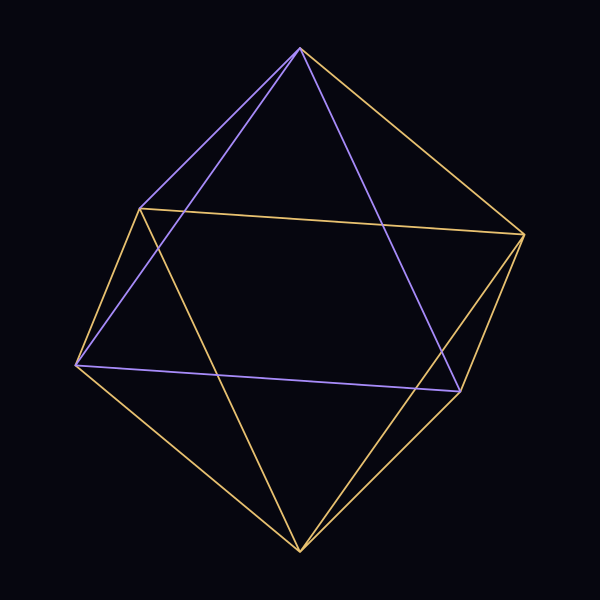
- Cut on to the middle of every edge and the hexagons close back into triangles: the octahedron is a tetrahedron cut to its midpoints.
- With the two snubs it is one of only three Archimedean solids with no center of symmetry. Turn any of the other ten inside out through its middle and it lands on itself.
- Truncated tetrahedra and tetrahedra together fill space with no gaps.
Measures
With every edge one unit long. For another edge, multiply the lengths by it, the areas by its square and the volumes by its cube.
- Circumradius (center to corner)
- 1.1726
- Midradius (center to edge)
- 1.0607
- Surface area
- 12.1244
- Volume
- 2.7106
- Dihedral angle, triangle and hexagon
- 109.47°
- Dihedral angle, hexagon and hexagon
- 70.53°
- Symmetries
- 24 (tetrahedral, Td)
History and meaning
Archimedes’ own book on the thirteen solids is lost. We know of it from Pappus of Alexandria, writing about 340 CE, who lists each one by its faces. Kepler found all thirteen again and named them in Harmonices Mundi (1619).
Across the dimensions
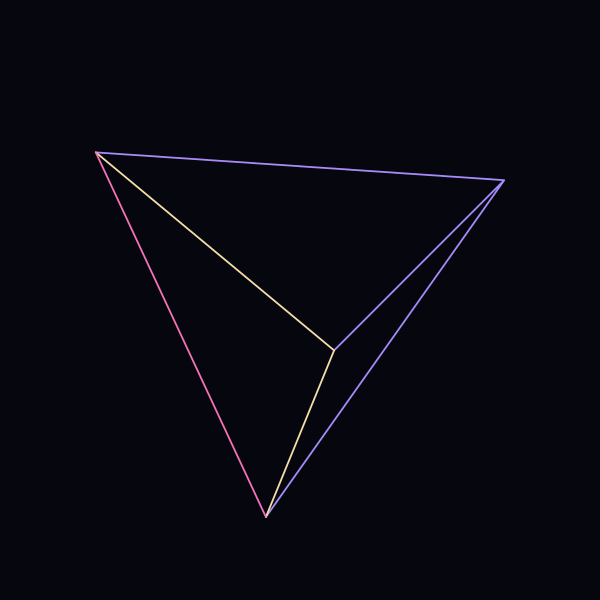
- Dual The triakis tetrahedron, which the app draws inside it.