Archimedean Solids · 3D
Truncated Cube
3.8.8 · t{4,3}
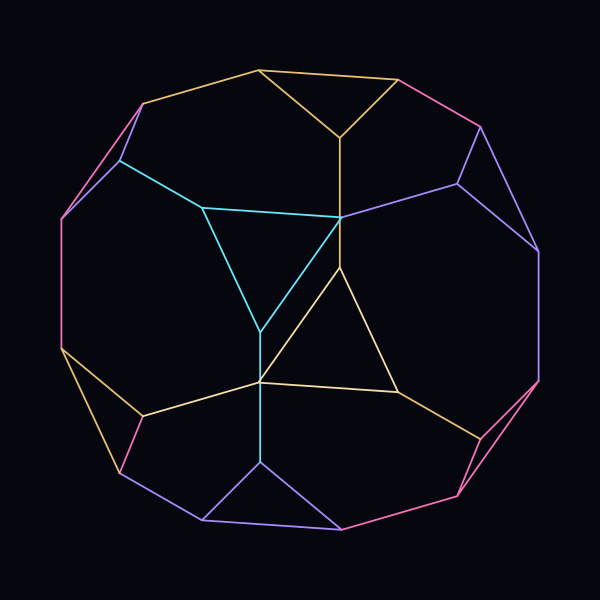
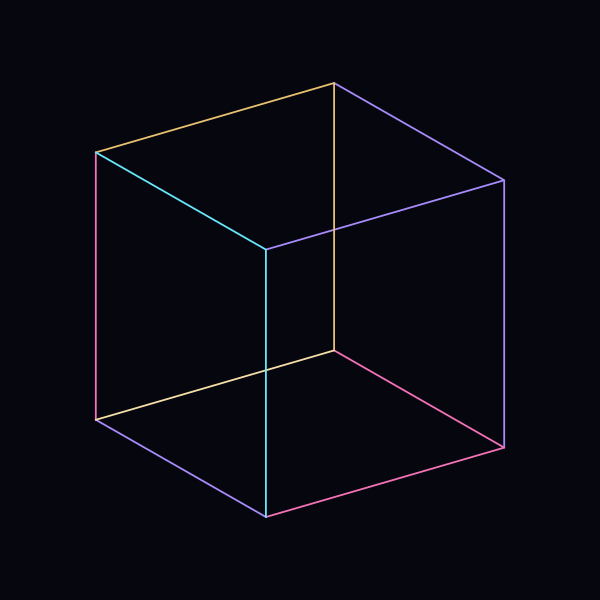
Slice the eight corners off a cube until every square becomes a regular octagon. Eight small triangles appear where the corners were.
- Vertices
- 24
- Edges
- 36
- Triangles
- 8
- Octagons
- 6
Turn it in your hands, strike it to hear the chord of its edges, and slice it with a plane.
Facts
- For regular octagons the cut runs 1 − 1/√2 ≈ 0.293 of the way along each edge.
- Opposite octagons are 1 + √2 edges apart: the silver ratio, which belongs to the octagon as φ belongs to the pentagon.
- Every corner joins one triangle and two octagons (3.8.8).
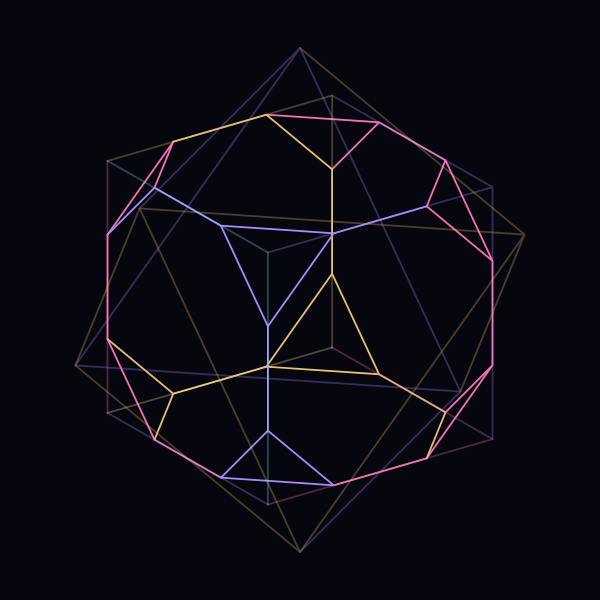
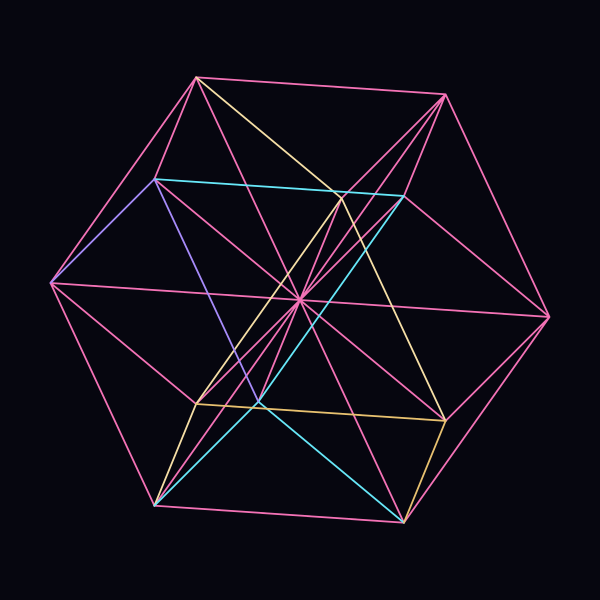
- Its dual, the triakis octahedron, is an octahedron with a low pyramid raised on every face.
Measures
With every edge one unit long. For another edge, multiply the lengths by it, the areas by its square and the volumes by its cube.
- Circumradius (center to corner)
- 1.7788
- Midradius (center to edge)
- 1.7071
- Surface area
- 32.4347
- Volume
- 13.5997
- Dihedral angle, triangle and octagon
- 125.26°
- Dihedral angle, octagon and octagon
- 90.00°
- Symmetries
- 48 (octahedral, Oh)
History and meaning
Renaissance artists drew the cut solids as exercises in perspective. Wenzel Jamnitzer’s Perspectiva Corporum Regularium (1568) is a whole book of them, turned, hollowed and stellated.
Across the dimensions
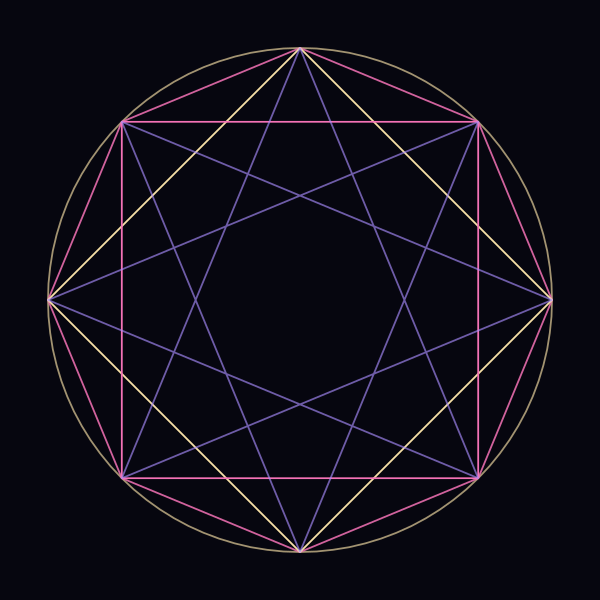
- Its slice The Sacred CutThe octagon of the sacred cut is a face of the truncated cube: lay the cut on every face of a cube and slice away its corners.
- Dual The triakis octahedron, which the app draws inside it.