Harmonic Curves · 2D
Spirograph
Hypotrochoid: a circle rolling inside a circle
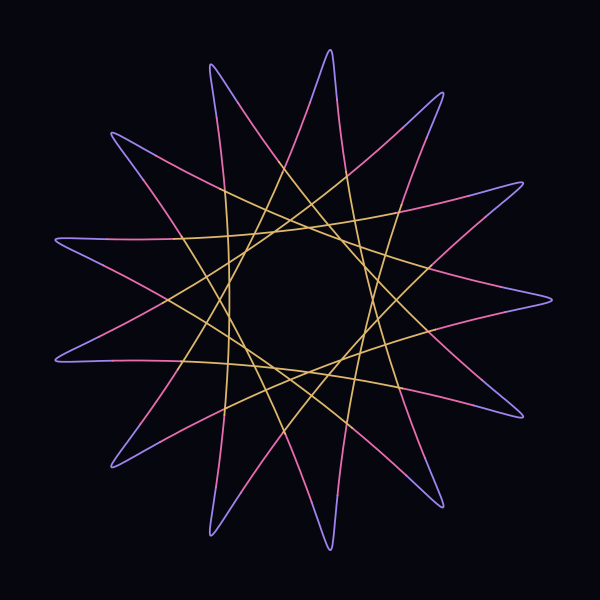
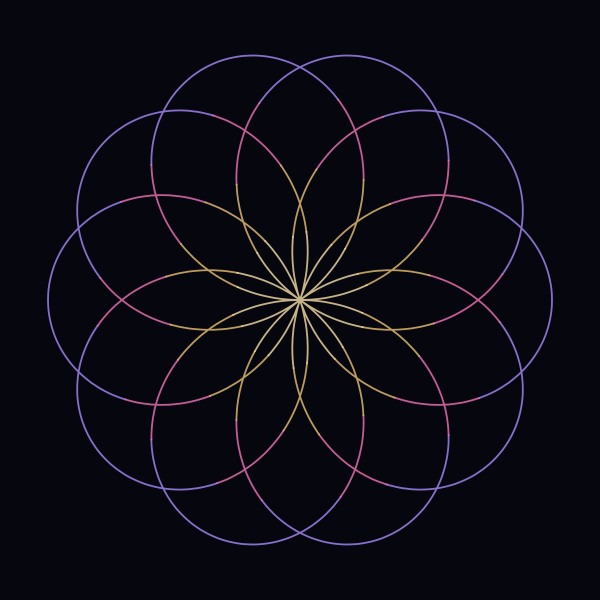
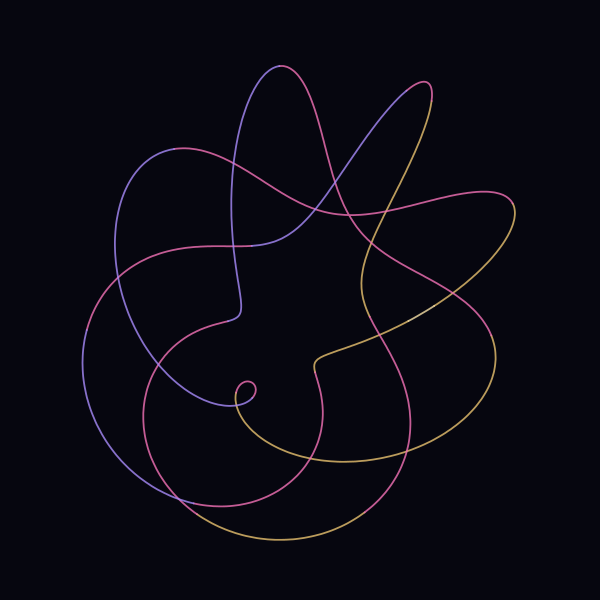
Roll a small toothed wheel inside a ring and trace a point on it. The ratio of teeth decides how many loops before the curve closes.
- Loops
- R ÷ gcd(R, r)
Watch it draw itself line by line, hear the chord of its lines, and slide the Dimension dial to raise its form in space.
Facts
- The curve makes R ÷ gcd(R, r) loops and closes after r ÷ gcd(R, r) trips around the ring.
- When the two tooth counts share no factor, it makes the most loops it can: one for every tooth of the ring.
- Pen offset 1 puts the pen on the wheel’s rim, and the loops sharpen into cusps (a hypocycloid). Inside the rim they round off; beyond it they curl.
- Ptolemy’s epicycles, circles riding on circles, drew planet paths of the same family.
History and meaning
The British engineer Denys Fisher launched the Spirograph toy in 1965. Gear-driven drawing machines are older: a “Speiragraph” was advertised in 1827, and patterns of the same family, engraved by machine, still guard banknotes against forgery.
Across the dimensions
- Shadow of Spirograph on the TorusThe curve runs around a ring, and a torus spans that ring: lifted onto it, the loops become a knot whose shadow is the curve.