Harmonic Curves · 2D
Rhodonea Rose
r = cos(k·θ)
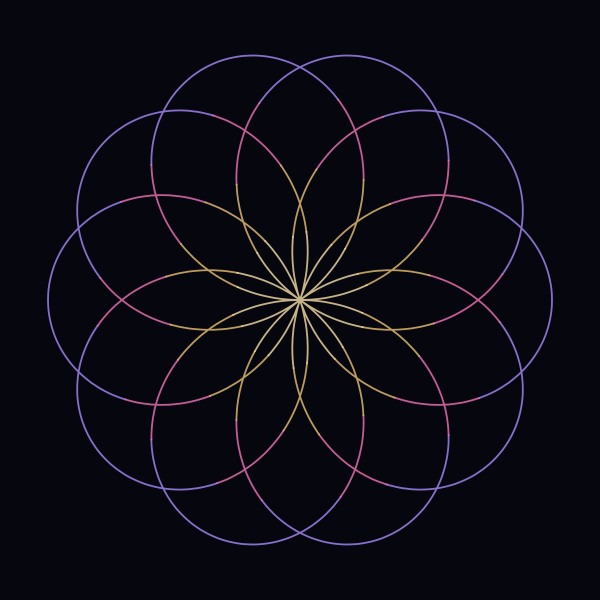
A curve with petals set by one ratio, k = n/d. Whole-number k gives a simple flower. Fractions weave overlapping petals into lace.
- k
- n / d
Watch it draw itself line by line, hear the chord of its lines, and slide the Dimension dial to raise its form in space.
Facts
- With k = n/d in lowest terms, the rose has n petals when n and d are both odd, and 2n otherwise: k = 3 gives 3 petals, k = 2 gives 4.
- The curve closes after d full turns, or only d half turns when n and d are both odd.
- If k were irrational the curve would never close, and its petals would fill the disk forever.
History and meaning
The Italian mathematician Guido Grandi studied these curves between 1723 and 1728 and named them rhodonea, from the Greek for rose.
Across the dimensions
- Shadow of Clelia CurveLet latitude turn in proportion to longitude and the curve winds over a sphere: seen from above, it is the rose.
Learn it step by step
- Journey Sound Made VisibleStep 4: Ratios make form