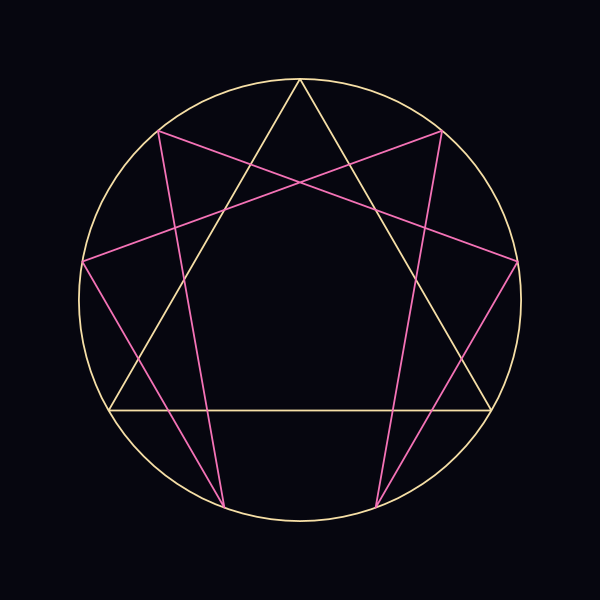
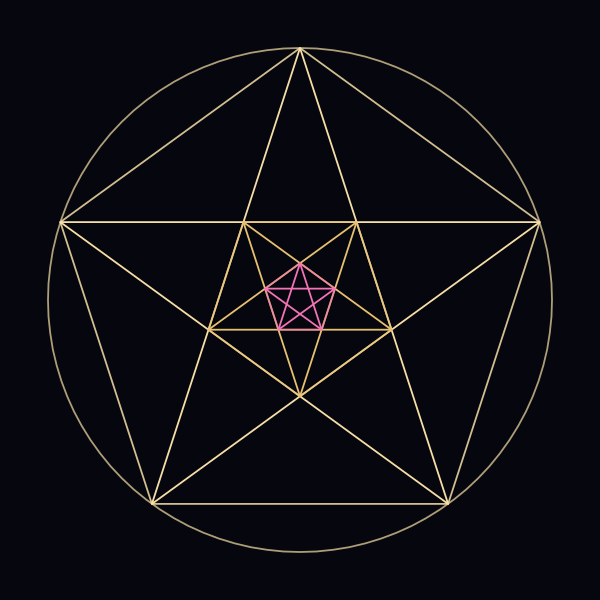
Star Polygons · 2D
Heptagram
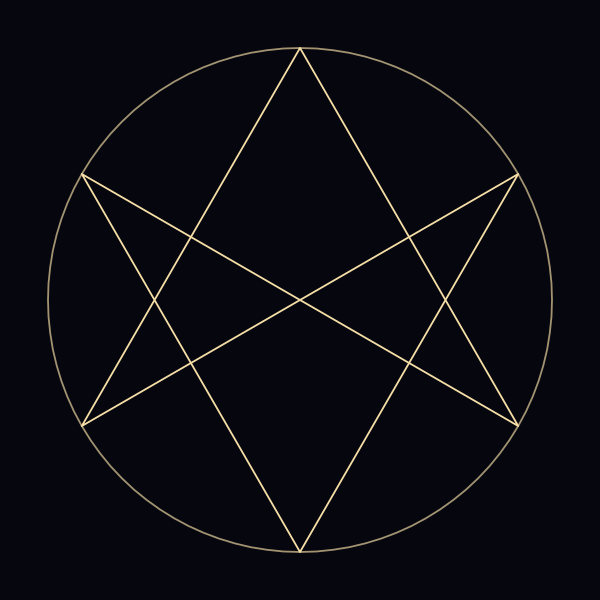
The seven-pointed stars {7/2} and {7/3}
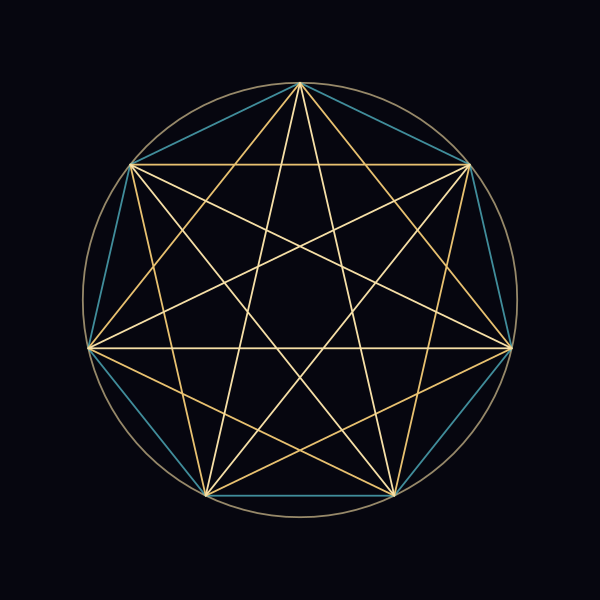
Seven points on a circle can be joined in two star-shaped ways: every second point for the blunt star, every third for the sharp one. Place the seven old planets on its points and the sharp star walks the days of the week.
- Points
- 7
- Stars
- {7/2} · {7/3}
- Point angles
- 77.1° · 25.7°
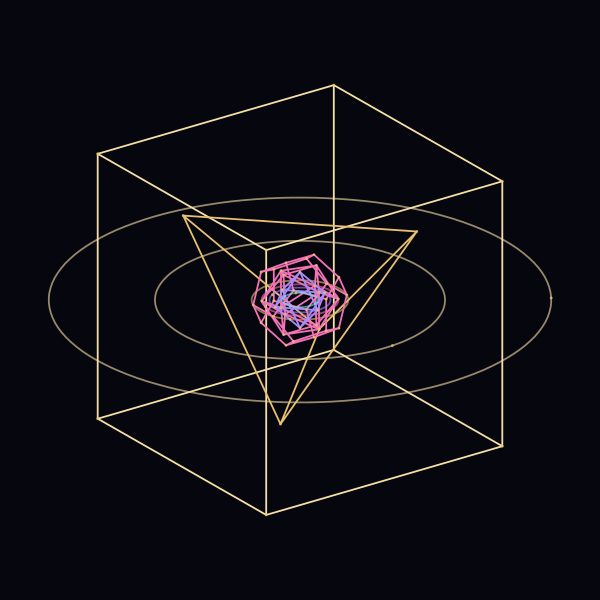
Watch it draw itself line by line, hear the chord of its lines, and slide the Dimension dial to tilt it into space.
Facts
- The regular heptagon cannot be drawn with compass and straightedge (Gauss gave the rule in 1801, Wantzel proved it in 1837), so neither can these stars.
- Its points carry the planets in the Chaldean order, slowest first: Saturn, Jupiter, Mars, Sun, Venus, Mercury, Moon.
- Follow the sharp star from Saturn and you meet the Sun, the Moon, Mars, Mercury, Jupiter and Venus: Saturday, Sunday, Monday… The days are named for the planets that rule their first hours.
- Seven is the fewest points that can make two different stars in one line: five and six points make one star or none.
History and meaning
The seven-pointed star is the Elven or Fairy Star of modern paganism, the seal of Babalon in Aleister Crowley’s Thelema, and an emblem of the seven Cherokee clans. Naming the days after the planets that rule their first hours came from Hellenistic astrology: a graffito at Pompeii already names a Sunday in AD 60.
The two heptagrams
Join seven evenly spaced points in turn and you get the heptagon. Join every second point and you get the heptagram {7/2}, the blunter star; join every third and you get the great heptagram {7/3}, the sharper one. Because 7 shares no factor with 2 or 3, each is drawn in one unbroken line that visits every point before it closes. The star is also called a septagram or septegram.
The point of a star {n/m} has the angle 180° × (n − 2m) / n, so the heptagram’s points are 77.14° and the great heptagram’s 25.71°. Seven is the fewest points that make two different stars of one line each.
What the seven-pointed star means
Mostly the number seven. There were seven classical planets, the Sun, the Moon, Mercury, Venus, Mars, Jupiter and Saturn, and the heptagram sets them round a circle. Placed in order of their speeds, the sharp star {7/3} visits them in the order of the days of the week, as the facts above show, because each day is named for the planet that rules its first hour. Alchemists matched the same seven planets to seven metals, gold for the Sun, silver for the Moon, and so on.
Today the star is the Elven or Fairy Star of modern paganism, the star of Babalon in Aleister Crowley’s Thelema, and, for the Cherokee, an emblem of their seven clans.
On flags and badges
The star on the flag of Jordan has seven points, for the seven verses of Al-Fatiha, the opening chapter of the Quran. The Commonwealth Star on the flag and arms of Australia has seven too: one for each of the six states that federated and one for the territories. The seven-pointed star of the Félibrige, the Provençal language society, is on the Occitan flag, and a seven-pointed star is the symbol of Hokkaido. In the United States it is the outline of some police badges and of the seal of the California Highway Patrol, and it is the white star in the logo of the Danish shipping company Maersk.
Can it be drawn with a compass?
Not exactly. The regular heptagon is the smallest regular polygon that compass and straightedge cannot make (Gauss gave the rule in 1801, Wantzel proved it in 1837), so neither heptagram can be drawn exactly that way. A marked ruler can do it. A close approximation goes back at least to Heron of Alexandria in the 1st century CE: half the side of the equilateral triangle in the same circle is the heptagon’s side, within 0.2%. Albrecht Dürer printed it in 1525, and the construction linked below follows him.
Learn it step by step
- Construct it Dürer’s HeptagonStep Dürer’s near-heptagon around the circle from P.