Yantras & Symbols · 2D
Lo Shu Square
The magic square of the river turtle
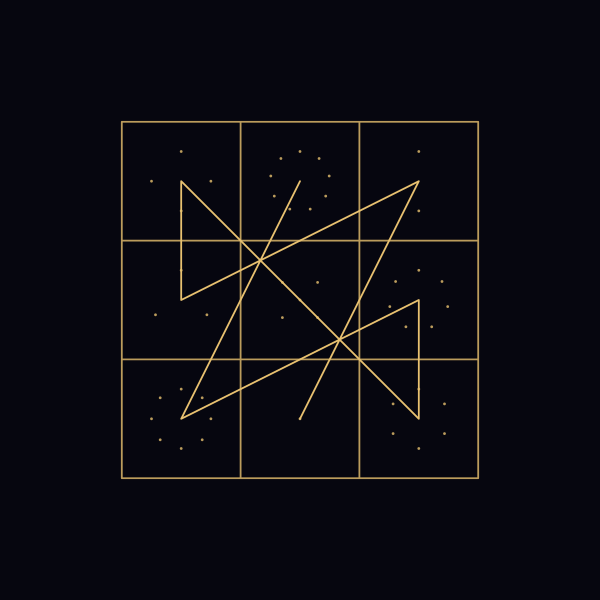
Nine numbers in a three-by-three square, so that every row, every column and both diagonals add up to fifteen. Join them in order, one to nine, and the magic line appears: a sigil drawn by the numbers themselves.
- Every line
- 15
- Center
- 5
- Magic squares of 3
- only 1
Watch it draw itself line by line, hear the chord of its lines, and slide the Dimension dial to tilt it into space.
Facts
- It is the only 3 × 3 magic square: every other is a turn or a mirror image of it.
- The odd numbers make a cross through the center, the even ones sit in the corners.
- Opposite cells always sum to ten, around the five in the middle.
- Tradition links its fifteen to the fifteen-day periods of the 24 solar terms that divide the Chinese year.
History and meaning
Chinese legend says a turtle rose from the Luo River during the Great Flood with this pattern of dots on its shell, and Yu the Great, who tamed the flood, read it as the order of the world. Texts describe it clearly as a magic square from about the 1st century CE. It underlies the nine palaces of feng shui and the Bagua, and the same square became the magic square of Saturn in Renaissance European talismans.
Why every line makes 15
The numbers 1 to 9 add up to 45, and three rows share them equally, so each row must make 15; so must each column and each diagonal. Only one arrangement of 1 to 9 does it, up to turning and mirroring the square, and its middle cell must be 5, the middle number, with each pair of opposite cells summing to 10. Even numbers fill the corners and odd numbers the edges.
How old is it?
The legend of the turtle from the Luo River belongs to the flood myth of Yu the Great. The square itself is younger than the legend: records from about 650 BCE mention a “river map” without saying what it was, texts clearly describe the magic square by 80 CE, and one draws it explicitly by 570 CE. As the Nine Halls Diagram it became a model for city planning and the layout of tombs and temples, and an emblem of feng shui, often paired with the eight trigrams of the Bagua.
Learn it step by step
- Journey The Builders’ MeasuresStep 8: The magic square