Lesson 15 of 20 · 7 moves
The Kepler Triangle
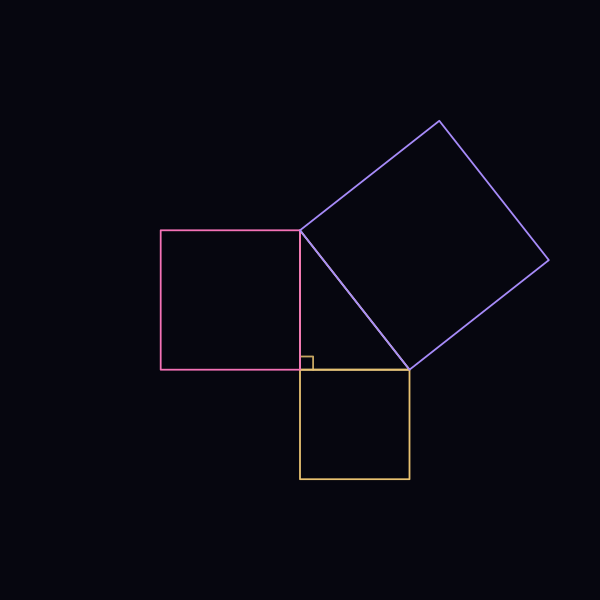
Build a right triangle on AB, square at B, whose longest side is φ.

Kepler wrote that geometry has two great treasures: the theorem of Pythagoras, “a measure of gold”, and the golden cut, “a precious jewel”. This triangle, which he described in a 1597 letter to his teacher Michael Maestlin, sets the jewel in the gold.
Raise an upright at B. Find φ from the midpoint of AB as you did for the golden rectangle, then swing it from A onto the upright.
The app snaps to every crossing, checks your construction exactly, and offers hints one move at a time.
Step by step
Bisect draws the perpendicular bisector of two points in one move: it stands for the circles and line of the perpendicular bisector.
Extend AB into a line.
Circle centered on B through A: it meets the line again beyond B.
Bisect A and that point: an upright at B. It meets the circle at T, one length above B.
Bisect AB: the midpoint M.
Circle centered on M through T: it lands on the line at E, and AE is φ.
Circle centered on A through E: it meets the upright at C.
Join A to C. The upright is already the side BC.
What it shows
Its sides are 1, √φ and φ, each √φ times the one before, and 1 + φ = φ² is Pythagoras speaking. The Great Pyramid’s slope comes within a tenth of a percent of it, but scholars think its builders used a whole-number slope, 14 up for every 11 across, and did not know φ.