Ratio & Proportion · 2D
Egyptian Triangle
Twelve knots, sides 3 · 4 · 5
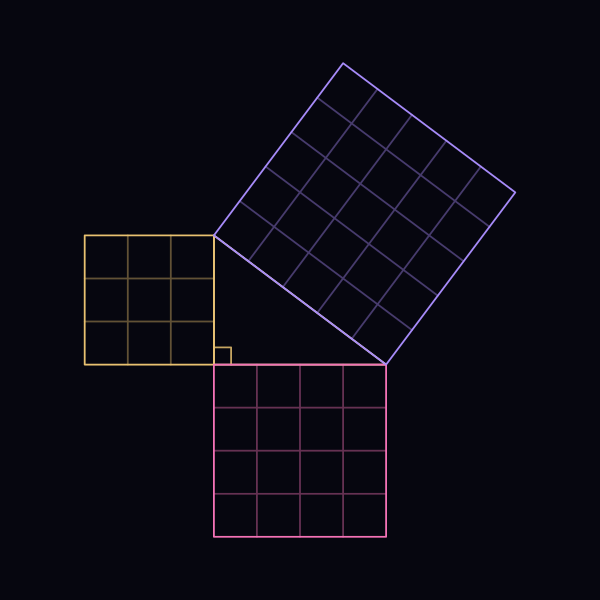
Tie twelve equal knots in a loop of rope and stake it out as a triangle with sides of three, four and five: the corner between the three and the four is a perfect right angle.
- Sides
- 3 · 4 · 5
- Knots
- 12
- Angle
- 90°
Watch it drawn with compass and straightedge, hear the chord of its lines, and turn the Dimension dial to tilt it into space.
Facts
- 3² + 4² = 5²: nine and sixteen make twenty-five. Toggle the squares and count the cells.
- It is the smallest right triangle with whole-number sides, and the only one whose sides are consecutive numbers.
- Its area, 6, is half its perimeter, 12.
- The circle inside it has radius exactly 1: half of 3 + 4 − 5.
History and meaning
Greek writers called the Egyptian surveyors harpedonaptai, rope-stretchers, and later authors credited them with this triangle for laying out temples and fields after the Nile floods. The rope story is a modern guess, but the Babylonian tablet Plimpton 322 (about 1800 BCE) lists fifteen such whole-number triangles, and Vitruvius gives 3 : 4 : 5 for setting out a staircase.
Learn it step by step
- Construct it The Rope-StretchersStretch the rope into a right angle at A: a triangle with sides 3, 4 and 5.
- Journey The Builders’ MeasuresStep 1: Twelve knots