Lesson 5 of 20 · 4 moves
The Rope-Stretchers
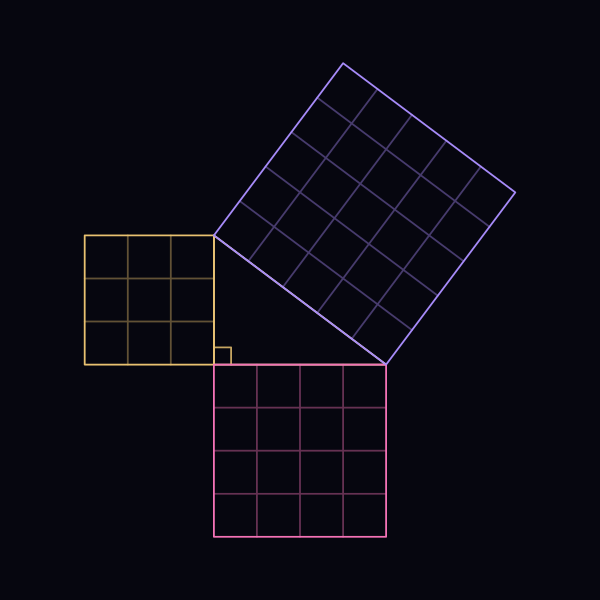
Stretch the rope into a right angle at A: a triangle with sides 3, 4 and 5.
Egypt’s surveyors were called harpedonaptai, the rope-stretchers. After each flood of the Nile they laid out the fields again, and the story goes that they squared their corners with a rope knotted into twelve equal lengths.
Pull it taut into sides of 3, 4 and 5 and the corner between 3 and 4 is square. The Compass carries a length to a new centre: Euclid showed in his second proposition that this can always be done.
The app snaps to every crossing, checks your construction exactly, and offers hints one move at a time.
Step by step
Compass carries a length to a new centre. Euclid showed in his second proposition that a collapsing compass can always do the same.
Circle centred on A through knot 3: every point three lengths from A.
Compass: take the five lengths from A to knot 5, and set them down on knot 4.
Join A to the crossing above it.
Join knot 4 to the same crossing: the rope is stretched.
What it shows
9 + 16 = 25: the squares on the two short sides fill the square on the long one. Pythagoras proved for every right triangle what the rope knew for this one, though whether Egypt really used it is still argued.