Ratio & Proportion · 2D
Kepler Triangle
Sides 1 : √φ : φ

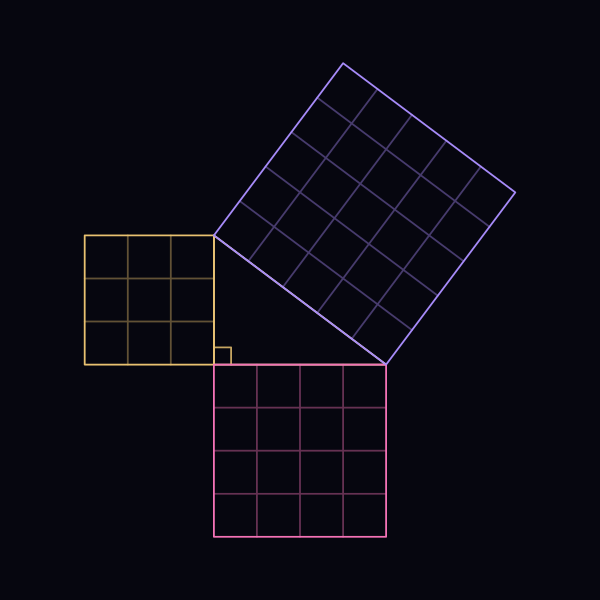
The one right triangle whose sides grow in a geometric progression: 1, √φ, φ. The squares on its sides are 1, φ and φ², and Pythagoras says φ² = φ + 1, the golden ratio’s own defining equation.
- Sides
- 1 · 1.272 · 1.618
- Angle
- 51.83°
- Squares
- 1 + φ = φ²
Watch it drawn with compass and straightedge, hear the chord of its lines, and turn the Dimension dial to raise its form in space.
Facts
- Each side is √φ times the one before: short side, height and hypotenuse in one geometric progression.
- The squares on its sides are 1, φ and φ², and φ² = φ + 1 is exactly Pythagoras’ theorem for this triangle.
- Put two back to back and you have the section of a square pyramid whose faces slope at 51.83°.
- The Great Pyramid’s faces slope at about 51.84°: within a few hundredths of a degree of this.
History and meaning
Named after Johannes Kepler, who wrote to his old teacher Michael Mästlin in 1597 that a line cut in the golden ratio makes a right triangle whose sides are in proportion. The idea that the Great Pyramid was built on it goes back to John Taylor (1859), who read in Herodotus that each face of the pyramid has the area of the square on its height: exactly this triangle.
Across the dimensions
- Slice of The Kepler PyramidTwo Kepler triangles back to back are the section of a square pyramid: turn it about its height and the pyramid rises.
Learn it step by step
- Construct it The Kepler TriangleBuild a right triangle on AB, square at B, whose longest side is φ.
- Journey The Builders’ MeasuresStep 3: The golden right angle