Ratio & Proportion · 2D
The Sacred Cut
Four arcs that divide a square
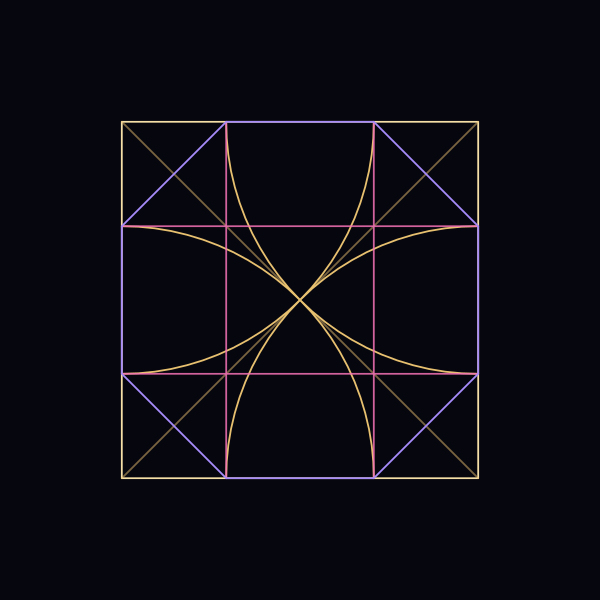
Set the compass on a corner of a square, open it to the centre and swing an arc to the sides. Do it from all four corners: the eight cuts divide the square into a grid of nine, and mark the corners of a perfect octagon.
- Cut
- 1 : √2
- Middle ÷ side
- √2 − 1
- Octagon
- regular
Watch it drawn with compass and straightedge, hear the chord of its lines, and turn the Dimension dial to raise its form in space.
Facts
- Each arc cuts the side at a distance from the corner equal to half the diagonal: the side and the half-diagonal stand as √2 : 1.
- The middle square of the grid is √2 − 1 ≈ 0.414 of the side: the inverse of the silver ratio.
- The eight cuts are the corners of a regular octagon, with no measuring at all.
- Lay it on every face of a cube and cut away the corners: the octagons become the faces of the truncated cube.
History and meaning
The Danish engineer Tons Brunés named it in The Secrets of Ancient Geometry (1967). Donald and Carol Watts later found its proportions in the plan of the Garden Houses at Ostia, Rome’s port, and argued that Roman builders laid out whole courtyards with it.
Across the dimensions
- Slice of Truncated CubeThe octagon of the sacred cut is a face of the truncated cube: lay the cut on every face of a cube and slice away its corners.
Learn it step by step
- Construct it The Sacred CutSwing an arc from each corner through the centre, and join the cuts into an octagon.
- Journey The Builders’ MeasuresStep 6: The sacred cut