Transformations · 3D
Cube to Octahedron
Truncation: cutting the corners away
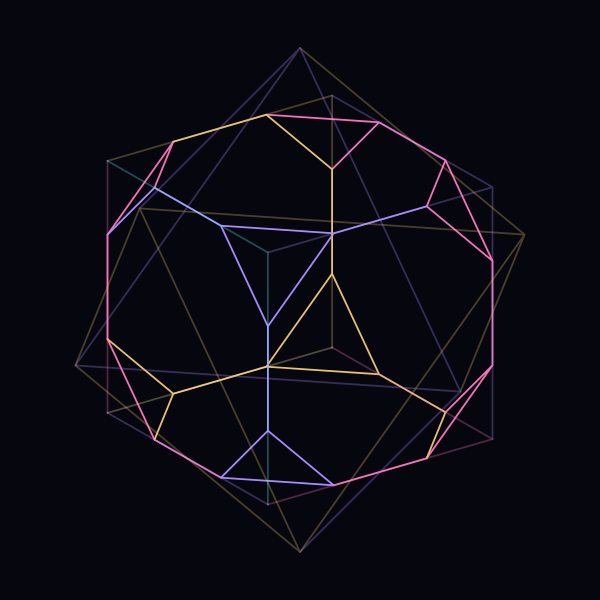
Cut the corners off a cube, deeper and deeper. The squares become octagons, then shrink back to squares as the cuts meet at the middles of the edges, while the corners grow into hexagons and at last into the octahedron’s faces. Animate the cut and watch one solid breathe into its dual.
- Solids
- 5
- Archimedean
- 3
- Symmetries
- 48
Turn it in your hands, strike it to hear the chord of its edges, slice it with a plane.
Facts
- At each named stop every edge is equal and every face regular: an Archimedean solid.
- The cube and the octahedron are duals, so cutting one all the way through leaves the other.
- Halfway, the cuts meet at the middles of the edges: the cuboctahedron, balanced between the two.
- Between the stops the faces are no longer regular, but the symmetry never changes.
History and meaning
Truncation is the oldest way to make new solids from old. Most of Archimedes’ thirteen are cut Platonic solids, and Kepler named them for it: truncus, cut short.
Learn it step by step
- Journey The Archimedean FamilyStep 2: Cut a corner