Archimedean Solids · 3D
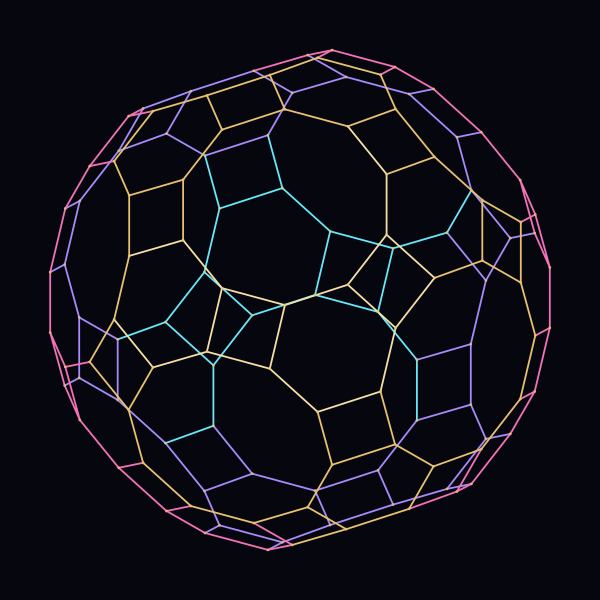
Truncated Cuboctahedron
4.6.8 · tr{4,3}
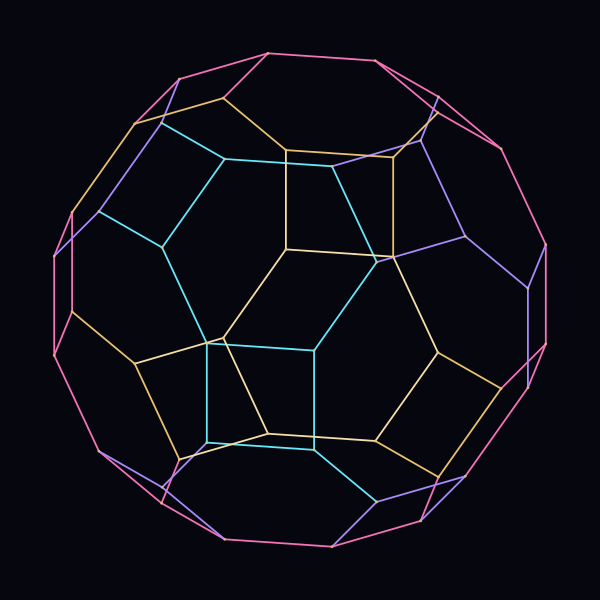
A square, a hexagon and an octagon meet at each of its 48 corners: the cube’s whole family of cuts at once. Also called the great rhombicuboctahedron.
- Vertices
- 48
- Edges
- 72
- Faces
- 12 ■ + 8 ⬢
- Octagons
- 6
Turn it in your hands, strike it to hear the chord of its edges, slice it with a plane.
Facts
- Its 48 corners match the 48 symmetries of the cube, turns and mirror images together: one corner for each.
- Despite the name, cutting the corners off a cuboctahedron gives rectangles, not squares: the corners have to be nudged apart to make it.
- Its corners are every arrangement of ±1, ±(1 + √2) and ±(1 + 2√2).
- Every face has its opposite sides parallel, so it can be built entirely from bands of parallel edges (a zonohedron).
History and meaning
Kepler named it in 1619. Its dual, the disdyakis dodecahedron, has 48 identical triangles, one for each symmetry of the cube: they are the cells into which the cube’s nine mirror planes cut the sphere.
Across the dimensions
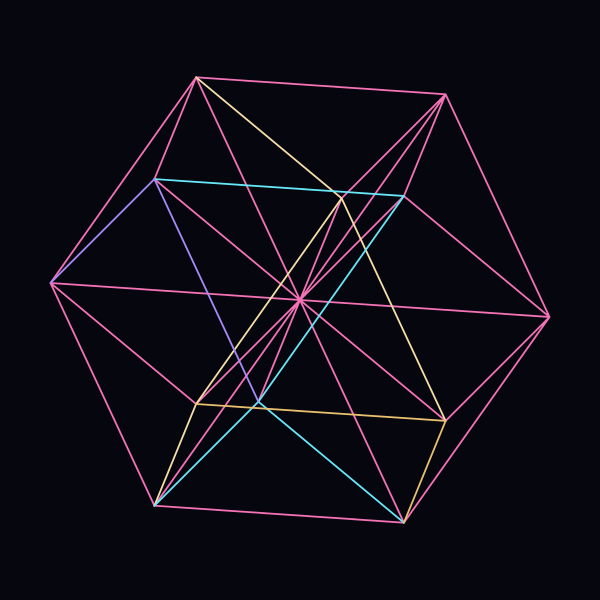
- Dual The disdyakis dodecahedron, which the app draws inside it.