Forms of the Plane · 3D
Star Pattern Polyhedron
Hankin’s method on a closed solid

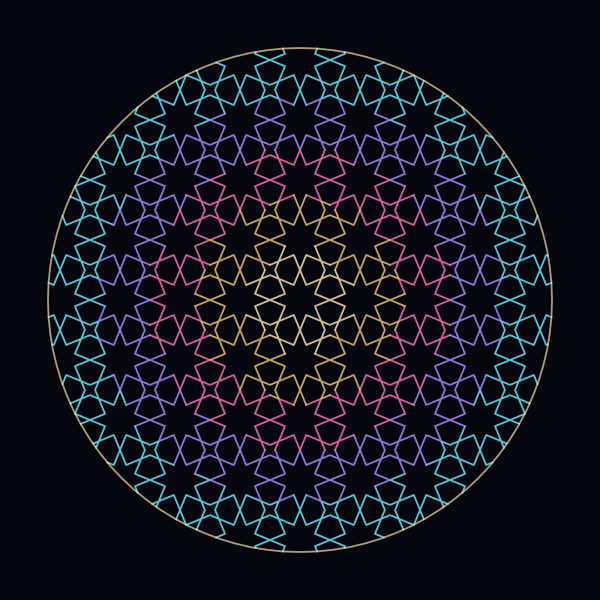
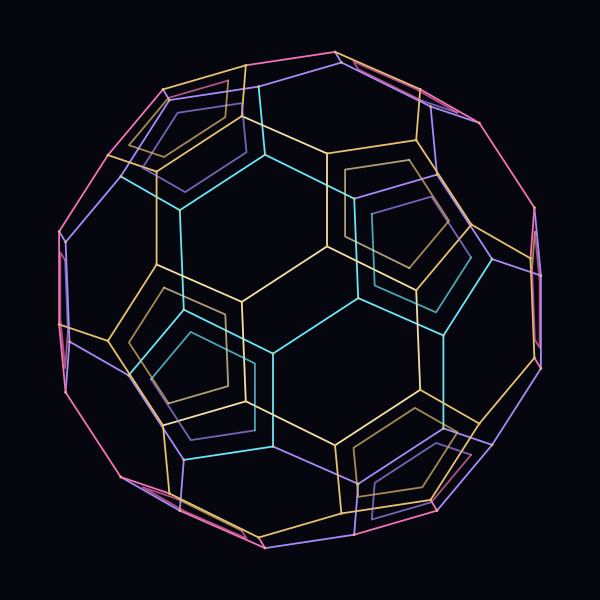
A flat tiling of octagons and squares fits four right angles round every corner. Give up one side at each corner and the tiling can no longer lie flat: it closes into a solid. Run Hankin’s rays across its faces and the star pattern wraps around it without a seam.
- Method
- Hankin 1925
- Seams
- 0
Turn it in your hands, strike it to hear the chord of its edges, slice it with a plane.
Facts
- Each flat tiling closes into the solid with one polygon a side shorter at every corner: 4·8·8 into the truncated cube, hexagons into the soccer ball, 3·6·3·6 into the icosidodecahedron, squares into the cube.
- The rays leave every edge at its midpoint, so the pattern bends over each edge unbroken.
- Octagons keep their eight-pointed stars. Where a hexagon became a pentagon, a five-pointed star appears.
History and meaning
Star patterns were carried onto curved and folded surfaces across the Islamic world: domes, muqarnas vaults and pierced metal lanterns. Craig Kaplan and David Salesin showed in 2004 how Hankin’s method lays a pattern onto any polyhedron.
Across the dimensions
- Wrapped from Islamic Star PatternGive up one side of a polygon at every corner and the tiling folds shut into a solid, the star pattern running unbroken over every edge.