Regular Polytopes · 4D
600-Cell
{3,3,5} · the tetraplex
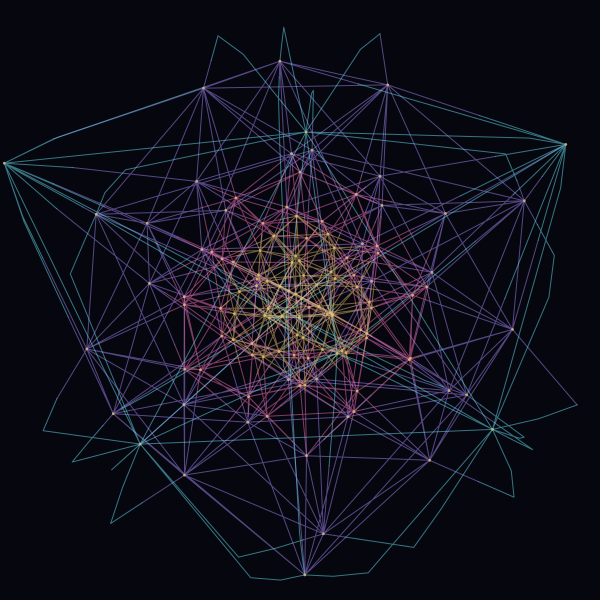
Six hundred tetrahedra, twenty around every edge, closing into a perfect hyper-sphere. The 4D icosahedron.
- Vertices
- 120
- Edges
- 720
- Faces
- 1200
- Cells
- 600
Watch it turn through the fourth dimension, hear the chord of its edges, and slice it with our space to see it pass through.
Facts
- Every vertex has 12 neighbours arranged as an icosahedron.
- Its 120 vertices form the binary icosahedral group, a sacred object of algebra.
- Its edge length is 1/φ when its radius is 1: golden all the way through.
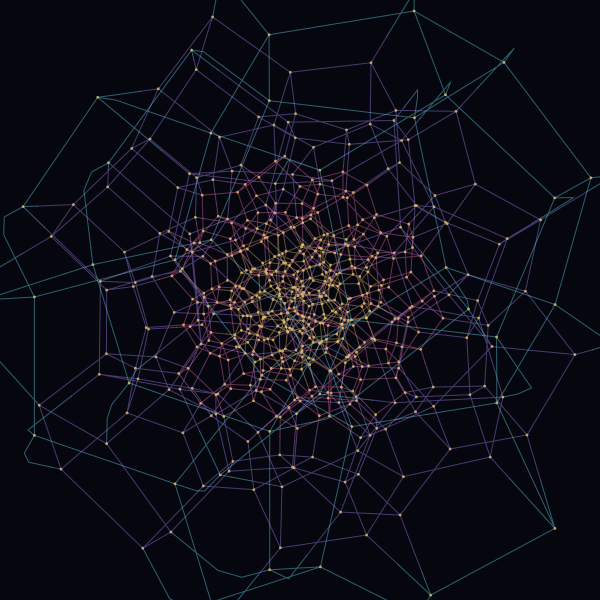
- Stereographic projection (default here) turns its edges into circles.
History and meaning
Ludwig Schläfli discovered all six regular 4D polytopes around 1852, long before anyone could draw them. Alicia Boole Stott, with no formal training, later visualised their 3D sections in exquisite cardboard models.
Across the dimensions
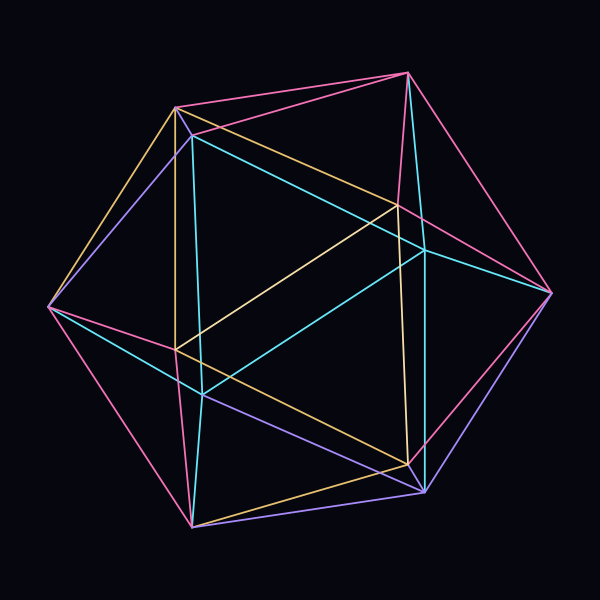
- Around each corner IcosahedronIn the 600-cell, the twelve neighbours of every vertex form an icosahedron.
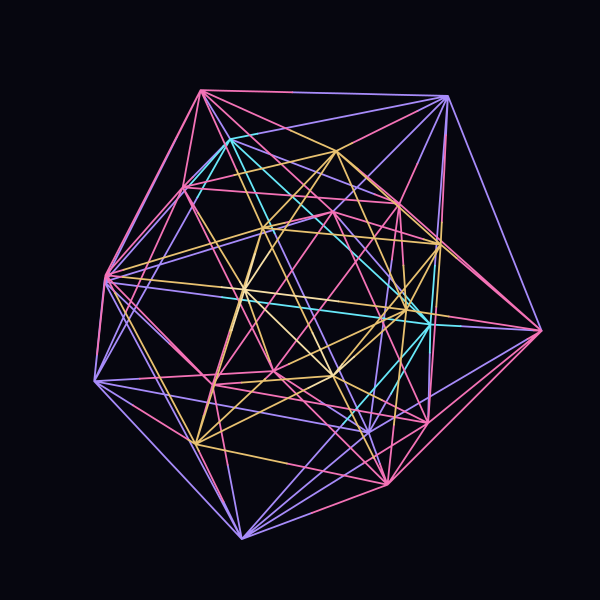
- Its equator IcosidodecahedronPass the 600-cell corner-first through our space: at its middle, thirty of its corners make the icosidodecahedron.
- Dual 120-Cell
Learn it step by step
- Journey The Golden ThreadStep 9: Into hyperspace
- Journey FlatlandStep 8: A geodesic heart