Pattern & Tiling · 2D
Penrose Tiling
Two rhombi, fivefold, never repeating
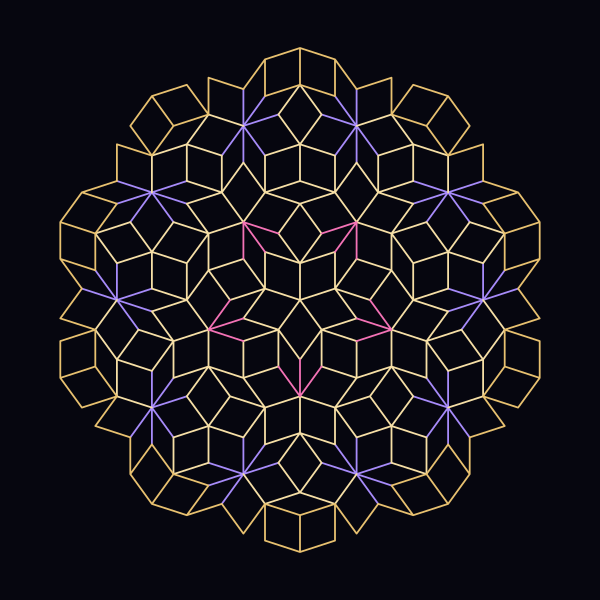
A thick and a thin rhombus, both built from φ, tile the plane forever without ever repeating. Every patch you see occurs again, infinitely often, yet the whole never shifts onto itself.
- Thick ÷ thin
- → φ
- Angles
- 36° · 72°
- Symmetry
- fivefold
Watch it drawn with compass and straightedge, hear the chord of its lines, and turn the Dimension dial to raise its form in space.
Facts
- In a large patch there are φ ≈ 1.618 times as many thick rhombi as thin ones.
- Built here by deflation: each triangle splits into smaller ones in golden proportion, generation after generation.
- No tiling of the plane can repeat with fivefold symmetry, yet this one has it everywhere, locally.
- Quasicrystals, discovered by Dan Shechtman in 1982, arrange atoms this way (Nobel Prize 2011).
History and meaning
Roger Penrose found his aperiodic tilings in the 1970s. Five centuries earlier the tile-makers of the Darb-i Imam shrine in Isfahan (1453) had built near-perfect quasicrystalline patterns from girih tiles.
Across the dimensions
- Rises into Icosahedral QuasicrystalOne dimension up, the two golden rhombi become two golden rhombohedra, filling space without ever repeating.