Harmonic Curves · 2D
Chladni Figure
Nodal lines of a vibrating square plate
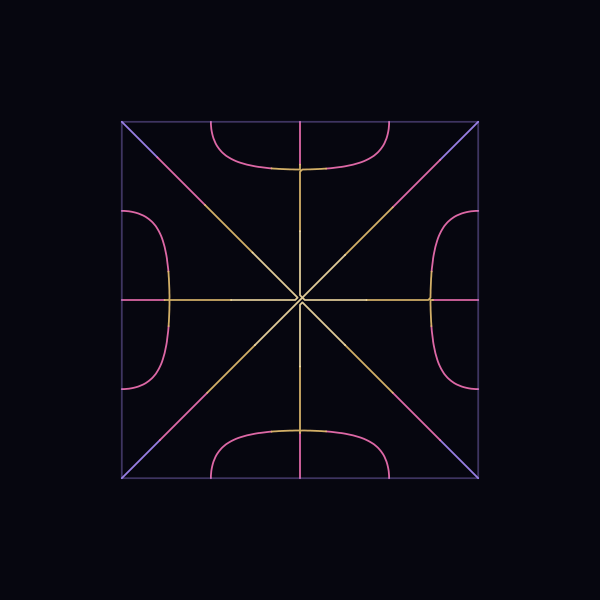
Sprinkle sand on a metal plate and bow it: the sand flees the moving parts and gathers on the lines that stay still. These are those lines, computed exactly.
- Discovered
- 1787
- By
- E. Chladni
Watch it drawn with compass and straightedge, hear the chord of its lines, and turn the Dimension dial to raise its form in space.
Facts
- Nodal lines are where the plate does not move, so sand collects there.
- Higher modes (bigger n and m) mean higher pitches and more intricate figures.
- Mode (n, m) and (m, n) have the same pitch on a square plate, so they mix.
- Open the Cymatics tab to watch sand find these lines in real time.
History and meaning
Ernst Chladni demonstrated his sound figures across Europe. Napoleon was so impressed that he funded a prize for their mathematical explanation, won in 1816 by Sophie Germain.
Across the dimensions
- Slice of Chladni CubeThe plate is one face of a vibrating cube, and every face carries its own sand figure.
Learn it step by step
- Journey The Plane RisesStep 8: A singing cube
- Journey Sound Made VisibleStep 1: Sand on a plate