Yantras & Symbols · 2D
Chartres Labyrinth
Eleven circuits, one path
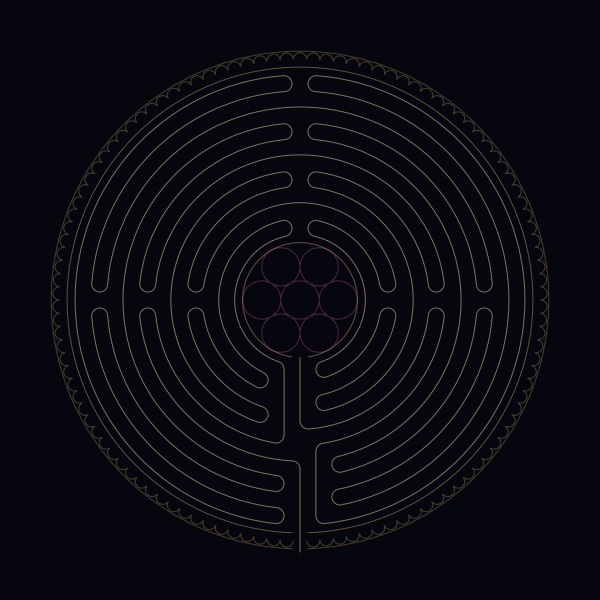
Not a maze: there is only one way, and it cannot be lost. The path swings through all four quarters and every one of the eleven rings, turning back on itself again and again, before it reaches the rose at the centre.
- Circuits
- 11
- Turns
- 30
- Cusps
- 112
- Diameter
- 12.9 m
Watch it drawn with compass and straightedge, hear the chord of its lines, and turn the Dimension dial to tilt it into space.
Facts
- The path visits the circuits in the order 5, 6, 11, 10, 9, 8, 7, 8, 9, 10, 11, 10, 9, 8, 7, 6, 5, 4, 3, 2, 1, 2, 3, 4, 5, 4, 3, 2, 1, 6, 7, then the centre.
- That order is self-dual: walk out again, number the rings from the inside, and you meet the same sequence.
- It reverses thirty times: 28 tight turns and two long ones beside the entrance, which with the ways in and out make the 34 turns walkers count.
- Around its rim run 113 foils meeting in 112 cusps, the so-called lunations, broken only at the entrance.
- Strike it: a single unbranched path rings like a string, its partials close to the harmonic series 1, 2, 3, 4…
History and meaning
Laid in the nave of Chartres Cathedral around 1200 to 1220, it is the most copied labyrinth in the world. A brass plaque of Theseus and the Minotaur once filled its centre, until it was melted down in 1792. The idea that its 112 cusps are a lunar calendar dates only from Keith Critchlow in the 1970s.
Learn it step by step
- Journey The Builders’ MeasuresStep 9: A path to walk